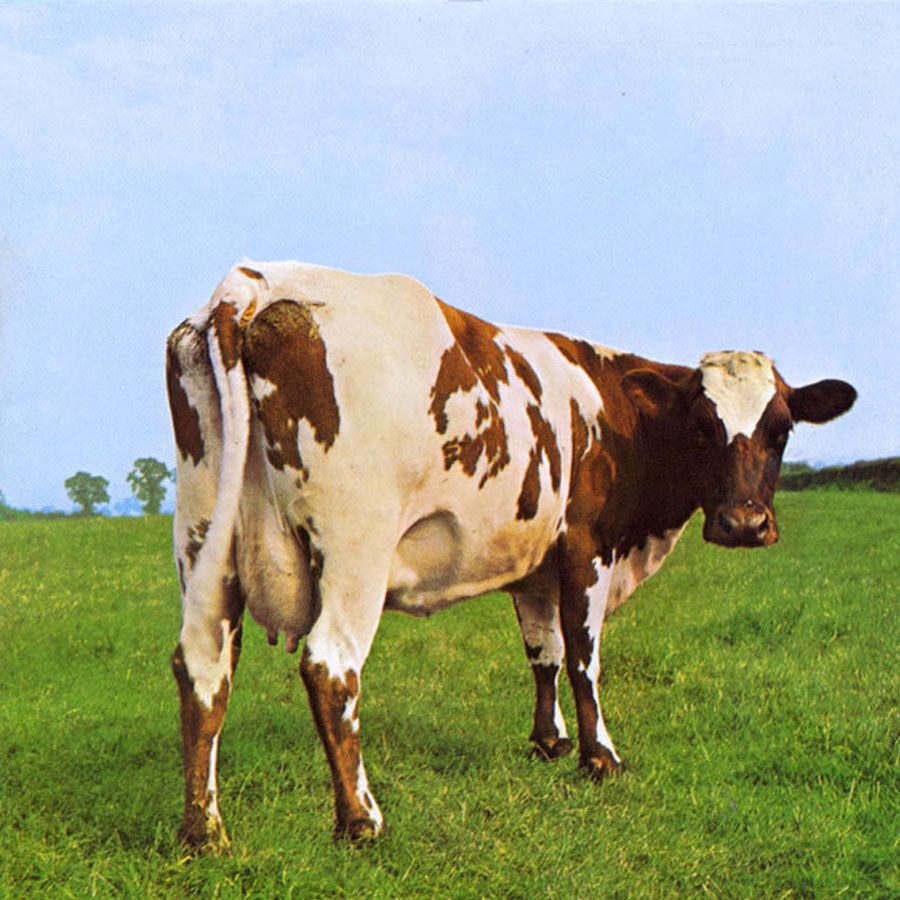
Label: EMI Records
Release date: October 2, 1970
Produced by: Pink Floyd
Album length: 51.54 min
Genre: Psychadelic Rock / Progressive Rock
Rating: 9.0/10
Lulubelle III, the cow on the sleeve of “Atom Heart Mother”, the fifth studio album from prog rock legends Pink Floyd, is surely the most famous cow in the world, right after that purple one on the Milka chocolate wrapper. The notorious dairy queen landed on the cover completely by accident and has nothing to do with the album’s music or lyrics, even though plenty of fans of the band still swear otherwise to this day. Cult artist Storm Thorgerson, the band’s longtime cover designer, was told to come up with something totally rural and unconventional for this one, which fit nicely with the band’s psychedelic space rock leanings at the time. These guys never knew any limits when it came to exploring and mixing different musical styles. “Atom Heart Mother” was originally supposed to be called “The Amazing Pudding”, but the band changed the name after bassist/vocalist Roger Waters spotted a weird newspaper story about a woman with an atomic-powered pacemaker.
When “Atom Heart Mother” came together, the band were still pushing relentlessly into musical experimentation, sometimes straight to the outer limits of psychedelic avant-garde weirdness and obscurity. At the same time they were still hunting for one very specific sound that would lodge them forever in the hearts of the wider music community and let them cut ties once and for all with the past and the long shadow of their fallen comrade, the “crazy diamond” Syd Barrett. “Atom Heart Mother” was another big step forward in that mission. They mostly settled accounts with the early psychedelic space rock elements that had usually defined their sound up to then, and moved noticeably closer to more refined forms of progressive rock, as lots of orchestral elements from classical music and jazz suddenly turned up in their music (the latter mostly applies to the title track). “Atom Heart Mother” could hardly be more different from its predecessor “Ummagumma” (1969), which was the peak of their psychedelic-avant-garde experimenting (I’m talking about its studio half, of course). Then again, with this band nearly every next album was a completely different story. “Atom Heart Mother” is also known as the album where young sound engineer Alan Parsons first showed off his production talents. He later made a worldwide name for himself as the creative head of his own band, The Alan Parsons Project.
Despite the not exactly flattering opinions Waters and Gilmour hold of it today, “Atom Heart Mother” was another major step in the band’s musical maturing. That goes above all for the crafting of epic symphonic arrangements (not typical for the band), which hit their peak here through the collaboration with an orchestra led by composer Ron Geesin. You can hear this step forward on the brilliant epic title suite, the centerpiece of this excellent album that’s still pretty overlooked today. In keeping with their tradition up to that point, each of the three key songwriters (besides Waters, that was lead vocalist/guitarist David Gilmour and keyboardist/occasional singer Richard Wright) contributed a piece typical of his own writing and playing style at the time. The only big psychedelic-avant-garde experiment is saved for the end of the album, where you get to listen to their roadie at the time eating his breakfast (!). That one is also among the rare burlesque moments in their history, and it could easily compete for the title of their wackiest, funniest creation. With all of the above, “Atom Heart Mother” is without a doubt one of the most stylistically varied releases in the band’s story, and it deserves far more respect than it usually gets.
The title track “Atom Heart Mother”, a six-part orchestral suite of epic proportions, is both the heart and the best work on the album. Despite its considerable length, this mighty piece, easily the band’s most ambitious up to then, can hold the listener in a trance from beginning to end with its incredible atmosphere and the fascinating nature of its individual arrangements. Besides being one of the most complex things they ever did, it’s also the longest composition in their history (a few seconds longer than the incredible “Echoes”, otherwise their greatest triumph when it comes to 20-plus-minute epics). That’s true, of course, only if I leave out the combined length of both parts of “Shine On You Crazy Diamond”, another of the biggest triumphs of their career. It was also one of the rare pieces in their story that involved somebody who wasn’t a band member, but an outside collaborator. In this case that was composer Ron Geesin, who wrote all the string and brass arrangements for the orchestra. Teaming up with an orchestra for multi-part epics on a grand scale was fairly popular among some prog rock bands at the time (as King Crimson with “Lizard” and Uriah Heep with “Salisbury” showed, with more or less success).
Inside this suite it’s often pretty hard to tell where each section starts, since they’re usually divided by sudden transitions, tempo changes and the introduction of strange effects and moods. Still, a listener could string them together into one meaningful whole, a concept that tells through music the totally ordinary daily life of the most ordinary cow, grazing in the English countryside. The mood within the sections shifts from epically pompous to almost obscurely psychedelic.
The opening section “Father’s Shout” starts out fairly innocently, with a quiet keyboard intro, until a mighty brass section crashes in with great pomp, together with Mason’s drum fills. That also happens to be the central motif of the album. In the background you can clearly make out lots of special effects like a tractor chugging and a horse neighing, which add even more to the rural, Anglo-Saxon feel. The mood turns far more melancholic the moment Wright’s organ passages come in, along with the lively rhythm section and a cello solo. When Gilmour’s soaring slide guitar solo joins in, the melancholic-ethereal atmosphere is perfect, and combined with the rich orchestral arrangements it sends shivers down your spine. Sonically this vibe is already very close to the one that later won them worldwide fame.
“Breast Milky” opens right after Gilmour’s slide guitar solo ends. An extremely mystical, I’d almost say druidic, mood rules here, created by majestic choral singing combined with Wright’s organ, Waters’ bass and Mason’s drums. For a short while the legends of ancient Celtic times come back to life, when druids held their rituals around stone circles, before a farmer built his farm on that spot and fenced off a pasture for his favorite cow.
The next section, “Mother Fore”, introduced by dramatic Wright keyboards, is another one of the suite’s atmospheric peaks and also a really interesting jam section where every single instrumentalist gets to shine. Gilmour drops in another excellent solo, this time with a bit more of a blues bent. He’s accompanied by passages on Wright’s keyboards (with the mini moog in the spotlight) and Waters’ bass line. At one point the choir comes in, this time singing some strange, hard-to-make-out but still very interesting chant. It builds up until the mighty brass section crashes in again and repeats the suite’s central motif.
That’s followed by “Funky Dung”, the most psychedelic-avant-garde and therefore the strangest section of the whole suite. Here a string of dissonant effects follows one another, especially high-pitched voices that can sound pretty annoying at times, though they never manage to kill the amazing atmosphere. Among all those discordant effects you can also hear the announcement “there’s now an important announcement”.
“Mind Your Throats, Please” is another avant-garde psychedelic section full of odd effects, which opens with a ringing telephone. Many instruments gradually slip in through effects, joining a melody that’s taking shape and building atmosphere right up until the brass section bursts in and someone firmly announces “silence in the studio”.
The closing section “Remergence”, where the opening motif from “Father’s Shout” returns, is the final triumph. The magical Celtic mood from the opening sections takes over again. The mighty brass section and cello solo are followed once more by a “weeping” slide guitar solo. Then it all wraps up by repeating the central motif from “Father’s Shout”. At that point the whole orchestra, the band and the choir all pile in and bring one of Pink Floyd’s best creations to a grand close. Even though Waters and Gilmour have few kind words for it, one fact says plenty about its true quality: legendary film director Stanley Kubrick, best known for the classic “2001: A Space Odyssey”, liked it so much that he wanted to use it in the cult film “A Clockwork Orange”. But the band turned down his offer (a typical move, especially for Waters).
The next three tracks on the album were much shorter and noticeably simpler, mostly pastoral and melodic in nature. On them all three of the band’s key creative forces showed off their songwriting talents in nice and distinctive ways. First up was “If”, a totally simple and extremely pleasant Waters folk ballad. A dreamy pastoral mood rules here, fitting the overall atmosphere of the album perfectly and calming down the electrified effect the magnificent title epic has on the listener. Waters presented himself again not only as one of the most innovative bassists of his time, but also as a good, very distinctive singer and a solid acoustic guitarist. The other three members keep him company, but they’re pushed fully into the background here, apart from Gilmour’s closing guitar solo and Wright’s piano passages in between. Waters’ lyrics (philosophical as usual) revolve around self-analysis and are quite far from his later, much darker and more socially critical messages. Over the years this pleasant folk ballad became one of the most beloved moments of Waters’ solo shows.
With the next track, the excellent “Summer ’68”, which is also a critique of the already fading hippie movement and the lifestyle of most musicians back then, keyboardist Rick Wright once again pleasantly surprised as the lead songwriter and singer. He usually stayed in the shadow of Waters and Gilmour, even though he was no less important in shaping their trademark sound and was one of the most gifted and versatile keyboardists in prog rock. The main charm of this superb song lies in how interesting its course and twist are, reached through the opening melodic build-up on piano. Wright’s dreamy vocals and piano build a pleasant melody right up to a sudden, mighty transition, when the other players and the pompous brass section of the backing orchestra suddenly crash in (it returns in the song’s orchestral finale too). Gilmour’s backing vocals and his acoustic guitar certainly add their share to the incredible magic. Wright’s lyrics express a longing for rest from a grueling concert tour and tell of one of the more memorable encounters with so-called groupies, although it’s hard to believe that such a deep song is about one of the typical clichés of rock star life.
Almost even more impressive was Gilmour’s gorgeous folk ballad “Fat Old Sun”. Today it’s recognized as a Pink Floyd classic and is practically a must at Dave’s solo shows. An extremely romantic and pastoral mood surrounds it the whole way through, radiating from both the central acoustic melody and the lyrics, which are a sort of ode to country idylls. Gilmour once again took on the role of multi-instrumentalist, with only Wright on keyboards keeping him company. What you really have to admire here is how his heartfelt singing and the seemingly simple guitar melody create incredible romantic magic. After the last chorus Dave moves into an excellent blues solo on electric guitar, of the kind he produced a good number of in his career, each one totally distinctive and beautiful in its own way. “Fat Old Sun” is nice proof of why Gilmour was always the central and finest singer of Pink Floyd for me, since his velvety voice always carried a special, heartfelt and utterly distinctive warmth that Waters and Wright, despite their proven singing talents, never managed to create.
The fun closing instrumental “Alan’s Psychadelic Breakfast” was a one-of-a-kind surprise, the kind a first-time listener would never see coming. With its psychedelic-avant-garde nature it was something totally different from the rest of the album, and I’d almost call it a provocation, yet it’s still interesting and fun today, grotesque banality and all. It’s exactly this kind of totally unconventional, free avant-garde idea, usually with no connection to carefully structured musical forms, that was always one of the main charms of this legendary band. “Alan’s Psychadelic Breakfast” is basically a three-part instrumental and by far the most psychedelic-avant-garde moment on the album. The star of the show is the not-at-all-suspecting roadie Alan Stiles, whom the band recorded during his morning meal. While the band play mostly symphonic instrumental sections in the background, a clearly starving Alan makes his breakfast and talks about his eating habits. Even though the laughter fades after a few listens, even for listeners most receptive to this kind of avant-garde experiment, this quirky, playful creation still stands as a totally unique and interesting experiment in late psychedelic rock.
The opening section “Rise And Shine” begins with a tap dripping over the sink. Suddenly you can hear Alan muttering to himself the dishes he’ll serve up for breakfast (he’s especially fond of marmalade), and then he lights the stove burner with matches. Suddenly an instrumental section kicks in, with steel guitar, cimbalom, organ and piano forming a playful melody. It could easily fit in a kids’ ad for Frutek juice or Ciciban shoes.
Suddenly the “Sunny Side Up” section follows, where Alan muses about a macrobiotic breakfast in Los Angeles, stirs his coffee, pours cornflakes from a bag into milk, and then starts frying eggs on the stove. What follows is an extremely grotesque but undoubtedly entertaining section, played entirely by Gilmour on steel guitar and acoustic guitar. All the while you hear Alan’s passionate smacking and gulping of food, which by the sound of the appetite on display recalls the gluttony of some decadent Roman senators. In the end he serves himself the fried eggs and starts mumbling his impressions of the meal contentedly to himself.
In the closing section “Morning Glory”, where you hear sizzling, the best instrumental section of the whole piece kicks in, with an excellent melody on piano, Hammond organ, electric guitar and rhythm section. Right at the end you can hear Alan toss his dishes in the sink, grab his keys off the table, walk out the door and drive off in his car. It all ends the way it began, with the tap dripping over the sink. To this day there are some folks who deny the album masterpiece status precisely because of this highly experimental closer, trying by any means to find some logic where there never was any.
“Atom Heart Mother” remains a pretty overlooked album to this day, both by the band members and by most of their fans, even though it fully deserves the status of a Pink Floyd masterpiece. Although over the years both Waters and Gilmour gave the album a lot of bad press with disparaging remarks along the lines of “it’s one of those albums to shove in a dusty corner and never listen to again”, “Atom Heart Mother” marked a noticeable step forward in maturity and an important moment in their career, where they showed some previously undiscovered sides of their songwriting. The collaboration with the orchestra was the moment Pink Floyd came closest to symphonic forms of progressive rock and made an important break from their early, often extremely obscure, psychedelic experiments. Whatever you might hold against this album, you can’t say it lacks the right balance of longer, complex instrumental pieces and more accessible, melodic ones, or that it doesn’t contain some of the most interesting and varied works in their history. After “Atom Heart Mother” Pink Floyd still remained “just” a cult band (even though this was their first album to hit the top of the UK charts), one that had earned its wider reputation mostly through early singles and spectacular stage shows, but it was no longer far from the invention of their truly distinctive sound and, with it, worldwide success.
Author: Peter “Dr. ProgRock” Podbrežnik
Tracklist:
1. Atom Heart Mother (23:51)
a) Father’s shout
b) Breast milky
c) Mother fore
d) Funky dung
e) Mind your throats please
f) Remergence
2. If (4:24)
3. Summer ’68 (5:26)
4. Fat old sun (5:17)
5. Alan’s psychedelic breakfast (12:56)
a) Rise and shine
b) Sunny side up
c) Morning glory
Lineup:
David Gilmour – vocals, guitar, bass guitar (4), drums (4)
Roger Waters – vocals, bass guitar, acoustic guitar (2), effects
Richard Wright – vocals, keyboards, orchestration
Nick Mason – drums, percussion
Guest musicians:
Ron Geesin – orchestration
Abbey Road Session Pops Orchestra – brass and orchestral sections
Philip Jones Brass Ensemble – brass sections
John Aldiss Choir – choral vocals
Alan Stiles – voice (5)