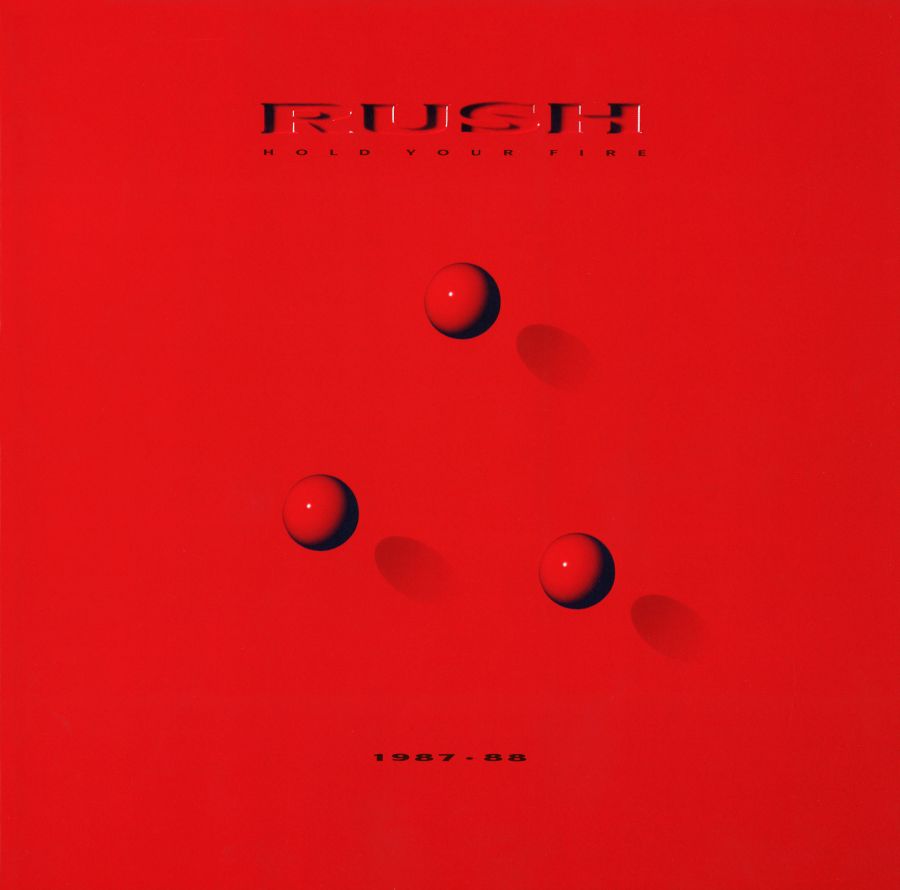
Label: PoliGram / Mercury Records
Release date: 08.09.1987
Production: Peter Collins & Rush
Album length: 50.21 min
Genre: Art Rock
Rating: 10 / 10
“Hold Your Fire” is the album where Rush hit the high-water mark of their “synth” era sound and songwriting style. The guys kept Peter Collins at the production helm, so the new record holds onto the sound of its predecessor, “Power Windows”. “Hold Your Fire” is the moment in Rush’s career where they came closest to a pop sound in their musical expression, one they’d been weaving modern trends into all through the eighties, with more or less success. So “Hold Your Fire” is the album where Rush pulled off the most successful integration of then-modern pop elements into the core of their understanding of musical tradition, across the board. That also makes it absolutely not an album for fans of the band’s “pre-Signals” era sound, and even “Signals” is pretty far removed from it.
You’re probably wondering what the difference is between “Power Windows” (1985) and “Hold Your Fire” (1987). The latter stripped the songs down so far that we can conclude Rush came closest here to the template pop framework in their songwriting: pre-chorus plus chorus (twice in a row), plus a middle instrumental section, plus a repeat of the chorus. In other words, this is an album where the songs are trimmed down even further in terms of motifs, but on the flip side, all those motifs are that much more clearly defined and highlighted. To go on a bit more, it’s one of the most listenable albums in the band’s discography, one of the easiest to get into, and the kind of album that slips under your skin completely unconsciously and spontaneously, with no strain at all and no hunting for ways to “understand” it (which is, generally speaking, the biggest nonsense there is). “Hold Your Fire” is an incredibly dynamic album, hugely fluid and changeable in both its motifs and its moods.
So Rush simplified their songwriting style a notch further, and those carved-out songs with their high-flying choruses are tailored even more tightly to the production the guys liked at the time, which was their tried-and-tested formula in this period. If “Power Windows” still held onto a bit of experimental tinkering in the middle sections and in the outros of the songs, now even that is gone, or rather, that element has been further detailed and refined. That’s why the album goes down that much sweeter for undemanding ears, making it the most pop-leaning Rush art rock album.
“Hold Your Fire” is also the most positively oriented album of all the Rush records. The lyrics are more personal again. In his verses, Peart is searching for — and this is the common thread through all the songs as far as the poetry goes — peace with the world, acceptance of the world as it is, a need for spiritual growth and reaching a higher level of self-knowledge, emotional and spiritual maturity, and the kind of self-reliance and independence that goes with it. The lyrics on “Hold Your Fire” prove that Rush reached a new, higher level of intellectual maturity in their own expressionism, which, combined with a further scaling-back of the band’s technical chops in favor of a higher definition of the new album’s excellent, polished melodicism, works triumphantly in every respect and clearly leaves the band’s previous three studio albums behind.
Force Ten, as the opener, defines the look of the whole record. If this song gets into your ear, the entire “Hold Your Fire” record will. It’s a bit more driving a track than you’d expect at the start of a record. But with Time Stand Still, Rush manage to serve up a song that is the career moment of the band’s most successful approach to eighties pop rhetoric. It’s a perfectly composed tune, it doesn’t get better than this, and as such it belongs straight on the radio airwaves. The type of hit you never get tired of listening to. In other words, the prototype of a song with the potential for the loveliest evergreen status. The feeling for the perfect melodicity of a composition is once again optimally capitalized on here and perfectly crowned by Lee’s emotionally sophisticated approach. Mission and Prime Mover come closest to this song, each in their own way. The trio allow themselves a bit more drama in Lock And Key and Turn The Page, while Tai Shan is a successful attempt at combining the Rush sound with a clichéd melos of the spirit of China. High Water, at the close, after Tai Shan, confirms the album’s complete calming down. In stringing together a rich sonic picture among the basic building blocks of the Rush sound, it works especially soothingly in keeping with tradition, and you could use it as a sound backdrop for various relaxation techniques. In this song, Peart’s drums step further into the foreground from round to round, combined with electronic percussion that grounds the esoteric moment of the song’s melos, created on the (by now well-known) curtain of background synthesizers.
The middle instrumental sections of the songs are trimmed down. Most often all we run into there is a blending of keyboard synth collages and Lifeson’s extremely detailed, sharp echo delay tones, which, through frequent hanging on the tremolo arm, build entirely simple motifs that in no way break up the compactness of the lead motifs. Lifeson’s task of hitting the frameworks demanded by the guitar’s subordinate position, in terms of production parity with the other instruments. It demands extra effort. It matters where, how and when you place each individual note. Especially when you’re limited with notes. Minimalism is wisdom, and Lifeson on the synth era Rush albums, taking this element into account, is by no means just a silent observer his bandmates occasionally use as a treat and a seasoning, but an important building block of the “eighties” Rush sound. These moments are again brilliantly peppered by Neil Peart’s electronic percussion, which adds that important counterweight, strengthens the atmosphere and builds the dynamics of the songs.
“Hold Your Fire” is the peak of Rush’s “synth eighties” era. After it, the guys started reviving the rock-style placement of the individual instruments in the production. The keyboards began sliding into the background, and the guitar started “strumming” riffs again. “Hold Your Fire” remains the most accomplished Rush “eighties” era album!
author: Aleš Podbrežnik
Track list:
1. Force Ten (4:31)
2. Time Stand Still (5:08)
3. Open Secrets (5:37)
4. Second Nature (4:36)
5. Prime Mover (5:18)
6. Lock And Key (5:09)
7. Mission (5:15)
8. Turn The Page (4:55)
9. Tai Shan (4:15)
10. High Water (5:33)
Lineup:
Geddy Lee – vocals, bass guitar, bass pedals, synthesizers
Alex Lifeson – guitar
Neil Peart – drums, acoustic and electric percussion
GUEST MUSICIANS:
William Faerey Engineering Brass Band – brass
Andrew Jackman – brass arrangements
Aimee Mann – backing vocals (Prime Mover & Time Stand Still)
Steven Margoshes – string arrangements
Andy Richards – keyboards