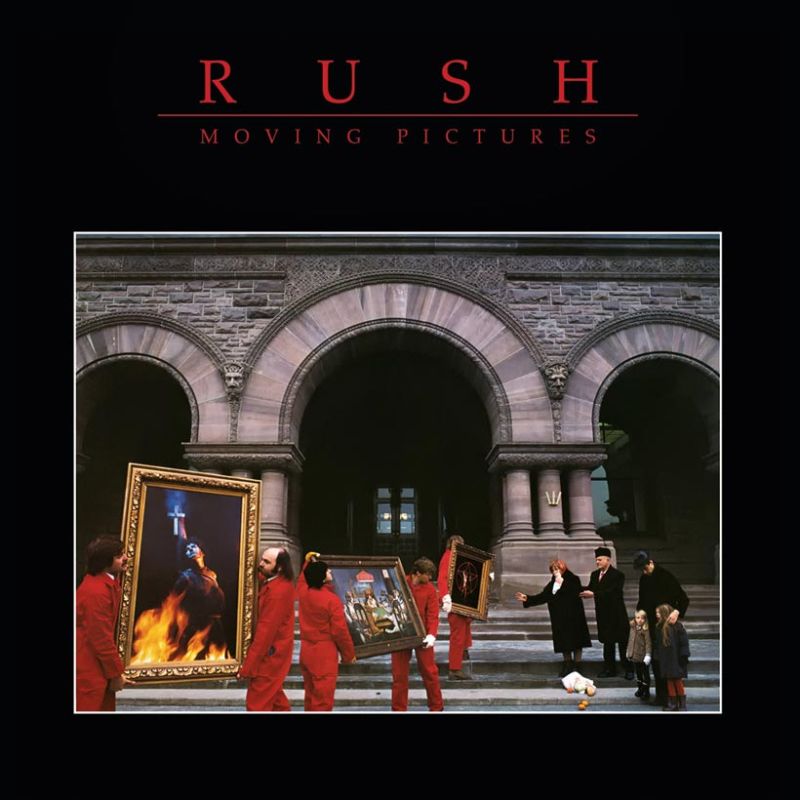
Label: Mercury Records
Release date: Feb 12, 1980
Production: Terry Brown & Rush
Album length: 39.55 min
Genre: Art rock / Progressive Rock
Rating: 10/10
This is probably the best-known and best-loved Rush album of all time. And without a doubt the most successful! “Moving Pictures” is the record where Rush finally cut ties with their prog rock era and turned to writing shorter, tighter songs, further defining their new musical voice, the so-called specific Rush art rock definition! Every track on this album is a big Rush favorite that now carries the status of a Rush classic, and the vast majority of them became part of the iron-clad live repertoire on Rush tours. Just how beloved “Moving Pictures” is can be seen in the fact that by February 1995 it had sold four million copies, making it four-times platinum by then!
This gradual weeding out of prog rock figures was already heavily marked by its predecessor “Permanent Waves” (1980), and “Moving Pictures” simply hammered the final nail into the coffin. The two main novelties, tied irreversibly to the transformation of their sound, like love at first sight, are Geddy Lee’s decision to stop using his frenetic, ear-piercing vocal registers, and the increasingly noticeable integration of vintage synthesizers, such as the Oberheim OB-X, which happened to be the handy model in the studio at the time.
Work on the album started at the end of August 1980. The opening track, “Tom Sawyer” (the inserts of which were played during the breaks between periods at the Ice Hockey World Championship Group A in Canada, 2008), was among the first songs written for the album, and it came about in an interesting way: during Lee’s spontaneous testing of a synthesizer sound in the studio. The song is still one of Rush’s best-known today, and it got so popular that it was used as the musical backdrop for several films, as well as for a scene in one of the episodes of the animated show South Park. Even though the bulk of the song is built on a dark mood, sustained by the famous Oberheim synthesizer backdrop combined with the voluminous sound of the bass pedals, Geddy Lee’s singing in a normal voice is the perfect counterweight. The feeling of this duality is like a young man, a modern-day rebel (Lee’s vocal), caught in a hopeless storm (the howling tones of the synthesizer and the bass pedals in the background) of all the conformism that’s squeezing him in. Whether that was the band’s intention or not doesn’t even matter in the end, because the effect is convincing, unique, even quirky, and thanks to its remarkably distinctive musical otherness, all the more appealing!
“Red Barchetta” paints a whole new atmosphere, a fictional ride in a fast Ferrari, and here Alex Lifeson steps into the spotlight with a gradual build-up of guitar noise. The start is fragile, resting on simple harmonics motifs, and from that simple, innocent accompaniment it flows almost imperceptibly into the famous racing riff, where it’s not hard to picture someone in a fast car with a foot getting heavier on the gas from moment to moment! Lyricist Neil Peart took his inspiration for the verses from the story “A Nice Morning Drive” by Richard Foster! As for Lee, he could have taken a quick crash course in Italian and pronounced Barchetta properly, singing the “ch” in one of the verses as a “k” (Barketa) and not “ch” (“Barcheta”)! A lovable slip-up.
“YYZ” is one of the best-known Rush instrumentals. The basic motif of the song is built on a repetition of tones that represent the Morse code for the sequence of letters “Y – Y – Z”. The track is marked by an extraordinary tightness of motifs that are hard to take in on first listen, if not downright quirky, all built into the song. This instrumental shows off the chemistry of the three musicians in the finest way, and how well their mutual awareness worked. The way the three musical entities complemented and latched onto each other operated on an exceptional level. The song develops in a very unpredictable way. The constantly rolling dynamic waves of mood are shaken up most effectively by Alex Lifeson’s adventurous, exploratory solo (with hints of arabesque in it). Shortly after, it gets “turned on its head” by a transition into a simple passage held up by a backdrop of synthesizers with a distinctly cerebral effect. After that, the song returns to the basic motif! The abbreviation YYZ refers to the IATA identification code of an airport (it tells you the airport’s location). In this particular Rush case, the one belonging to Toronto’s airport (Toronto Pearson International Airport).
“Limelight” is the second single from this album. The verses are about the unease of living as a popular star in the glare of the spotlights. And that’s exactly the role everyone around you dreams about. Peart, as a complete individualist, felt that role most strongly during this period, when Rush’s popularity had soared, and he was the one of the three who had the hardest time bearing it. In these very positive, major-key-tinged basic motifs, which contrast with the defensive lyrics, Lifeson’s solo stands out once again, and here it expresses the proverbial “loneliness of a musician within the role of a media-exposed star”. The “crowd” that wants to tear you apart would, in this case, be the seductive basic structure of the song, which the crowd identifies with instantly. The song itself once again conveys this duality in an enormously subtle way, this split within the person, or the incomprehension of an individual who doesn’t accept the status he has gained. The symbol that embodies the spirit of Rush’s legacy and illustrates “an individual turned toward the upright pentagram (the pressure of the masses)” takes on all the more expressionist weight here!
“The Camera Eye” is the band’s last longer song ever! Over ten minutes. Those who know the track count it as the last relic of the band’s progressive rock period, though in both its production and the general simplification of the way its chosen motifs fold into one another, it has a strong accent of art rock expressionism with new wave touches. With this song the band tried to capture two completely different moments in the pulse of big cities, namely European London and American New York. Sequences of rock-emphasized communication between the trio, along with parts where synthesizers gain more and more weight in the sonic backdrop, alternate with a dash of necessary unpredictability, and the element of “quirkiness” is once again deeply exposed, with a closing figuration that works in the Rush language as unique, logical, and completely under control. It’s the only song on “Moving Pictures” that the band never played live again in their career after the tour supporting the album “Signals” (1983).
“Witch Hunt” is the third part of Rush’s famous “Fear” tetralogy! Part one, “The Enemy Within”, can be found on the album “Grace Under Pressure” (1984), part two, “The Weapon”, on the album “Signals” (1982), and part four only came out in 2002 on the album “Vapour Trails”, under the title “Freeze”. The basic idea of this tetralogy is supposedly that most human actions and reactions in our society are driven by fear. So not love or courage, but fear of being alone, fear of losing property, fear of illness, and so on… In other words, it’s about seeking control in order to achieve greater safety. And the masses don’t even ask how much personal freedom (individual freedom) is being sacrificed for that. So we’re back at the questions of Tom Sawyer from the start of the album, and the circle closes. “Witch Hunt” is the darkest moment on “Moving Pictures”. It builds an almost chilling atmosphere. The opening din added to the start of the song is made up of recordings of the band members horsing around during one of the breaks when they stepped out of the studio for a moment, in the middle of a snowy winter day. These recordings were made on the day John Lennon was assassinated. The date, then, was December 8, 1980!
The closing track of the album, “Vital Signs”, is the third single from the record, but it wasn’t a commercial success, as it didn’t even make the charts. The song is extremely interesting because it foreshadows the band’s further shifts in expression. That’s hinted at by the reggae rhythmic foundation in the pre-chorus. A trick that showed up even more often on the “Signals” album, and a trick that was an irresistibly attractive spice in art pop back then, with its ties to punk and SKA elements (check out, for example, the musical output of The Police). “Vital Signs” is one of the simplest songs on the album, but at the same time one with a strong message, which is highlighted even further at the end of the song (and the album): “We all must step away from the norms!” So, the familiar alarm call that to find the right answers you have to turn inward and follow the voice of your own individuality first. Nothing new, but still always relevant. Especially considering that the number of “sold souls” and the mass subservience of the brainwashed is skyrocketing from day to day today as well. Finding the strength and courage to stay yourself and defy everything in the process. That’s been the wisdom and the temptation of humankind since time immemorial.
The album “Moving Picures” is the moment in Rush’s career when all the factors came together at the right time, in the right place. Musical ideas delivered in a strictly recognizable way, yet with an energy that the masses could easily identify with. With the band’s power to offer enormously colorful variety between the lead motifs of the individual songs and to deliver tracks that reach the same level of quality and are all favorites of this album, one and all. A Rush moment that marked one of the peaks of the band’s creative career. One of those career zeniths where you simply say: “It doesn’t get any better”. With its avant-garde, forward-looking, exploratory, positively progressive stance, “Moving Pictures” stays eternally and evergreenly relevant. An album like “Moving Pictures” always holds a special place in the universe of rock music. The place of a rock masterpiece!
Author: Aleš Podbrežnik
Track list:
1. Tom Sawyer (4:34)
2. Red Barchetta (6:08)
3. YYZ (4:24)
4. Limelight (4:21)
5. The Camera Eye (10:57)
6. Witch Hunt (Part III of Fear) (4:44)
7. Vital Signs (4:47)
Lineup:
Geddy Lee – bass guitar, vocals, synthesizers (Oberheim polyphonic, OB-X), mini moog
Alex Lifeson – 6- & 12-string electric and acoustic guitars, Taurus bass pedals
Neil Peart – drums, percussion
Guest musicians:
Hugh Syme – synthesizers on track no. 6