Label: Cherry Red Records
Release date: 10. 9. 2021
Production: Tony Kaye
Genre: Progressive Rock
Rating: 8.5/10
Among fans of the legendary prog giants Yes, seasoned English keyboard master Tony Kaye often gets treated as the “forgotten” ex-keyboardist, even though his Hammond organ playing left a huge mark on the band’s early years. He also played an important part later on, during their biggest commercial success. Even though Kaye, who made a name for himself with his refined organ technique in the late sixties and early seventies, is a founding member of the cult outfit, after his (first) departure in 1971 he was quickly overshadowed by his notorious successor Rick Wakeman, with whom Yes recorded most of their best work.
So for most Yes fans, Kaye stayed a tragic figure for a whole decade, right up until the early eighties — the guy who left the band “just when things got really interesting,” because he refused to bow to the demands of guitarist Steve Howe, who wanted a more varied range of keyboards than Hammond organs for Yes’s future sound.
Until the end of the seventies, Tony tried his hand at a string of short-lived groups like Flash (which he founded with former Yes guitarist Peter Banks), Badger and Detective, but none of them matched the success he’d had in 1971 with the cult Yes record “The Yes Album,” where his organ playing shone in all its glory. In 1976 he was part of David Bowie’s backing band on the tour supporting “Station to Station.” His brief ‘pit stop’ with Badfinger on the album “Say No More” (1981) didn’t make much of a splash either.
Luck finally smiled on Tony again in 1982, when Yes were reborn with a new lineup and a year later released “90125,” their most commercially successful album. Tony stayed with Yes for thirteen years, until 1995, when it became clear that the more popular and famous Wakeman among fans was coming back to take his spot. Tony turned down an offer from Yes’s management of the time to stay involved with the band only as part of the management side, and decided to retire from music.
His retirement lasted until 2006, when he started working with former Yes guitarist/keyboardist (and current bassist) Billy Sherwood in the band Circa. That musical story turned out to be a success. In between, Kaye and Sherwood, together with former Toto singer Bobby Kimball, also formed the short-lived outfit Yoso, which stopped operating after 2011. In 2018, Tony joined forces with his old Yes buddies as a special guest for the ‘Cruise to the Edge’ cruise festival and the U.S. dates of the North American tour.
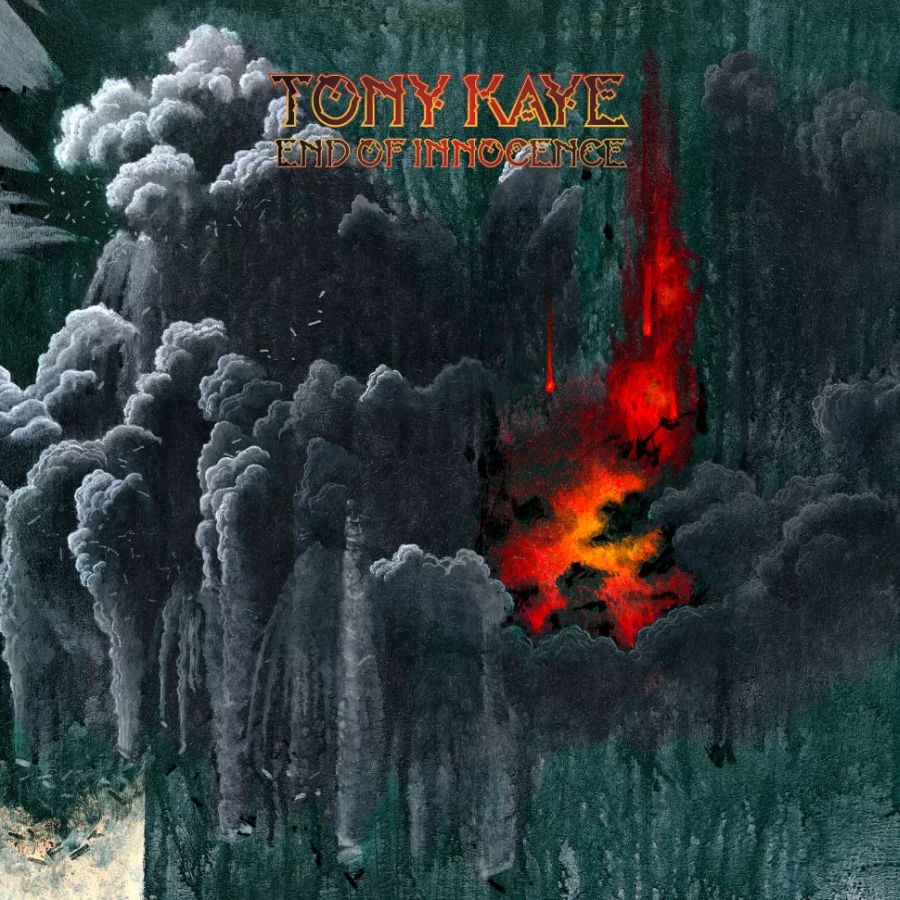
On September 10, 2021, he finally decided to release his solo debut, titled “End Of Innocence.” It was inspired by Kaye’s haunting feelings about the tragic events of September 11, 2001, which kicked off the so-called war on terror and the beginning of the end of American global dominance, even if most people didn’t realize it at the time. That the mostly instrumental “End of Innocence” deals with the most traumatic event in modern American history is obvious from the cover, designed by Roger Dean, which shows fire and smoke pouring out of the burning World Trade Center ‘twins.’
Kaye, who has lived in the U.S. since 1974 (in 2019 he moved from California to Florida), though he still doesn’t have American citizenship, used some archival recordings on “End Of Innocence” that marked the event twenty years ago. Luckily there aren’t many of them, and apart from one that I’ll get to later, they don’t spoil the very pleasant, almost enjoyable sound of this album, which at times sounds like the soundtrack to a documentary about 9/11.
Most of the compositions are marked by rich orchestral arrangements and occasional displays of Tony’s signature organ technique, which will remind plenty of listeners of some of his work from his Yes days. The mighty, dramatic “911 Overture” was the first piece written after Tony’s musical retirement, recorded in demo form on cassette the day after that fateful date. The track “Flight 11” features a dynamic drum solo by Tony’s friend Jay Schellen (Circa, ex-World Trade). “Battle Cry” stands out too, with its ‘Arabic’ pentatonic scales and the occasional voices of Middle Eastern fanatics just about to carry out a terrorist attack.
On the lament “Sweetest Dreams,” set right after the destruction of the two ‘twins,’ the lead vocals are sung by Tony’s wife Dani Torchia, one of the few vocal moments on the album. The prevailing mood of “End of Innocence” is, fitting for the subject, dark, ominous and dramatic, though especially in the closing section you can also hear some bright and decidedly epic motifs.
The final part of the album, or concept, is also marked by three tracks dealing with the aftermath of the catastrophe, like the American invasion and the ultimate defeat in the Afghan war twenty years later, which in many ways ended four centuries of Anglo-Saxon (American and, before that, British) imperialist dominance and kicked off a new era of the rising Chinese empire, the so-called Asia-tinged 21st century.
As an Americanized Englishman, Kaye of course couldn’t resist an outpouring of patriotism, as you can hear in “Hope And Triumph” and “Homecoming.” Despite being instrumental, these pieces patriotically celebrate American soldiers as heroes rather than as imperialist losers. “Hope In Triumph” is especially tasteless, opening with a propaganda speech by former U.S. president Bush, which is the only real thing you can hold against “End Of Innocence.” The line between a sonic documentary of an era and political propaganda gets very thin here, and professional musicians should steer clear of it.
Of course Tony isn’t going to ‘spit in his own bowl’ and face a media lynching from his American fans the way the cult British neo-prog band IQ almost did in 2004 with their ‘anti-imperialist’ epic “Harvest of Souls,” but it would still have been better if the “End of Innocence” concept had stayed politically neutral. That said, as far as the music goes, the final impression is positive. “End of Innocence” wraps up on an optimistic note with “Ground Zero,” which through its bright ambient nature offers symbolic hope for a brighter future.
Across the whole of “End of Innocence,” a very successful sonic ‘documentary’ of one of the key events of modern history, and one not even tarnished by the patriotic closing stretch, Mr. Kaye proves he could have been a great film composer if he’d wanted to. The album is an utterly convincing sonic adventure that leads the listener through the streets of New York, the plane attack on the ‘twins,’ and later onto the scorched ground of the Afghan war, in the ‘graveyard of empires.’ It’s actually a shame Tony didn’t go solo sooner, since his keyboard and songwriting talent was never in question, but he evidently needed a few decades to ‘find the courage.’ Maybe “End of Innocence” will turn out to be a very good springboard for an interesting and successful solo path.
Author: Peter “Dr. ProgRock” Podbrežnik
Tracklist:
1. Twinkle Twinkle Little Star/Twilight Time
2. 911 Overture
3. NYC Blues
4. Battle Cry
5. 285 Fulton Street
6. Let’s Roll
7. Tug of War
8. Flight 11
9. Towers Fall
10. Sweetest Dreams
11. Aftermath
12. Heroes
13. The Battle
14. Hope and Triumph
15. Homecoming
16. Ground Zero
Lineup:
Tony Kaye – keyboards, programming, orchestral arrangements, composer, producer
Guest musicians:
Dani Torchia – vocals on tracks 1 and 10
Jay Schellen – drums