

“Heaven And Hell” is the album that gave Birmingham’s legendary metal pioneers Black Sabbath a second coming. With it, the band modernized and refreshed its sound. The album, for which the band had to swallow a string of risky compromises just to survive, ended up giving Black Sabbath a smooth, relaxed entry into the new era of the eighties, the era of heavy metal’s unstoppable boom. So this was the first album with Ronnie James Dio on vocals, and it’s at least as good as the best Black Sabbath albums with Ozzy. It also brought the band a whole new crop of young fans. They were hyped on the bands of the N.W.O.B.H.M. movement, which played right into this Black Sabbath renaissance. Even the old “Ozzy era Sabbath” fans, who had fully expected a massacre, could only shrug after hearing the substance of the new “Heaven And Hell”: “Ozzy who?” Not all of them, of course. This album split the band’s older fans down the middle. According to Tony Iommi, Ronnie James Dio was a rainbow that shone at exactly the right moment and in exactly the right place, in all its glory, just when the band had wandered into a dark dead-end street, and pulled Black Sabbath in out of the rain. The album title “Heaven And Hell” is certainly more than fitting. Its substance delivers both. While it was coming together, the band was practically walking barefoot along the edge of a sharp blade the whole time, making a whole string of seriously risky moves and decisions that, when the dust settled, brought success and an artistic renaissance.
We’re back in that long-gone year of 1980. Add up what happened in rock’n’roll that year and it’s not hard to conclude that this was very likely the most pivotal and important year for metal. The bands of the N.W.O.B.H.M. movement burst onto the scene: Iron Maiden, Girlschool, Diamond Head, Def Leppard and Angel Witch with their debuts, while Saxon, the early ringleaders of the movement, put out no fewer than two new studio albums that year. Judas Priest released their album (British Steel), followed in the middle of the same year by AC/DC (Back In Black), and toward the end of the year by Motorhead (Ace Of Spades). “Heaven And Hell,” released that year, is hugely important in cementing the heavy metal genre. It didn’t just help Black Sabbath survive; as it turned out later, its presence and musical character have been inspiring new waves of metal fans nonstop for 40 years now, not to mention its influence.
You can read RockLine’s review of “Heaven And Hell,” written way back on 29.01.2007 by Rok Klemše, HERE!
But before this album came out, things for the legendary Birmingham outfit were far from rosy. The second half of the seventies hadn’t gone quite the way the band wanted. At the end of 1977, just as recording was supposed to begin on the material that would later land on the “Never Say Die!” album (RockLine review), Ozzy Osbourne left the band for the first time. The band had already been rehearsing for “Never Say Die!” with a new singer, Dave Walker (who came from Mistress and had earlier worked with Fleetwood Mac and Savoy Brown), but in early 1978 Ozzy changed their mind, came back, and went on to record and release “Never Say Die!” with the band that same year. Black Sabbath then lasted one more tour with Ozzy, opening for them were a hungry, fired-up bunch of youngsters called Van Halen, for whom it was the first tour ever, while the press liked to write that Black Sabbath often came across as pale and disengaged on stage during the run. In December 1978 the band stayed in the USA and began writing material for the new album. By then Ozzy had sunk to the extreme into every kind of addiction imaginable, and working together was simply no longer possible. Never mind that everybody in the band was actually “hooked”; Ozzy’s problem was above all constant, extreme drunkenness. The pressure from the label kept growing, and the band was also suffering because Ozzy was mostly dead set against getting involved vocally with the material Tony Iommi was writing for the new album. So Iommi, with a heavy heart, finally decided to boot Ozzy out of the band. The job of delivering the news of the expulsion from Black Sabbath, which became official on 27.04.1979, went to drummer Bill Ward, who had always gotten along best with Ozzy.
And who brought Ronnie to Black Sabbath? Ironically, it was the daughter of the band’s then-manager Don Arden, the well-known egg-throwing enthusiast Sharon Arden, later Ozzy’s wife. Ronnie joined the band in June 1979, though all that time Arden kept stubbornly trying to convince Ozzy to come back to Black Sabbath. Of course, Arden saw immense commercial potential in a Black Sabbath with Ozzy in the lineup. Ozzy later said that enough was enough with all the experimental maneuvers the band had started pulling with the album “Technical Ecstasy” (RockLine review). In that story, there soon wouldn’t have been any Black Sabbath left. Ronnie and Tony first talked about starting a completely new musical project. Not long after, they ran into each other totally by chance at the Rainbow bar (Sunset Strip, Los Angeles). Both were looking for new musical challenges. Dio for the challenges themselves, Iommi first of all for a new singer. “It was meant to be,” Dio recalls, adding: “We clicked right away.” The two musicians stayed in phone contact afterward. So one day Dio showed up to visit Iommi at the home in Los Angeles. There they had a get-to-know-you jam, and also finished the song Children Of The Sea together, which Iommi had despairingly stashed away in the archive and now dragged back into the light. It had been written quite a while earlier, and Ozzy had sung it with a completely different vocal melody and lyrics.
Dio remembers: “Black Sabbath were in a bind at that time. With me coming in, we kicked ourselves back together. We paid a lot of attention to each other, we knew we could do it again, especially given that we were in a band that had been hugely successful!”
Still, the lineup was actually teetering on the edge of chaos at that point. Not only did Black Sabbath have to replace a charismatic and hugely likable singer with a new one, drummer Bill Ward also ran into personal troubles (alcoholism, the death of both parents), which ended with Ward leaving the band a few months later. And that’s not all. The band recorded all the demos in Los Angeles before heading off to Florida, with Geoff Nicholls on bass, a member of Quartz, where Nicholls normally played guitar and keyboards, since Geezer Butler was in the middle of a divorce and the future with Butler was totally unclear for the band. At the same time, Geezer didn’t see a real future for Black Sabbath without Ozzy in the lineup. So for a while Iommi seriously considered just “switching off” the band completely and starting a brand new project. The idea was, among other things, to keep only the Sabbath name. When Ronnie James Dio first showed up in Black Sabbath, Dio was forced for a while to play bass (while singing), as in the days of Elf. A desperate Iommi got to the point of calling good friend Frank Zappa to ask if Zappa could recommend a bassist. Frank offered a bassist of Zappa’s own for the studio, but Iommi insisted on someone who would become a full-fledged member of the band right away. In the end Butler did come back after hearing Ronnie James Dio’s vocal performance, and Nicholls switched from bass to the spot of the band’s unofficial keyboardist. Butler replayed and re-recorded all the bass lines. So yes, that “myth” above about Butler’s initial absence and being replaced actually has some confirmation. The second myth, that demo recordings exist with Ozzy on vocals, remains made up, and so is the third myth, that Black Sabbath had already been rehearsing with Dio before Ozzy was thrown out of the band. Then there’s a fourth tale. That’s the story of a collaboration with former Elf and Rainbow member, bassist Craig Gruber, which also stands on shaky ground.

Even though Children Of The Sea was the first song the band had fully written, the first thing they demoed was the album’s title track. The foundation of that song is a standout bass line, the kind the rock’n’roll universe had never experienced before that day. That bass line supposedly goes back to the time when Geoff Nicholls was creating the song Mainline Riders with Quartz. In fact, Geezer Butler later admitted that he would never have come up with a bass line like the one driving the album’s title track, not even in his dreams.
On top of all the personal problems, drummer Bill Ward wasn’t completely happy with the new Black Sabbath’s musical direction either. The fantasy lyrics that suddenly filled the message of the new Black Sabbath music just didn’t sit right with Ward, in the sense that this had never fit the band’s original musical direction, going all the way back to Ward’s Polka Tulk days. So the unrealistic messaging of the poetry bugged Ward. Dio effectively gave the band a gothic tinge. No wonder, then, that Ward’s favorite song on “Heaven And Hell” is Lonely Is The World, with its personal messages.
The album »Heaven And Hell« was recorded at Criteria Studios in the middle of Miami, Florida, where Black Sabbath had cut »Technical Ecstasy« four years earlier, and at Ferber Studios in the heart of Paris. For producer, Ronnie James Dio suggested Martin Birch, whom he knew very well from their time together in Rainbow. That made Martin Birch only the second producer the band had worked with since 1971. That was the year »Master Of Reality« came out (RockLine review), produced by Rodger Bain, while every album after it, right up to »Heaven And Hell«, was produced by none other than Tony Iommi himself.
In his autobiography, Iommi says the band was really creating something special at this point, and among other things he wrote: »Ozzy would sing along with a guitar phrase, like he did in, say, Iron Man. His vocal lines copied the line of my guitar phrases, or the lead melody in the music. Of course, there was nothing wrong with that, but unlike Ozzy, Ronnie loved to sing over the guitar phrases instead of following them, coming into a song with a different vocal melody than the one that defined the song itself. Musically, that opened a lot more doors for us than ever before. I wouldn’t want it to sound like I’m criticizing Ozzy’s contribution to Black Sabbath, but Ronnie’s approach personally meant opening up new creative dimensions for me, ones that pushed me toward a new way of thinking and a new musical perception.«
Black Sabbath have a long history of making Bill Ward the butt of their pranks and gags, and that didn’t change while recording »Heaven And Hell«. One day Iommi doused Ward with a liquid the techs normally used to clean the heads on tape machines. When he flicked the lighter, the stuff turned out to be way more flammable than usual, which Iommi definitely didn’t expect. Ward, in line with all the laws of physics known so far, went up in flames and suffered third-degree burns, and the scars on both his legs are still there to prove it. Bill adds that he doesn’t remember the recording period at all. Thanks to the extreme boozing. During the tour that followed, too, his behavior got more and more exhausting and burdensome. The death of both his parents added to it, and the man soon left the band. Dio remembers it roughly like this: »Bill called me on the phone and said: I’m out.« Dio replied: »Oh, that’s nice Bill, where are you headed?« Ward answered: »You got me wrong, buddy. I’m out, at the airport«, hinting that he couldn’t carry on with the tour. It was mid-August, after the band’s show in Albuquerque (New Mexico, USA). For the rest of the tour the band called in Vinny Appice (recommended by Ronnie, Vinny had previously played in Derringer), and finished the tour with him. Appice later joined Black Sabbath as a full-fledged member and recorded the follow-up to »Heaven And Hell« with them, the one we all know as »Mob Rules«.
When Bill Ward left the band, they had a few days off before the next show, which was announced for Hawaii. With Vinny Appice on board, those few days gave the band enough time to rehearse the live set with the new drummer. Iommi remembers a funny incident from that time involving the new drummer: »When we got together to audition Appice, Vinny’s drum kit was incredibly small. I figured it was just his practice kit. But when we got to Hawaii and the Aloha Stadium, where he played with us for the first time, I was shocked, because that very same kit was set up on Bill’s giant drum riser. On it, it looked like a kit made for a dwarf, and that made me paranoid. It was the first time I was playing with a drummer who wasn’t Bill, so I was even more on edge before the show. Every time I glanced over at Vinny’s kit, I was filled with dread that something terrible would happen during the show and that it would all go wrong.«
Luckily, Appice fit in well with Black Sabbath’s new style and sound, though when he came on board to help see out the rest of the tour, the band decided to tweak the repertoire a bit. Lonely Is The World was dropped from the setlist (remember? That’s the one Bill Ward loved most of all the new songs) and swapped for Lady Evil. Iommi doesn’t actually remember the real reason for changing the track in the setlist, which means Wishing Well and Walk Away became the only two »Heaven And Hell« songs that were never played on this tour (it finally wrapped up on 02.02.1981 in Cornwall).
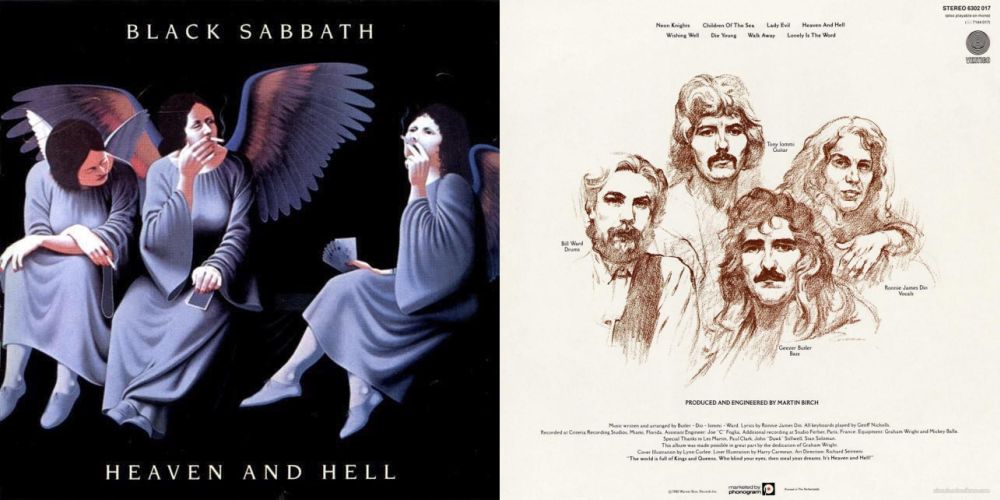
The cover for »Heaven And Hell« was created by Lynn Curlee and shows angels smoking cigarettes and playing poker. The band liked the choice because, in Iommi’s words, the motif feels “heroic”. The cover motif was inspired by a photograph taken in 1928 of women dressed in angel-like outfits who, during a break in some college performance, treated themselves to a few puffs of cigarette smoke each. The back of the album, with the band members, was photographed by Harry Carmean.
»Heaven And Hell« came out on 25.04.1980 and brought the band success, since after »Sabotage« (1975, RockLine review) it was once again an album that sent Black Sabbath climbing high on the charts. In the United Kingdom it reached number 9, and in the USA number 28. It’s also the third best-selling album of Black Sabbath’s career, right behind »Paranoid«(1970, RockLine review) and »Master Of Reality« (1971, RockLine review). In 1986 it went platinum in the USA, passing a million copies sold there. In the United Kingdom, with 60,000 copies, it became the third Black Sabbath album to get a silver certification, in November 1980. By April 1982 it had sold 100,000 copies and reached gold status on British soil.
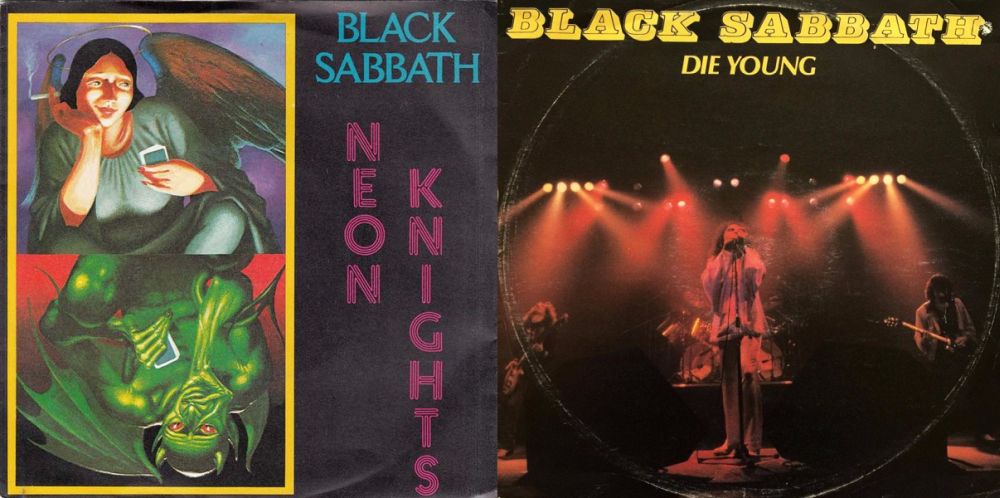
The album spawned two singles. The first was the album opener Neon Knights, released in July 1980 (the B-side has a live version of Children Of the Sea). It’s a song that came together right at the very end of the »Heaven And Hell« sessions, when the band was already in France, wrapping up production in Paris. Simple as that. They were short on studio time, so they had to write something quick. It’s actually also the only song on which Geezer Butler is credited as co-writer. On release the song hit number 22 on the UK singles chart (it didn’t chart in the USA). The first 25,000 copies of this single came in a picture sleeve. The second single came out in December 1980, and the band picked Die Young for it. It reached number 41 on the UK singles chart. Once again it didn’t chart in the USA. The B-side of this single has a live version of Heaven And Hell.
So. Now the band had to win over, if not outright re-educate, its fans on the new tour too, and they’d been shoved into an awkward spot: they had to build a live set out of Ozzy-era favorites and material from the new album. Two things that don’t mix easily. Who’s going to buy that, and how? How would the »pint-sized screamer who’ll make you lose your pants with one yell« handle Ozzy’s role? Not even close. That was obvious. Still, with his giant charisma, clear focus and incredible self-confidence, he slowly managed to bring the fans over to his side. The tour kicked off on 17.04.1980 in Germany. And it was a success. Venues were packed everywhere. In the UK leg Black Sabbath played twenty shows, including four nights in a row at the famous Hammersmith Odeon. Only on the American leg, on 09.10.1980 (by then Vinny Appice was already behind the kit), did a black mark land on the tour: the band was playing to 7,000 people in the middle of Milwaukee when, after just two songs (War Pigs and Neon Knights), a bottle flew from the crowd toward the stage and smashed right into the head of an unsuspecting Geezer, who later needed a few stitches. The band, of course, stopped the show right away.
And what does Tony Iommi say about »Heaven And Hell« today, 40 years after its release? “I believe the album has stood the test of time extremely well and helped us get through the transformation really well. As far as the songs go, it’s among the most musical albums of our career. I realize some people will always insist that Black Sabbath is only everything connected to Ozzy. But then on the other side there are plenty of other music lovers who discovered us through this very album, like Dave Grohl of Foo Fighters and his musical generation. From there, they went on to discover our past. That’s why »Heaven And Hell« played an important role and significantly extended the band’s musical career.«
This is an album that still splits music fans and critics today. Musically, Black Sabbath used it to climb toward new artistic horizons. That “doom” sound vanished from the songs, and the blues elements that had clung to the band throughout the seventies were scrubbed out too. Instead, the band built a run of tracks with an incredible musical payoff, giving the album a bombastic theatricality, while Iommi’s riffs grew a much higher jagged, destructive edge, which fit right in with the trend of the day, chasing the maximum combination of noise, speed and, of course, punch in the “aesthetics” of metal phrasing. Dio’s vocals opened up new dimensions of songwriting for the band, ones Iommi couldn’t have dreamed up without him. The band changed its sonic and compositional nature dramatically, and the songs work completely differently than they would have with Ozzy. With Ozzy, it would have been impossible to record an album like “Heaven And Hell”. That’s exactly why many think Black Sabbath should have changed their name back then, or taken a different one. One such critic is Ozzy’s loyal sidekick and guitarist Zakk Wylde, who says that in the Dio era the band lost every essential element of its authenticity.
Of course, Dio is a singer on a completely different level when you put him next to Ozzy (and vice versa). Despite the radically transformed musical look, the band’s trademarks still held on. The sound of Iommi’s guitar kept its elemental core, though Birch weighed it down with a lot of trendy heft, so it sounds downright Teutonic. Both in the solos and in the superior riffs Iommi crafted for this album. Then there’s Geezer’s thundering bass, which in this new guise brings even more musical dynamics and, along with that, delivers an incredible contrast to the guitar phrases, and in a way balances them out in the band’s new sound. “Heaven And Hell” is, in every way, a Black Sabbath album. Just for new times. The band’s rebirth, happening right alongside the birth of the phenomenon called N.W.O.B.H.M., with a brilliant and unique new singer and a Renaissance-style refresh, under the production baton of Martin Birch, who breathed a new sonic and stylistic trend into this transformation. “Heaven And Hell” left an indelible mark on the global rock scene of the time, landing on the pedestal of the greatest heavy metal albums, not just of its era but of the whole age of metal and rock, as over the years that followed it slowly picked up an evergreen shine.
author: Aleš Podbrežnik
