Label: Vertigo Records
Release date: 07/21/1971
Production: Rodger Bain
Album length: 34.29 min
Genre: Heavy Metal
Rating: 9.5 / 10
On their third studio album »Master of Reality«, the legendary godfathers of heavy metal, especially of its ‘doom & gloom’ atmospheric strain, reached a new stage in spreading dark sonic shades and deepening their occult lyrics, which led plenty of the media back then to link them with Satanism, something the band members have always firmly denied. Before recording this album, guitar virtuoso Tony Iommi, who had injured his fingers years earlier while working in a factory, decided to tune his guitar down a step to make playing easier, and that had a key influence on the darker sound of »Master of Reality« compared to both of its predecessors.
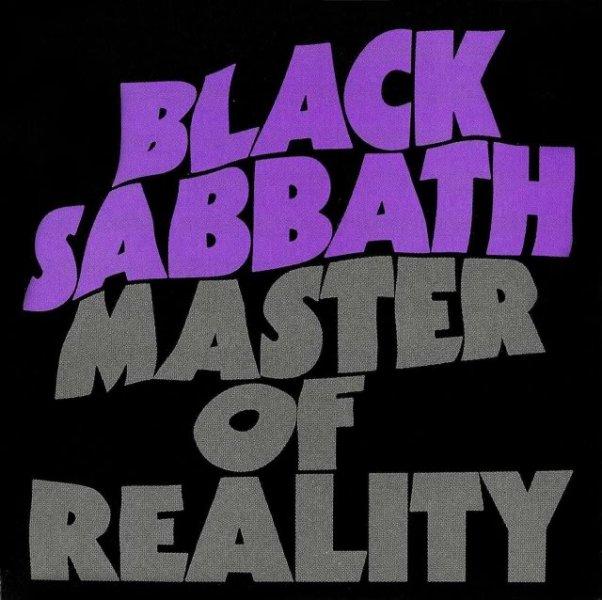
Like it or not, the ever-growing intake of intoxicating substances played an important role in the artistic process behind »Master of Reality«. Its ambiguous, apocalyptic-psychedelic title and the gloomy cover with its stylized lettering are in perfect harmony with the fatalistic, doom-laden atmosphere of this pioneering heavy rock achievement in many respects. The band was so ‘stoned’ in this period that they dedicated the opening classic »Sweet Leaf« — which, along with »Children of the Grave«, is the best-known Sabbath standard on »Master of Reality« — to marijuana. They hadn’t yet discovered hard drugs, cocaine above all, at this stage of their career, and fame hadn’t started pressing down with full force either, so new ideas rained down one after another with ease. In the mix they even deliberately left in the dissonant coughing that serves as the intro to this famous ode to getting high and prototype of doom metal. Iommi’s uncompromising, roaring guitar riff is laid over a slow, rolling rhythm, while Ozzy’s vocals, half in ecstasy and half in withdrawal shock, rather naively celebrate the “liberating” herb amid the ominous atmosphere.
Catholic-raised bassist Geezer Butler, besides celebrating soft drugs and sounding pacifist warnings about the wrong turns of the so-called developed world, still liked to swear by the occult in his lyrics back then. That’s felt especially on »After Forever«, whose message is steeped in the eternal question of the afterlife: is there really a choir of angels sitting on golden thrones on the ‘other side’, led by an old man with a long white beard, while down below the rabble of horned ones, headed by his hellish deceitfulness, carouse — or does death perhaps bring a reunion with our nearest and dearest, or just plain emptiness and the final end of consciousness? The lyrics, of course, met with anything but approval from the soul-minders of the day, especially because of the line about the pope on the end of a rope, and they deepened the myth of Black Sabbath as notorious Satanists. Musically, it’s yet another pioneering creation with an inventive supply of Iommi’s punchy guitar phrases that dictate the tempo changes in between, directed by Ward’s decisive drum crotchets, while Geezer’s melodic bass lines keep him company. The charismatic Ozzy is once again in his trademark, almost stereotypical vocal role of the eternal villain and tempter, though it’d be a lot easier to call him the Benny Hill of heavy metal than a Mephistopheles.
Crowned with a baroque guitar arrangement, »Embryo« is the first of two short instrumentals on the album and serves as a brief intro to the famous heavy rock evergreen »Children of the Grave«, the best-known and hardest-hitting piece on »Master of Reality«, which became famous above all for its chilling vibe. The lyrics are among the best of their career, as the message is more relevant than ever. Ozzy sings about the youth, a lost generation that’s already dead without even realizing it, whose future has been stolen and who’ve been sentenced to an early grave by a community of corrupt old men, politicians and clergy at the head, who together run the world like a giant corporation. Iommi’s full-bodied guitar phrases cut uncompromisingly through the air, accompanied by rattling bass lines and crushing, merciless drum transitions. Its brutal, distinctly dark atmosphere shot this standard straight into the ranks of the greatest metal classics of all time the moment it came out. »Orchid«, the next instrumental, boasts a lovely melody on acoustic guitar and was, at the time of release, one of the first proofs that there’s plenty of potential for subtlety hiding inside the legendary Birmingham foursome.
The uncompromising wrecking ball »Lord of This World« is another of Geezer’s occult yet pacifist creations with Lucifer in the lead role, only here it’s not the mythological lord of hell in the dock but humanity, which has enthroned evil with its own vile deeds. No need to guess that this was yet another Sabbath standard that thoroughly riled up the self-appointed guardians of public morals when it came out. Once again a distinctly dark ambience reigns, with a slow, rolling tempo and punchy guitar phrases, while dynamic drum transitions, lively percussion, melodic bass lines and even a few short guitar solos provide sudden bursts of energy. Ozzy sounds as evil and enraged as he possibly can, which only ramps up the fatalistic atmosphere further.
»Solitude« may well be the strangest »Master of Reality« experiment, a tender love ballad with a pleasant acoustic melody and confessional lyrics. Ozzy’s atypically ethereal, soft tone is so altered here that many followers of this legendary Birmingham collective long wondered whether drummer Bill Ward, who five years later shone on the ballad »It’s All Right«, had perhaps stepped in on lead vocals instead. But this wonderful ballad, crowned with Iommi’s pastoral arrangements on acoustic guitar, piano and flute, was in fact sung by a barely recognizable Ozzy, proving that with a bit of practice he could have improved as a singer on the technical side too. Although »Solitude« doesn’t get mentioned much when the most famous Sabbath achievements are usually listed, it set plenty of standards for later heavy metal ballads.
The closing, fairly complex and rhythmically rich ‘doom & gloom’ classic »Into the Void« is about the Cold War space race that was still going on between the two superpowers at the time, while also warning, revolutionarily for those days, about the ecological problems of ever-growing pollution, which is further proof of the intellectual breadth that often hid in Sabbath lyrics. Merciless guitar riffs hack through fragmented, rolling rhythms and create an atmosphere of total gloomy apathy, born from the primitivism of self-appointed world leaders and their space programs, which sadly always served first and foremost as political muscle-flexing and measuring contests while the world slowly ‘goes down the drain’. A central pacifist message without a shred of occultism was of course out of the question, so once again the fairytale lord of hell got a mention. Ozzy’s melodramatic vocal delivery is truly superb in terms of atmosphere and fits perfectly with Iommi’s brutal guitar finesse and Ward’s drum stampedes, through which Geezer’s groovy bass lines are artfully woven. The sudden time changes are timed very well, while the short closing guitar solo and the build-up of the central motif drive this Sabbath evergreen to an abrupt finish.
»Master of Reality« is still one of the most influential heavy rock albums ever, playing a hugely important role in the development of the heavy metal scene, especially the doom metal and stoner rock/metal subgenres, and with its dark, brooding atmosphere it helped cement the popular myth of Black Sabbath as worshippers of the fairytale horned one. It was precisely this funny but popular media label, which the band members never wanted to wear, that, along with their essential artistic maturing in composing ever more complex standards, helped them establish themselves in just a few years, from their humble blues beginnings, as the most important heavy metal collective of the seventies.
author: Peter Podbrežnik
Track list:
1. Sweet Leaf
2. After Forever
3. Embryo
4. Children Of The Grave
5. Orchid
6. Lord Of This World
7. Solitude
8. Into The Void
Lineup:
Ozzy Osbourne – vocals
Tony Iommi – guitar, synthesizer on “After Forever”, flute and piano on “Solitude”
Geezer Butler – bass guitar
Bill Ward – drums