Label: Vertigo Records
Release date: 28.07.1975
Production: Black Sabbath & Mike Butcher
Album length: 43.44 min
Genre: Heavy Metal
Rating: 10 / 10
By the mid-seventies, Black Sabbath were at their creative and commercial peak, with everything in artistic terms curving steadily upward, and they were turning out most of the best work of their career. »Sabotage« was their sixth studio album, and after a failed attempt at recording in America it was made all over again on home English soil, where the old-school ambience of Morgan Studios played a major part in its character and structure. This time the band had a crystal-clear vision of the sound they were after: with a bigger dose of punch, they wanted to step away from the progressive rock leanings of the superb predecessor »Sabbath Bloody Sabbath« (1973).
According to Iommi, they could have kept developing the technical side through extensive use of orchestration, but first and foremost they wanted to make a harder, more rock’n’roll-flavored record. »Sabotage« may not have a guest keyboardist, but despite the clearly much rawer nature of the individual tracks, there’s no shortage of symphonic arrangements and experimental moments, since this time absolutely everyone in the band tried their hand at keyboards. The notorious Ozzy Osbourne messed around with a synthesizer, which is hard enough to picture, guitar innovator extraordinaire Tony Iommi went back to organ, synthesizer and piano, bass wizard Geezer Butler found himself behind that ‘typical’ prog rock instrument, the mellotron, and even drummer Bill Ward ‘played’ piano on the 31-second hidden track »Blow On a Jug«, tucked away at the end of »The Writ«.
»Sabotage« sails successfully the whole way through between heavier staples like »Hole In the Sky« and »Symptom of The Universe« and softer, more experimentally minded efforts led by »Supertzar« and »Am I Going Insane (Radio)«, which is a sort of logical stylistic continuation of the previous album. This direction paid off handsomely for Black Sabbath in every respect, as »Sabotage« ranks among the best achievements of their long career.
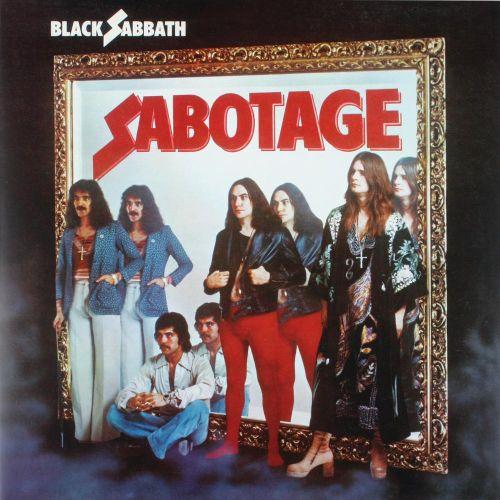
The goofy, comic cover is the product of a bizarre fashion fiasco that happened during the photo shoot, and it shows plainly why so many of the so-called music critics, who cared more about outward image than musical substance, didn’t take them seriously even then. Bill Ward stands out most of all, in his wife’s red tights and Ozzy’s underpants, worn to better hide his manly ‘bulge’, while Ozzy in a kimono, looking like a Western European gay man in the middle of Tokyo, and Geezer with a walking stick and ankle-length trousers are almost equally ridiculous. Iommi in a white shirt and jeans came off as by far the most ‘normal’. Of course, all four were draped in big crosses, which only boosted the occult aura that had followed Black Sabbath since their beginnings. And no, the occult vibe isn’t missing from individual tracks this time either, while Geezer’s lyrics once again touch on mystical visions, schizophrenia and social ills, in other words almost textbook heavy metal themes.
The album is stuffed with moments where the band outdo themselves in experimentation and innovation. The opening classic »Hole in the Sky« is a revolutionary, top-league heavy metal wrecking ball, where Iommi’s guitar riff slices through the air like a white-hot knife, while Ozzy screams as if hundreds of bats were chewing on his backside. For all the punch, which Ward’s densely packed drum quavers do a lot to deliver, there’s still just the right amount of rhythmic subtlety courtesy of Geezer’s melodic bass lines. Many younger generations first got to know this classic only through Metallica’s cover, which is definitely better than never. After the opening cataclysm comes a sudden switch into the less-than-a-minute-long »Don’t Start (Too Late)«, a slightly pastoral piece with some interesting acoustic guitar finesse. The heavy rock classic »Symptom of the Universe« is surely the hardest-hitting track of the entire Ozzy era, and with its openly brutal guitar riff and staccato rhythm it had a key influence on the development of so-called thrash metal. Ozzy, always up for all sorts of mischief, once again lets loose with pent-up rage. Geezer’s lyrics deal with his dreams of the creator and the origin of the universe, and also contain some mythological references. The punchy opening section is followed by a somewhat calmer, acoustic-driven second half, which finally steers things into much more subtle waters.
Almost ten minutes long, »Megalomania« is one of the most experimental and also most complex achievements of their career, with Ozzy in the vocal role of a complete schizophrenic, which fits the title and lyrics of this composition perfectly. Despite its skillfully woven-in acoustic finesse and symphonic arrangements, it repeatedly descends into brutal chaos with a full-fat guitar riff and a rumbling rhythm. That goes especially for its mellotron-spiced finale. »Thrill Of It All« is blessed with a punchy, innovative guitar riff and the classic Sabbath ‘doom & gloom’ slow, rolling rhythm, which makes it a thoroughly representative piece that captures the band’s gloomy aura perfectly. The transition into the instrumental section with lively synthesizer textures is brilliantly pulled off. The lyrics, as is so often the case with ‘blasphemer’ Geezer, contain plenty of references that religious minds won’t find comfortable.
The mystical, pompous »Supertzar«, which sounds like a soundtrack for a film version of Dante’s Inferno and Purgatorio, is likewise one of the strangest experiments of their career, with epic choral vocal harmonies and orchestral arrangements by producer and arranger Will Malone, through which Iommi’s irritable guitar phrases wander. This esoteric-flavored piece, with its exceptional atmosphere, is once again proof that the band’s gaze often liked to stray beyond the expected heavy rock confines.
No less interesting is »Am I Going Insane (Radio)«, which was a sort of overture to Ozzy’s solo career and catches the unpredictable singer in his most schizoid phase, with the paranoid vocal fitting the lyrics about madness perfectly, backed by a mounting rhythm and white-hot guitar passages. Listening to the crazed laughter at the end, it’s really not hard to picture Ozzy in a straitjacket in the middle of a padded room. The closing experimental treat »The Writ« opens with a rattling bass line, which is pierced by a sudden explosion of heavy guitar riff and Ozzy’s vengeful singing. The atmosphere is once again exceptionally intense, while the lyrics drift between occultism and sociological critique. Here they indulge in a series of restrained but interesting instrumental passages, with pleasant acoustic guitar finesse and a gentle layering of synthesizer textures. The short hidden bonus track »Blow On a Jug« is a complete goof by Ozzy and Bill, most likely added in the studio after some serious boozing.
»Sabotage« is a heavy rock masterpiece with a strong experimental streak and yet another gorgeous document of the golden era of musical innovation, when Black Sabbath were at the peak of their creative powers. Sadly, in the years that followed, Ozzy’s problems with intoxicating substances slowly began to take their toll on the creative process and the live shows, and the end of the classic Black Sabbath wasn’t far off.
author: Peter Podbrežnik
Track list:
1. Hole In The Sky
2. Don’t Start (Too Late)
3. Symptom Of The Universe
4. Megalomania
5. Thrill Of It All
6. Supertzar
7. Am I Going Insane (Radio)
8. The Writ
Line-up:
Ozzy Osbourne – vocals, synthesizer
Tony Iommi – guitar, piano, synthesizer, organ
Terry “Geezer” Butler – bass guitar, mellotron
Bill Ward – drums, piano on “Blow On A Jug”
Guest musician:
Will Malone – arrangements for English chamber choir