

King Crimson put out not one but two albums in 1970. The second one, “Lizard” (RockLine review), was recorded by a completely different lineup, one that, just like the patched-together crew behind its predecessor, was doomed to a short life and never played a single gig.
Robert Fripp decided the third King Crimson album would sound decidedly different from the first two. What probably pushed him that way was the fact that music critics had branded “In the Wake of Poseidon” (RockLine review) an attempt to recreate what the band had served up on their 1969 debut “In the Court of the Crimson King” (RockLine review).
The band’s third album came out on December 10, 1970 and reached number 29 in the UK. On January 3, 1971 it was released in the US too, where it landed at number 112 on the Billboard chart. Funny detail: in the US it came out on the very same day as two other albums tied to former members of the band. Those were the debut from ELP and the joint album by Ian McDonald and Michael Giles.
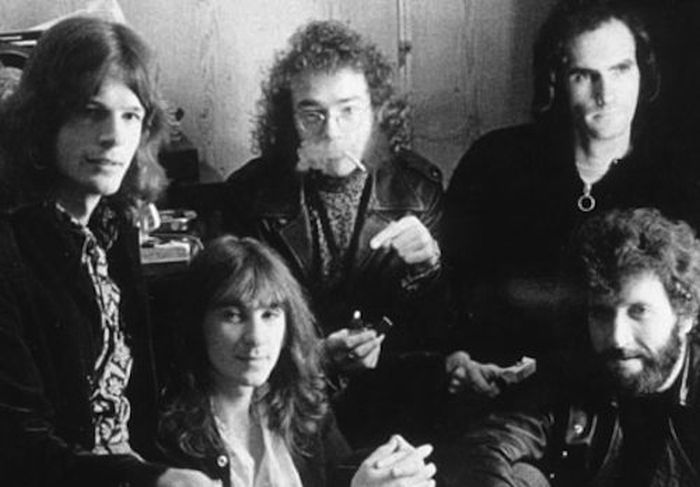
“Lizard” introduces two new members: singer and bassist Gordon Haskell, who passed away this past October, and drummer Andy McCullogh. Fripp had known Haskell for a long time. The two were classmates at grammar school. Now and then they played together in a local band, The League of Gentleman, who gigged at a shopping center in Wimborne, near the British seaside town of Bournemouth. Haskell came to Fripp’s rescue and sang the vocals on the gorgeous ballad “Cadence And Cascade,” after Greg Lake already had one foot in ELP during the recording of “In the Wake of Poseidon.” Fripp, who had been watching the “In the Wake of Poseidon” crew’s shipwreck with worry, asked Haskell, who could also play bass guitar, if he’d join King Crimson.
In a 1991 interview, Haskell later said he never actually liked King Crimson. He’d always been way more into R&B, Motown bands and soul than the freshly emerging “abrasion” of a new genre branch that was slowly picking up the nickname progressive rock. After Haskell’s wife nagged him about Gordon being financially “thin as pepper,” the guy thought it over again and decided to accept Fripp’s invitation. Besides Haskell, Fripp invited saxophonist and flutist Mel Collins, who had already played on the previous album “In the Wake of Poseidon,” to join fully, as well as a brand-new drummer, Andy McCullogh, who replaced Michael Giles. The new King Crimson membership, besides Fripp, Haskell, McCullogh and Collins, was of course rounded out by Peter Sinfield (poetry). For outside contributors, Fripp once again called on keyboardist Keith Tippett (who passed away in mid-June this year), who had already played piano on the previous King Crimson album, plus a wind section featuring Robin Miller, Mark Charig and Nick Evans. Yes vocalist Jon Anderson also appeared as a special guest on the album.
Soon after joining the process of creating and recording the new album, Haskell and McCullogh grew more and more unhappy with the way things were going. Haskell, who as we mentioned joined the band for financial rather than creative reasons, later described the recording as difficult and tense. Add to that Fripp’s infamous, almost proverbial stubbornness, demanding the highest level of instrumental execution from a mixed bunch of musicians the whole time, and it’s hardly surprising. Haskell once said: “During the recording Fripp was reducing McCullogh to tears, because he had a real bullying attitude toward him. He did it without mercy. In fact, he developed that attitude toward all of us. It didn’t toughen me up one bit. I started laughing out loud whenever Andy cried. You can even hear it on the album, at the end of the song “Indoor Games.” I started laughing uncontrollably. The others took it as some kind of charming “prank,” like I’d gotten totally into the lyrics, or into my contribution to that song. Truth be told, that song was rubbish, the lyrics absurd and my singing terrible. The others thought otherwise. They said it was wonderful!”
According to Haskell, the atmosphere during recording was feverish and crazy, and the music on the album mirrors that state. “Cirkus” opens the album with a meditative jazz-folk intro. It’s followed by a typical Crimson phrase led by Fripp’s mellotron and Collins’ saxophone. “Indoor Games” is a distant cousin of “Cat Food” from the previous album, with Sinfield’s VCS3 synthesizer (with vocoder) also playing its part. Besides King Crimson, Curved Air, Pink Floyd and the Moody Blues were already using it, and it was becoming a fashion craze. “Happy Family” drifts somewhere among the sonic pastels of free-jazz flashes, lit up by occasional escapes into psychedelic pop. The album’s peak is its B-side with the “Lizard” suite, split into four parts: it opens with “Prince Rupert Awakes” (featuring a somewhat overlooked vocal turn from Jon Anderson), continues with the orchestral and magical “Bolero – The Peacock’s Tale,” tangles into apocalyptic chaos with “The Battle of Glass Tears” and wraps up with the shorter exit “Big Top.”
Fripp, who in recent years finally showed some personal mercy toward “Lizard,” didn’t hide his bitter disappointment with its music in his earlier comments. For many years after its release he stayed cold toward it. Given Gordon Haskell’s statements above, that’s hardly surprising. Fripp didn’t spare even the “Lizard” suite, especially its first part, saying it would’ve been better if Rupert hadn’t gotten out of bed that day at all. “Jon Anderson sang something that’s impossible to sing. Neither the one who wrote the melody nor the one who wrote the poetry was any help to him. To make sense of the poetry in this section you need a proper dictionary,” Fripp snarked in one of his comments. The only piece Fripp praised years ago was “Bolero – The Peacock’s Tale”: “That’s the part of the album that finally settles in my head and doesn’t fill me with fear, terror, misery, suffering… The main theme, played by Robin Miller on oboe, is a true gift. It’s the piece that kept me going through hard times.”
Fripp, in fact, liked tearing apart most of the album in interviews. He once wrote on his DGM page: “Many ideas, presented simultaneously, didn’t work. For many of the bits it’s not at all clear whether they want to stay connected to the central theme or maintain their independence. The search for a link to the central theme remains largely unsuccessful, and these building blocks take on the look of neutral wateriness. The functioning and appeal of the elements is unsatisfactory, not inspiring, even though they strain desperately to provide cohesion.”
With his cynicism about “Lizard,” Fripp even went so far as to kindly suggest that people steer clear of it and spend their hard-earned money on something else. Well, unless they want to take the album to a party where an uninvited guest turns up and they’d like to drive him off with music. As if that weren’t enough, he added this: “I know there are lovers of “Lizard.” They must surely be big oddballs.”
Even if Robert Fripp isn’t a fan of his own album, which more than obviously polarizes listeners, its “repellent” brilliance has survived the decades and inspired generations of prog rockers. On that note, Steven Wilson, who remastered King Crimson’s entire discography in 5.1 stereo surround, said in 2011: “Lizard is basically a Robert Fripp solo album. King Crimson had fallen apart. Only he was left. And what did he do? He didn’t invite a bunch of rock musicians onto the album, only jazz musicians. That’s the approach I chose myself on my solo album “Grace for Drowning.” (RockLine review)
“Lizard” may really not be King Crimson’s most listenable work, though listenability has always been debatable with a band this avant-garde. For some, the constant walk on a razor’s edge between “digestible” and “annoying” parts is a true revelation of top-tier musical intelligence; for others, it’s just irritating. Some arrangements are indeed extremely dense, since Fripp didn’t budge an inch from blindly following his musical direction at the time, and the rest of the top-notch musicians had to follow it too. The band, at least going by Fripp’s comments, evidently failed to grasp that direction, but it did deliver some seriously enviable and fascinating “twists” of a colorful, unusual musical fusion, embodied in the unique nature of this record. Especially when it comes to the mingling of jazz and classical elements.
After the recording, Haskell left King Crimson. For the next 19 years he fought a compensation battle, convinced he’d been cheated out of the songwriting credits he was owed on the album. McCulloch soon followed Haskell and left the band too. The promotional material that made the rounds in support of “Lizard” included parts of Max Ehrmann’s poem Desiderata. Sinfield read the verses, and their central message is really advice on how to pick the right direction despite a state of total confusion.
After “Lizard” came out, Fripp’s lineup fell apart again. So its material didn’t come alive in stage shows until the next album, “Islands,” in 1971. Alongside Fripp, Peter Sinfield stayed in the band, and so did Mel Collins. Haskell was replaced by Boz Burrell, whom Fripp reportedly taught to play bass guitar in extremely short order, while Ian Wallace took the drum seat. This revamped lineup added the songs “Cirkus” and “Lady of the Dancing Water” to its live repertoire. Many years later, “Cirkus” also became a regular in the repertoire of 21st Century Schizoid Band, featuring Mel Collins and Jakko Jakszyk.
2016 brought King Crimson fans their biggest European tour since 1974. The setlists of those shows included “Cikrus” and “Dawn Song,” as part of the Lizard suite, which was thus performed on stage for the first time in the band’s career. The following year, when King Crimson headed out on a North American tour, “Dawn Song” was extended, and they started playing “Battle of Glass Tears” in full (the sections “Last Skirmish” and “Prince Rupert’s Lament” were added, which the band also played live for the first time). The Lizard suite section called “Bolero” joined the live repertoire of the European tour in 2018. Apparently Fripp’s heart finally thawed, and in his mature years he came to love “Lizard.”
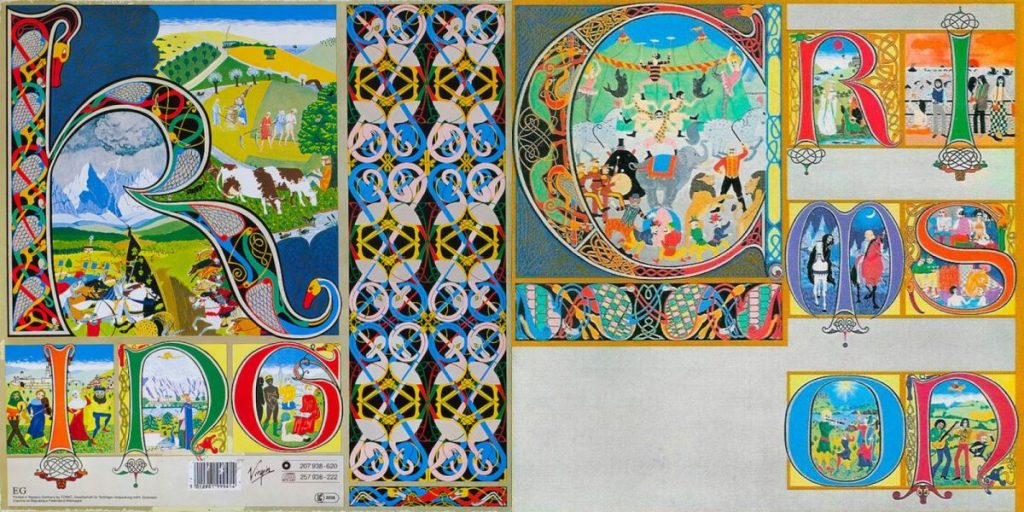
The album cover was created by Gini Barris, based on a concept by Peter Sinfield. The lettering on the front and back of the album forms the band’s name in medieval ornaments. That is, the word “King” on the back of the album and “Crimson” on the front. Each visual theme within a letter represents one of Sinfield’s lyrical concepts, or an individual track on the album.
With “Lizard,” an album marked by a departure from the musical direction of the first two records and a completely new lineup, Robert Fripp established himself as the band’s principal composer. The album, backed by a string of top-class musicians, is considered an incredibly ambitious, unusual and eclectic distillate of rock, jazz and quasi-classical maneuvers, where Robert Fripp’s sparkling guitar ideas, avalanche-like surges of woodwinds and an apocalyptic mellotron pave the way to peak dramatic effect. The standout moments are “Circus,” “Bolero – The Peacock’s Tale,” the gorgeous ballad “Lady of the Dancing Water” and Fripp’s phenomenal guitar solo on “Prince Rupert’s Lament.” Keith Tippet, a piano virtuoso, and guest Yes frontman Jon Anderson left their mark on the record. With its grandiose clash of styles, free-spinning improvisations and intricately woven orchestral arrangements, “Lizard,” in its untamed expression of ideas, is a kind of uncut artistic diamond and a one-of-a-kind work of absolute originality.
Author: Aleš Podbrežnik
