Label: Island Records / Atlantic Records
Release date: December 10, 1970
Production: Robert Fripp & Peter Sinfield
Length: 42.30 min
Genre: Progressive Rock
Rating: 9.5/10
In mid-1970, King Crimson were still in an unenviable spot, caused by the collapse of the original lineup that recorded the legendary debut “In the Court of The Crimson King” (1969). By then, only guitar oddball Robert Fripp and poet, computer and visual tech Peter Sinfield were left from that lineup, and the two of them were also the (informal) co-leaders of the band. Fripp took care of the main musical ideas, compositions and motifs, while Sinfield watched over the lyrical and visual side of the band, though he too started trying his hand as a musician on this album with his new “toy”, the VCS3 analog synthesizer. It was on “Lizard” that the collaboration between the two reached its peak and bore some of the best fruit in the band’s history. Luckily, they didn’t stay on their own for long, and a bunch of top-notch musicians came to their aid, among them Fripp’s former schoolmate Gordon Haskell, who took over vocals and bass from Greg Lake, and who had already worked with the band on the previous album “In The Wake Of Poseidon” (1970) as the singer on the esoteric ballad “Cadence And Cascade”. Mel Collins on saxophone and flute, who had also already played as a session musician on the previous album, and the excellent jazz fusion drummer Andy McCulloch (ex-Manfred Mann) joined as new official members. The orchestral, jazzy arrangements on the album were superbly played by session musicians Robin Miller (oboe, English horn), Mark Charig (cornet) and Nick Evans (trombone), under the direction of jazz keyboardist Keith Tippett (piano), who had likewise already worked with the band on the previous album. All these great musicians formed a brilliant framework for the band’s new face, but as so often in its history, this incarnation didn’t last long, and Haskell and McCulloch left before the record even came out, reportedly unhappy with the band’s further musical direction.
“Lizard” is without a doubt the most jazzy album the band ever made. In my view it’s also their most overlooked and misunderstood album among most fans, mainly thanks to the exceptionally diverse jazz fusion arrangements that make the record extremely complex, even by the band’s standards. That’s exactly why “Lizard” may even be their most complex and, for the average listener, quite demanding album. This combination of jazz fusion, Canterbury and authentic pastoral Celtic atmosphere (especially on the title track) was never repeated on any later album, and that’s precisely why “Lizard” is once again something special in their catalog and a masterpiece that only got its proper recognition, and its place among the band’s best albums, years later. Jazz fusion elements take up a big chunk of this album, and all lovers of that genre will be thrilled with it, no less than fans of symphonic progressive rock. Sinfield’s lyrics on this album are among his best and include some of his most imaginative metaphysical works. The whole album has a mysterious atmosphere, like some medieval scriptorium full of mystical books, each telling its own story.
The energetic opener “Cirkus” is the best-known track on the album. It opens with Haskell’s mysterious, almost whispering vocals before tipping over into a motif played on Fripp’s Mellotron that’s almost “villainously” creepy in mood. The verses weave dramatically around that motif throughout the song, and Fripp backs it all up with some of his best acoustic guitar parts. Then comes Collins’ unbridled sax solo, and the whole atmosphere stays tense until the end. With Sinfield’s metaphysical but also deeply sarcastic lyrics about the circus, clowns and chameleons, who stand as a metaphor for the corruption of innocence (the song says that “life is really one big ‘circus’, full of all kinds of clowns who constantly wear and swap masks”), this track, closing with a cacophonous climax of instruments, is undoubtedly one of the band’s classics.
The next two tracks are built on a loose, scattered jazzy rhythm. Both are full of sarcastic humor in the lyrics, and Haskell’s vocals are distorted through the VCS3 effect on both. “Indoor Games”, built on an excellent jazz fusion groove, has brilliant lyrics from Sinfield that allude to the hedonism of modern British aristocratic society. Haskell’s manic laughter at the end of the song is fun, but after repeated listens it can start to irritate anyone who can’t stomach genuine “Zappa-esque” humor. He later explained that his laughter came from being unable to make sense of Sinfield’s lyrics, and therefore unable to sing the closing line “hey ho”, which got on his nerves.
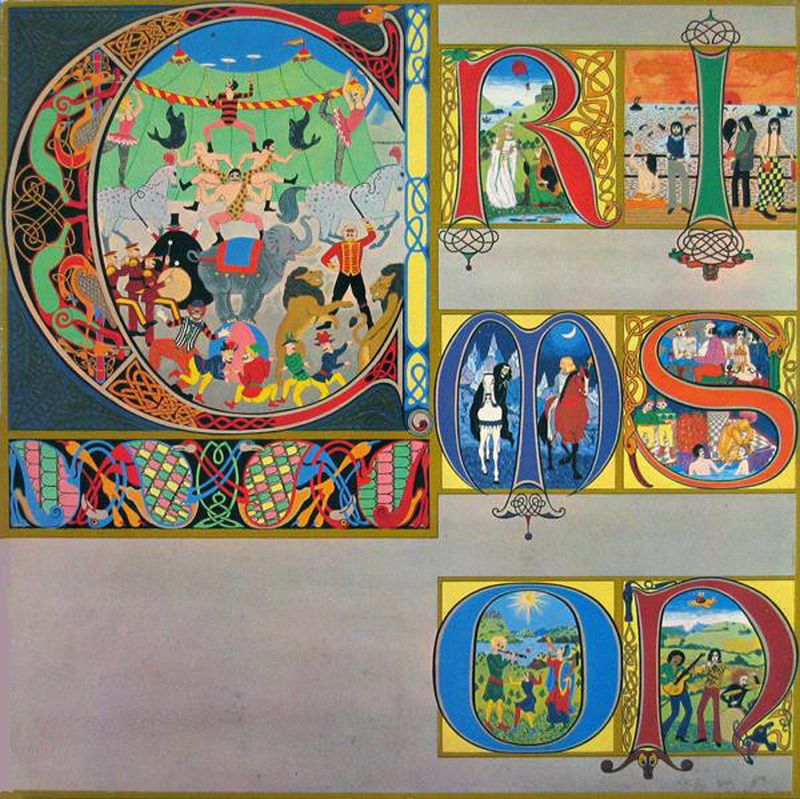
“Happy Family” is another avant-garde jazz fusion track, even by this band’s standards. It’s dedicated to the breakup of The Beatles, which is obvious from both Sinfield’s tongue-in-cheek lyrics and the album cover (look at the letter I on the cover). They appear in the lyrics as “Judas” (Paul McCartney), “Rufus” (Ringo Starr), “Silas” (George Harrison), and “Jonah” (John Lennon). Haskell’s vocals here are completely soaked in the VCS3 effect and almost unrecognizable. It’s a track that’s kindred in spirit to some of Frank Zappa’s jazzier works.
The gorgeous, romantic, medieval-troubadour ballad “Lady Of the Dancing Water” makes a real stylistic contrast with the previous track and is surely the brightest song on the record, with dreamy, romantic vocals from Haskell, Fripp’s acoustic guitar and Collins’ beautiful, melodic flute. It’s one of the loveliest ballads in the band’s history and a welcome warm-up for the majestic finale that follows. I personally think Haskell was a very good singer on songs that don’t demand so much technical skill as warmth and emotional expressiveness in the vocals. He simply never got a real chance with the band and didn’t stick around long enough to establish himself as a bassist and singer. His voice has improved a lot technically over the years, and in recent years he’s been enjoying commercial success with his solo career.
Next comes a real fairy tale for all lovers of good jazz fusion. This is the title track, the bombastic super epic “Lizard” at more than 23 minutes, which is surely the most ambitious work in the band’s history and also the longest track they ever recorded. It’s split into four sections and three subsections. Sinfield’s metaphysical lyrics tell of the ordeal of a legendary prince in the service of the “crimson king” Frederick II (a historical figure), who sets off with the crusaders on a bloody clash with the Mongols, and before the fight even begins, he settles accounts with the “lizard” (that is, the dragon) in passing. The epic’s opening section, “Prince Rupert Awakes”, has an excellent main chorus with a special guest on lead vocals, none other than Jon Anderson (Yes), who was unsuccessfully trying at that very time to lure Fripp over to fill the vacant guitarist spot in Yes. Anderson’s voice here is different, and sounds unlike what we’re used to from Yes. It’s a bit more mysterious and in a lower register, and by his standards even slightly dark, not at all angelic, but no less esoteric for it. This way of singing fits the whole section perfectly. Anderson’s excellent chorus “Burn the bridges, burn the water-stake the lizard by the throat” is without a doubt one of the most striking in the band’s history. Then a “folky” chorus kicks in with hand claps and playful Anderson vocals, instantly conjuring up the celebration of Yes’s “eternal merrymakers and children of the sun” (compared to King Crimson). No doubt about it, the “Prince Rupert Awakes” part will please fans of both bands. Soon there’s a way out on Mellotron and woodwinds, and the mood turns less optimistic and mysterious again. Robin Miller’s horn announces the second section of the epic, called “Bolero-The Peacock’s Tale”, which is my personal favorite part of the whole composition. A wonderful orchestral atmosphere and jazz fusion arrangements that stand up against the best the genre has to offer. This part of the epic is a playground where the other artists, that is the guest musicians Tippett, Miller, Charig and Evans, show off their talents in the best light. As they play over McCulloch’s drum rhythm, based on bolero elements, the woodwinds take up a lot of space and create excellent jazzy solos around the central theme. Then the third section starts, “The Battle Of Glass Tears”, split into three subsections (Dawn Song, Last Skirmish, Prince Rupert’s Lament). “Dawn Song” opens with Robin Miller’s English horn, soon joined by Haskell’s melancholic, dark vocals. A mysterious, tense atmosphere builds, heralding the start of the battle. The next subsection, “Last Skirmish”, is a real battle of the woodwinds (Collins masterfully handles the flute), Fripp’s Mellotron and McCulloch’s drums, and it’s surely the instrumental high point of the epic, during which we can even hear the central motif from “Cirkus”. If “Last Skirmish” was the clash, “Prince Rupert’s Lament” depicts the end of the bloody fight, with corpses rotting across the field and the whole senselessness of the battle laid bare. A funeral rhythm section, backed by woodwinds, suits the mood, and when Fripp finally plays electric guitar after clinging to the acoustic for most of the album, it’s clear the composition is nearing its end. Fripp is an excellent acoustic guitarist, and in a way it’s a real shame that in the years after this album came out he began abandoning the acoustic guitar, and today doesn’t use it at all anymore. “Big Top” is the closing of the suite and at the same time the closing of the album. It has a downright sarcastic, carnival-like outro, as if someone were deliberately mocking the whole epic, and it’s already based on self-parody. Maybe this closing parody is aimed at the senselessness of the whole battle and serves as an instrumental sneer at human stupidity. This carnival motif is also in fact a modified, reworked version of the motif that opens “Cirkus”, and so the circle is closed.
The album cover is great once again. The letters on the front and back of the album spell out the band’s name in medieval ornaments. That is, the word “King” on the back of the album and “Crimson” on the front. Each illustrated theme within a letter represents one of Sinfield’s lyrical concepts, or an individual track on the album.
“Lizard” is one of my favorite albums, not just by King Crimson but in progressive rock overall, one that will reward you with something new every time you spin it again. It’s the band’s most ambitious and one of its best albums, and one that pays off hugely on repeated listens. The arrangements are so numerous and so varied that you only catch many of them after several listens. Compared to the band’s first two records, which were still fairly similar to each other in style, there’s a big stylistic leap here. “Lizard” is an album completely different from the first two albums and completely different from everything the band put out after it. It took many years for the full greatness of this monumental work to show itself. If Richard Wagner and Miles Davis were still alive today and ever worked together, they’d surely pick the King Crimson of that era as their backing band.
Author: Peter “Dr. ProgRock” Podbrežnik
Track list:
1. Cirkus (including Entry Of The Chameleons) (6:28)
2. Indoor Games (5:41)
3. Happy Family (4:16)
4. Lady Of The Dancing Water (2:44)
5. Lizard:
– a. Prince Rupert Awakes (4:36)
– b. Bolero – The Peacock’s Tale (6:39)
– c. The Battle Of The Glass Tears (10:58)
I) Dawn Song
II) Last Skirmish
III) Prince Rupert’s Lament
– d. Big Top (1:13)
Lineup:
Robert Fripp – guitar, Mellotron on tracks 1, 2 and 5, synthesizer, organ, electronics
Mel Collins – flute, saxophones
Gordon Haskell – bass guitar, vocals
Andy McCulloch – drums
Peter Sinfield – lyrics, VCS3 synthesizer on tracks 2 and 3
Guest musicians:
Jon Anderson – vocals on “Prince Rupert Awakes”
Keith Tippet – piano, electric piano
Robin Miller – oboe, English horn
Mark Charig – cornet
Nick Evans – trombone