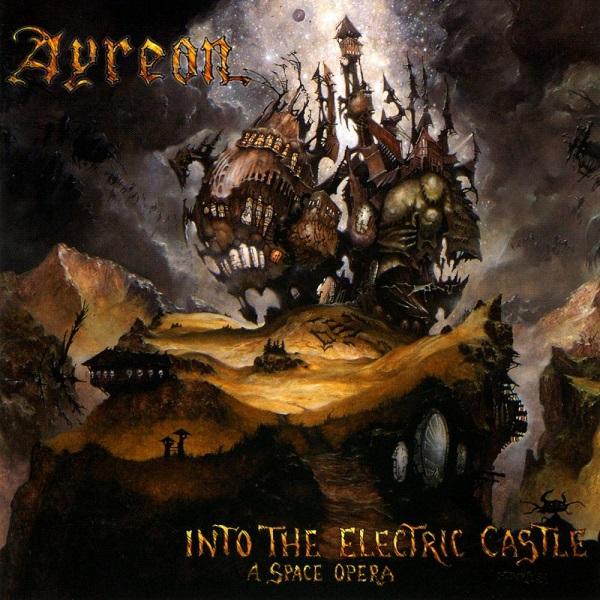
Label: Transmission Records
Release date: 10/31/1998
Production: Arjen Anthony Lucassen
Album length: 104.47 min
Genre: Progressive Rock / Space Rock
Rating: 10 / 10
Dutch musical genius Arjen Anthony Lucassen, a multi-instrumentalist, singer, composer, lyricist and producer all in one, used his ambitious project (and later band) Ayreon in the mid-nineties to revive the concept of the rock opera, an idea that seemed to have died along with the 1970s. Bringing back such a long-written-off idea is his greatest achievement, though far from his only one. This master of blending progressive rock and prog metal with occasional touches of folk, classical music and electronica set brand-new standards for what a modern concept rock/metal opera should be with Ayreon’s debut “The Final Experiment” (1995).
By 1998, though, Arjen was not exactly in an enviable spot. The second Ayreon album, “Actual Fantasy” (1996), still the band’s only non-concept record to date, had been a considerable flop compared to the warmly received debut. Lucassen made no secret of his disappointment, and before recording the next album he announced that if it flopped too, he would simply end the Ayreon story and focus on other (solo) projects.
Determined to show the music world how to make a (double) rock opera of enviable sonic, atmospheric and conceptual proportions, this ambitious musical mastermind set out to make “Into The Electric Castle” a completely different beast from its far-from-bad predecessor “Actual Fantasy”. First, he decided the new studio project would have a sci-fi concept, but with a less serious tone than “The Final Experiment”. That’s exactly why Arjen drew inspiration for the “Into The Electric Castle” concept from some B-movie sci-fi films, while the basic premise (unintentionally) bears a slight resemblance to the cult Marvel comic saga “Secret Wars” from the eighties.
On “Into The Electric Castle”, which Arjen wrote, arranged and produced himself, while also contributing vocals, guitars, bass and keyboards, he gathered a truly impressive legion of guest musicians, with the prestigious guest vocalists standing out above all. It made sense that Arjen would invite mainly his Dutch friends: Edward Reekers (Kayak) as the Futurist, Sharon den Adel (Within Temptation) as the Indian, and Anneke van Giersbergen (ex-The Gathering) as the Egyptian, while the lesser-known singers, Edwin Balogh as the Roman and Jay van Feggelen as the Barbarian, also did a fine job on their vocal missions.
His biggest coup, though, came when he managed to lure in the cult Scottish singer Fish (ex-Marillion) and the English vocal standout Damian Wilson (Threshold, ex-Landmarq). The renowned English solo musician Peter Daltrey (Kaleidoscope, Fairfield Parlour) proved himself as the Voice (of the alien). Among the instrumentalists, the standouts were the legendary Dutch flutist/keyboardist/vocalist Thijs van Leer (Focus), the English keyboard wizard Clive Nolan (Arena, Pendragon, Shadowland) and the Dutch keyboardist Ton Scherpenzeel (Kayak, ex-Camel). Each of these singers was cast as one of the characters in Arjen’s sci-fi concept. The Scottish giant Fish (fittingly) played the Highlander superbly, and Damian Wilson was just as brilliant as the Knight. Arjen himself took the role of the Hippie, as his psychedelic-tinged vocals were tailor-made for the job.
The “Into The Electric Castle” concept goes something like this: a mysterious force pulls people from different eras and places and materializes them on an unknown planet in another dimension. The Highlander, the Knight, the Roman, the Hippie, the Egyptian, the Indian, the Barbarian and the Futurist find themselves in this odd company, utterly unable to wrap their heads around their new situation. Suddenly they hear a strange voice that guides them through the adventure while warning them of the many dangers and trials awaiting them on the way to their goal. Their salvation lies in the mysterious Electric Castle. The first dangerous trial is a special Tree of Decision, which tells the group that one of them will have to part with life.
The Highlander is the first of the group to succumb to the trial, so on the way toward the mysterious, enticing light he stops, lies down and dies. Then, after they come across a strange garden surrounding the Electric Castle, the Egyptian spots a mysterious light and feels that her supreme god Amon Ra is calling her. So she heads toward the light, lies down and dies. The rest of the odd group finally enter the Electric Castle. The Indian lets her guard down for a moment, lured by a mysterious gust of wind, which proves fatal for her, and she follows the Highlander and the Egyptian to her death.
In the end, the Knight, the Roman, the Hippie, the Barbarian and the Futurist face the final trial in the shape of two doors. One leads to destruction and death, the other to salvation and earthly paradise. The group has to pick the right door, the one that will bring them salvation. The first door looks disfigured, sinister and grotesque, while the second is far more inviting, made of pure gold. The Barbarian succumbs to his arrogance and pride and walks through the golden door, which brings him instant death. The remaining four, having passed the toughest test of the whole adventure, are rewarded before heading through the right door: the source of the mysterious voice finally appears before them.
It turns out the mysterious voice belonged to a lonely alien who had brought them to his planet only because he was bored amid the castle walls and craved some games and excitement. Now he’s forced to send them back to their various eras and places. Just before the four step through the door to salvation, the alien tells them he will wipe their memories, so they’ll forget everything they experienced on his planet.
So the Hippie finds himself back in his own time and starts wondering whether his miraculous journey was just the result of overdoing the psychedelic substances. The Futurist, on his return, can’t shake the nagging feeling that someone erased his memory with some special device. The Roman, on the other hand, comes away from the strange experience, which he reads as a dream, a stronger person. And the Knight is convinced that through his dreams he managed to achieve the greatest knightly honor, the Holy Grail, which fills him with immense pride and bliss. The ending is thus left open to the listener’s own interpretation of what really happened to these odd adventurers.
The album’s sound combines some of the best elements of progressive rock and prog metal, with no shortage of orchestral classical touches and pastoral hints of folk. The remarkable variety of genres and arrangements, the top-notch virtuosity of the individual musicians and the brilliant vocal performances from all the guest singers are the main strengths of this concept masterpiece, whose intense atmosphere keeps the listener ‘on tenterhooks’ throughout, with dramatic and serene moments harmoniously trading places the whole time.
“Into The Electric Castle”, which also marked the first collaboration between Arjen and longtime Ayreon drummer Ed Warby, packs nearly two hours of music (an hour and 45 minutes, to be exact), and there isn’t a single boring moment on it, one more telling proof that Mr. Lucassen was positively bursting with artistic fervor and innovative ideas. It hardly needs saying that the album also boasts excellent production, which was nothing unusual for Mr. Lucassen. The first disc opens with “Welcome To The New Dimension”, where the alien’s voice, played by Peter Daltrey, greets the bewildered newcomers to the new dimension while electronic samples and ethereal guitar variations drift in the background.
On the eleven-minute symphonic prog epic “Isis and Osiris”, an in-great-form Fish shines especially bright with his theatrical vocal performance, as do both female singers with their operetta-style approaches, while harmonic interplay between the keyboards and electric guitar creates a majestic atmosphere. The instrumental sections are full of witty variations that only deepen the dramatic mood. In places you can clearly feel the atmospheric influence of some rock legends such as Pink Floyd (the guitar-and-keyboard harmonies) and Led Zeppelin (the pastoral elements). Arjen made maximum use of traditional prog keyboards, led by the Hammond organ, Mellotron and Minimoog.
The remarkable atmospheric contrast and the variety of arrangements and vocals suck the listener into the heart of the concept right from the start. “Amazing Flight” is another ambitious epic of majestic atmospheric proportions, where special guest Clive Nolan impresses with his colorful, distinctive synth solos. The vocal harmonies, in which absolutely all the singers get their moment, Arjen as the Hippie included, are once again a chapter of their own and can’t be praised enough. Arjen’s guitar solos weave beautifully throughout and keep the epic mood going, with plenty of subtle moments. Mr. van Leer shines too with sparkling flute variations, while both female singers do a fine job on the ethereal multi-part vocals.
“Time Beyond Time”, where the characters wonder about the true meaning of their mysterious predicament, opens with a moving, ethereal intro over pastoral acoustic guitar chords, while Mr. Reekers, as the Futurist, helps build the hypnotic mood with his wonderful vocal tone. Damian Wilson provides a brilliant vocal contrast as the Knight, who wonders whether this cosmic experience is a side effect of the Holy Grail at work. Maestro van Leer shines again with a short flute solo, while Arjen, with a spacey improvisation, proves once more why he’s one of Europe’s greatest guitar masters.
On “The Decision Tree (We’re Alive)”, which has some space rock electronic shades, Fish as the Highlander falls for the warning words of the Tree of Decision about the foretold death of one of the group. The instrumental sections are ruled by melodic guitar passages that nicely sustain the mighty mood. Fish is at the peak of his vocal melodrama here, backed by epic multi-part vocals. Especially fun within this brilliant composition is the Highlander’s vocal squabble with the philosophically kindred Barbarian and Roman over who will be the one to sacrifice himself and who will then get the posthumous glory. A few crazy variations on the traditional keyboards, unbridled metal drum stampedes and unpredictable electric guitar artistry are once again a real treat for the ears of all fans of musical virtuosos.
The pastoral ballad “Tunnel Of Light”, where the group runs into a new dangerous trial in the form of the Tunnel of Light, is Fish’s (the Highlander’s) farewell song on the album, with ethereal female vocal harmonies accompanying him over a pastoral acoustic guitar melody. The Scottish giant feels right at home in this kind of sonic setting and delivers an unforgettable vocal performance. “Across The Rainbow Bridge” opens with a melancholic intro, where Wilson shines above all with his moving vocals, while sprawling keyboard curtains and rhythmic variations rule the background. The multi-part, epic chorus built on symphonic prog metal is a chapter of its own. The keyboard section plays around with electronic textures again, while this time the electric guitar mercilessly grinds out ‘metal notes’. Arjen has a blast here in the psychedelic vocal role of the confused Hippie.
The second disc opens with the composition “Garden Of Emotions”, where the group faces a new trial right at the entrance to the Electric Castle. The opening section is marked by epic arrangements with gorgeous harmonies between electric guitar and keyboards. Arjen shines again as the Hippie, who in his muddled state has not the faintest idea what danger they’re in. Anneke van Giersbergen, meanwhile, sees an illusion of the ancient Egyptian sun god Amon Ra and chooses the road to death. The middle part is taken over by a metal section with brutal guitar passages and a merciless drum march, while alternating vocal harmonies shift the composition back into more ethereal realms. One of the more entertaining moments is the vocal squabble between the Roman and the Barbarian over prestige, since they have similar ideas about what reward awaits them at the end of the adventure. In the instrumental section the guitar maestro once again doesn’t hold back on his witty variations, while the dramatic mood builds by the second.
The naive Egyptian has fallen for the voice of her supreme god and parted from the group forever, which is also the central theme of the melancholic, pastoral ballad “Valley Of The Queens”, where van Giersbergen takes the lead vocal role. On the darkly tinted “The Castle Hall”, which opens with eerie, animalistic sounds, the remaining members of the group finally find themselves in the middle of the Electric Castle. There the alien’s warning voice greets them once more. This time Arjen opts for an interesting fusion of space rock and prog metal, which with its slow rhythmic elements occasionally leans toward doom metal. Particularly interesting here is Damian’s performance as the Knight, who is utterly confused and convinced he has returned to the Middle Ages, being tested by the wizard Merlin behind the walls of the legendary Camelot. In the closing part Mr. van Leer shines with a charming flute solo, joined by Lucassen with shrewd guitar variations.
“Tower Of Hope” is another track with a dark ambience, where a new trial awaits the group in the form of the Tower of Hope. This time Arjen impresses in the intro with a space rock sound collage, before moving on into more metal waters with a harmonious exchange of different vocal roles. The interesting, slightly psychedelic chorus works especially well. In the closing part comes an unexpected short instrumental twist into jazz fusion, after which the psychedelic-metal hybrid motif takes over again.
“Cosmic Fusion” has an ominous opening section, and this time it’s Sharon den Adel’s turn to say goodbye as the Indian, who suddenly feels the call of the spirits of nature and the sun beckoning her. That means this melancholic, gloomy track is built around her gorgeous vocals, with enigmatic synth curtains flowing in the background. The other members of the group warn her that it’s a lie and that death awaits her, but their warnings fall on deaf ears. The Indian walks into death, which this time shows up in person through the growling vocal contributions of Robert Westerholt (Within Temptation) and George Oosthoek. The instrumental, symphonically spiced section is ruled by a wild yet dynamic dance of instruments.
“The Mirror Maze”, where the remaining five face the castle’s last trial, opens with a piano arrangement and Arjen’s psychedelic vocals as the Hippie (this time he sounds quite a bit like John Lennon a few times). A majestic symphonic arrangement together with acoustic guitar chords and ethereal vocal harmonies shapes an epic chorus. Lucassen again doesn’t hold back on subtle guitar variations, while the atmosphere of this brilliant track practically never stops shifting.
“Evil Devolution”, a sharp critique of runaway technological progress with no oversight whatsoever, has a psychedelic intro with bizarre, burbling effects, followed by a spill into a melodramatic section with epic guitar variations. The closing part is taken over by a short space rock section with dissonant electronic textures. On the punchy “The Two Gates” the remaining five face two doors and have to choose the right one. The Barbarian, in the vocal guise of Edwin Balogh, makes the fatal mistake of stepping through the golden door, which brings him death. Fittingly, Balogh’s vocals are pushed to the front this time. The track’s dramatic nature, led by an epic chorus, is spiced with punchy, metal-minded guitar passages over uncompromising rhythmic support.
“Forever Of The Stars”, where the surviving four get the riddle solved through their meeting with the alien, is a short space rock interlude with electronically manipulated narration by Peter Daltrey as the Alien. “Another Time, Another Space” is the album’s epic closer, with dramatic symphonic arrangements, where all four surviving characters, back in their own eras and places, ask themselves questions about the recent experience, since they simply can’t remember the details anymore. That means all four remaining singers trade off successfully on lead vocals over the melodic backdrop, delivering the final conceptual climax and a triumph of unforgettable atmosphere.
“Into The Electric Castle” was the defining work of the one and only Arjen Anthony Lucassen, setting brand-new standards for the modern rock/metal opera and helping revive interest in a concept-album genre that was all but buried. It was an unparalleled concept masterpiece that didn’t just let Ayreon keep their footing on the music scene, since its success blew past all of Arjen’s expectations, but shot them into the stratosphere of the most exciting names in modern prog rock and prog metal.
At the same time, Arjen laid the cornerstone with it for Ayreon’s long-running tradition of assorted guest musicians, led by famous guest vocalists who mostly came from renowned bands. Through his work he managed to bring together musicians from different generations, countries and genres into a successful creative community and to shift plenty of genre boundaries. Hard as it is to believe, with his next concept project (in two parts), “Universal Migrator”, Arjen would not only match the quality level of “Into The Electric Castle” but even create the best work of his career so far.
author: Peter Podbrežnik
Track list:
CD1: 47:25 min.
1. Welcome to the New Dimension (3:05)
2. Isis and Osiris (11:11)
A) Let the Journey Begin
B) The Hall of Isis and Osiris
C) Strange Constellations
D) Reprise
3. Amazing Flight (10:15)
A) Amazing Flight in Space
B) Stardance
C) Flying Colours
4. Time Beyond Time (6:05)
5. The Decision Tree (We’re Alive) (6:24)
6. Tunnel of Light (4:05)
7. Across the Rainbow Bridge (6:20)
CD2: 57:10 min.
1. The Garden of Emotions (9:40)
A) In the Garden of Emotions
B) Voices in the Sky
C) The Aggression Factor
2. Valley of the Queens (2:25)
3. The Castle Hall (5:49)
4. Tower of Hope (4:54)
5. Cosmic Fusion (7:27)
A) I Soar on the Breeze
B) Death’s Grunt
C) The Passing of an Eagle
6. The Mirror Maze (6:34)
A) Inside the Mirror Maze
B) Through the Mirror
7. Evil Devolution (6:31)
8. The Two Gates (6:28)
9. Forever of the Stars (2:02)
10. Another Time, Another Space (5:20)
Musicians:
Arjen Anthony Lucassen – electric and acoustic guitar, bass guitar, Minimoog, Mellotron and keyboards, vocals (Hippie)
Edwin Balogh – vocals (Roman)
Sharon den Adel – vocals (Indian)
Jay van Feggelen – vocals (Barbarian)
Fish – vocals (Highlander)
Anneke van Giersbergen – vocals (Egyptian)
Edward Reekers – vocals (Futurist)
Damian Wilson – vocals (Knight)
Robert Westerholt and George Oosthoek – vocals (Death)
Peter Daltrey – vocals (Voice)
Ed Warby – drums
Roland Bakker – Hammond organ
Robby Valentine – piano, synth solo on “Isis and Osiris, I. Let The Journey Begin”, “Amazing Flight, I. Amazing Flight in Space” and “Tower of Hope”, Mellotron on “The Mirror Maze, I. Inside the Mirror Maze”
Ernő Oláh – violin
Taco Kooistra – cello
Jack Pisters – sitar
Rene Merkelbach – synth solo on “The Decision Tree (We’re Alive)” and “Evil Devolution” and piano on “Valley of the Queens”
Clive Nolan – synth solo on “Amazing Flight, III. Flying Colours”
Ton Scherpenzeel – synth solo on “Cosmic Fusion, III. The Passing of an Eagle”
Thijs van Leer – flute on “Amazing Flight, III. Flying Colours”, “Time Beyond Time”, “Valley of the Queens” and “The Castle Hall”