Label: Vertigo Records
Release date: 01.12.1973
Production: Black Sabbath
Album length: 42.35 min
Genre: Heavy Metal
Rating: 10 / 10
On their fifth studio album »Sabbath Bloody Sabbath«, Black Sabbath threw the doors wide open to a kind of artistic experimentalism you don’t usually associate with the term ‘heavy metal’. One of the key roles went to the legendary Yes keyboardist and Ozzy’s (drinking) buddy Rick Wakeman, who showed up as a special guest. Wakeman happened to be in the studio next door with Yes at the time, recording the masterpiece »Tales From Topographic Oceans« (1973), and his symphonic arrangements on »Sabbra Cadabra« inspired the band to add an orchestral dimension to their mostly heavy rock standards with that ‘doom & gloom’ atmosphere. Ozzy, Tony Iommi and Geezer Butler even fooled around a little with a synthesizer they’d unexpectedly discovered in the California studio.
But even the revolutionary synth technology of the day couldn’t hide the band’s trouble with intoxicating substances, alcohol above all, and you can feel it in the lyrics too, which, in true Geezer tradition, are full of the occult and unresolved sociological and psychological questions. What proved crucial for the dark, esoteric and at times apocalyptic atmosphere of »Sabbath Blodoy Sabbath« was the move from Los Angeles back to England after a chronic shortage of ideas. In the dungeons of the old Clearwell manor in Gloucestershire (supposedly haunted, according to local legends), they finally found real inspiration and broke the creative block. Iommi came up with the main guitar phrase for the title track while wandering around the castle’s dungeons, and from there on it was no longer hard to write the rest of the songs, every one of which ranks among the best moments of their long and turbulent career.
Certain prog rock tendencies had already been faintly noticeable on the previous album »Volume 4« (1972), so it was no surprise that they continued down this adventurous, more complex sonic path, which finally paid off richly. It’s somewhat ironic that the top contender for the best album of the classic Black Sabbath is also the most experimental record of their career. »Sabbath Bloody Sabbath« had an especially important influence on the further development of heavy metal, and yet today, thanks to its adventurous nature, it’s also appreciated by plenty of progressive rock fans.
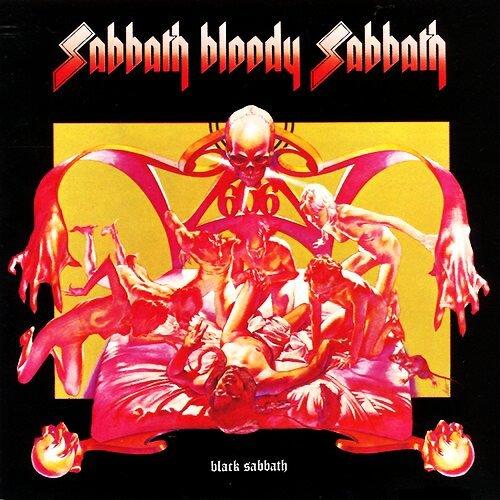
The otherwise excellent album cover caused quite a bit of controversy, especially in the hypocritically moralistic US, with its Nazi-flavored initials of the album title, plus a skull and the ‘devil’s’ number above a bed. The front and back covers depict an occult-spiced schizophrenia of a person caught in a dual dream, a favorite theme of this legendary heavy rock band, which was linked to Satanism throughout its entire career, giving it some extra free publicity. The dreamer finds himself in the middle of a nightmare, where his nearest and dearest, transformed into perverse demons, are trying to destroy him, while on the other picture he’s reached a state of bliss and peace, though you could also read the image as him dying of fright during the nightmare and ending up in ‘God’s embrace’.
The title track, which carries far more than just symbolic weight thanks to its conspiratorial-fatalistic lyrics, is one of the most beloved classics in their story and a heavy rock standard in every sense of the word. It opens with an imposing Iommi guitar riff and Ozzy’s raging vocals. Geezer’s grooving, melodic bass lines and Ward’s crushing drum rolls deliver a mighty rhythmic punch, while the peak is a melodic chorus. What makes it so distinctive are the acoustic interludes in the middle, which add a broader, subtler dimension. »A National Acrobat« is an interesting, experimental, rhythmically unpredictable piece set at a mid tempo, with plenty of witty time changes and a unique Iommi guitar solo. A slightly psychedelic guitar riff and Ozzy’s conspiratorial, mischievous vocals add yet another dimension. »Fluff« is a gorgeous instrumental with a magical vibe, courtesy of Iommi’s pleasant acoustic guitar melody and delicate piano arrangements. You could say that just as the title track perfectly represents the front cover, »Fluff« aptly symbolizes the picture on the back of the album, since it’s a proper ambient counterpoint to the typical dark and spooky Black Sabbath.
»Sabbra Cadabra« is another interesting, experimental effort, with an emphatic bluesy guitar phrase and a sped-up rhythm, where Wakeman’s dynamic piano and Moog synthesizer arrangements also settle nicely into the sonic collage. The love lyrics about a femme fatale stand in sharp contrast to the usual Sabbath tradition, but Ozzy’s raging vocal contribution is, as expected, anything but lyrical, so instead of his chosen one he could just as well be singing about a beheaded bat.
»Killing Yourself to Live«, whose lyrics deal with individual band members’ health problems as a result of excessive boozing, is the next heavy metal classic, and it’s actually a suite in three parts titled »Killing Yourself to Live«, »You Think That I’m Crazy« and »I Don’t Know If I’m Up or Down«, which is yet another prog rock move. The full-bodied guitar riff is blood-soaked with rattling bass lines, while the paranoid vibe seems made for Ozzy’s schizoid vocals. A tasty guitar solo and cataclysmic drum fills eventually make room for an interesting instrumental section, which also features a few playful synth arrangements.
Those are also present on the anticlerical »Who Are You«, where Geezer’s lyrics once again touch on the eternal, unsolved question of the existence of ‘someone above the clouds’. It’s an almost typical Sabbath creation, with a slow, rolling rhythm, wicked vocals and a dark, fatalistic, almost creepy atmosphere. What sounds totally untypical, though, is the dramatic orchestral section with dramatic bits on Moog synthesizer and mellotron, two classic prog rock instruments. »Looking For Today« is another dynamic heavy rocker, with lyrics about how fleeting fame is, built around a dirty guitar riff, grooving bass lines, mighty cymbal crashes and pastoral arrangements on flute and acoustic guitar. Ozzy’s paranoid singing fits the dualistic mood of this composition perfectly, as it floats somewhere between tension and release the whole time.
The centerpiece of the »Sabbath Bloody Sabbath« peak, however, belongs to the closing masterpiece »Spiral Architect«, which, thanks to its gifted rhythmic complexity and lavish orchestration, contains plenty of prog rock finesse. The pastoral-ethereal acoustic guitar intro creates a mysterious atmosphere that, with the help of a punchy guitar passage, turns into a relatively cheerful section. The psychedelic lyrics with elements of metaphysics are in fine harmony with the mighty orchestral arrangements under the baton of Will Malone and Ozzy’s raging vocal approach. The pompous finish with applauding audience is the cherry on top of the Sabbath-esque artistic maturity gained over the years.
The adventurous masterpiece »Sabbath Bloody Sabbath« is the most artistically accomplished achievement of the Ozzy era. It finally crowned the legendary heavy metal forefathers from Birmingham as the most important heavy rock band of the seventies, and it’s a must-have in any decent rock collection. The following year, 1974, Black Sabbath deservedly found themselves at the very peak of their career, playing in front of a crowd of two hundred thousand at the California festival California Jam, alongside other legends of 70s rock music like Emerson, Lake & Palmer, Deep Purple, Eagles and Earth, Wind & Fire.
author: Peter Podbrežnik
Track list:
1. Sabbath Bloody Sabbath
2. A National Acrobat
3. Fluff
4. Sabbra Cadabra
5. Killing Yourself To Live
6. Who Are You
7. Looking For Today
8. Spiral Architect
Lineup:
Ozzy Osbourne – vocals, synthesizer
Tony Iommi – guitar, piano, synthesizer, organ, flute
Geezer Butler – bass guitar, synthesizer, mellotron
Bill Ward – drums, timpani, bongos on “Sabbath Bloody Sabbath”
Guest musicians:
Rick Wakeman – keyboards, synthesizer and piano on “Sabbra Cadabra”
Will Malone – conductor, arranger