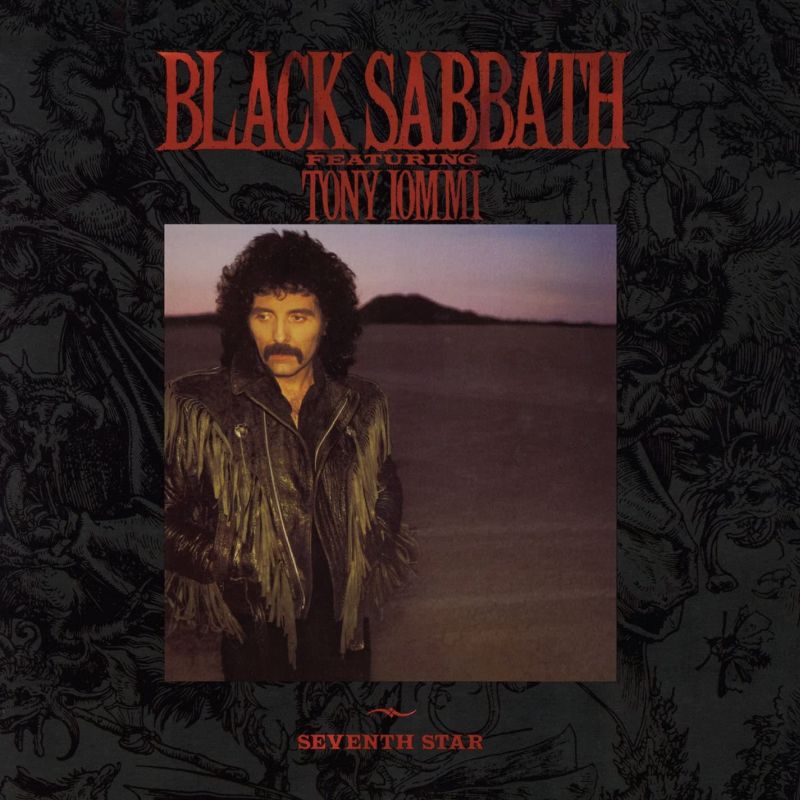
Label: Vertigo Records
Release date: February 27, 1986
Production: Jeff Glixman
Album length: 34.55 min
Genre: Heavy Metal
Rating: 9 / 10
The first half of the eighties was without a doubt the most chaotic chapter in the story of British heavy rock/metal institution Black Sabbath. The great revival sparked by the mighty Ronnie James Dio with the cult records “Heaven and Hell” (1980, RockLine review) and Mob Rules” (1981) was followed, after his departure, by a rapid collapse of the whole system. Guitar grandmaster Tony Iommi, who was the last original member standing of the legendary band after bassist Geezer Butler and drummer Bill Ward left (the latter made a few more failed comebacks in between), tried to patch up the vocal hole with his drinking buddy Ian Gillan (Deep Purple). That, to put it mildly, unusual decision, along with the controversial album “Born Again” (1983) and an even more controversial tour featuring a miniature replica of Stonehenge (one of the main elements of the later Spinal Tap satire), cost Black Sabbath dearly and very nearly buried them.
After the symbolic, only temporary reunion of the original Ozzy Osbourne-era lineup at Live Aid in 1985 and a failed experiment with singer David Donato, a former male model, Iommi decided to record his first solo album, titled “Seventh Star”. Helping him out were bassist Dave Spitz (later Great White, Impellitteri, White Lion), drummer Eric Singer (ex-Lita Ford, later Badlands, Alice Copper, Kiss) and keyboardist Geoff Nichols, a longtime unofficial member of Black Sabbath, who finally got to shake off the “unofficial” tag. The lineup was rounded out by cult singer and bassist Glenn Hughes (ex-Trapeze, Deep Purple, Hughes-Thrall), who, after Gillan, was the second former Deep Purple singer to join the Sabbath ranks.
Hughes, who was hired strictly for vocal duties, was in a catastrophic physical and mental state at the time, thanks to a cocaine habit and a binge on junk food, especially Mars bars, which he was flat-out crazy about. The pudgy, sullen bearded guy with the Bundesliga haircut looked little like the promising former member of Trapeze and Deep Purple. Despite being half dead physically, though, one of the best rock singers of all time carried out his mission with flying colors and drenched the album in a generous dose of his trademark “white soul”. The rehabilitated Hughes has since apologized to Iommi more than once for his careless attitude toward the “Seventh Star” project and the tour.
Under pressure from the label, mostly thanks to then-Sabbath manager Don Arden (father of Ozzy’s wife Sharon), Iommi’s solo project got shoved through, with the “Black Sabbath featuring Tony Iommi” tag slapped onto the album title so it would sell better to the masses. Nobody was bothered by the not exactly brilliant cover either, with a somewhat melancholy Iommi, lonely in the middle of a desert, dressed in one of his many leather jackets. It all looked like a recipe for total disaster and the final nail in the coffin of the legendary band, but old fox Iommi wasn’t about to be duped by the label gluttons, and against all expectations he made an excellent album that eats its predecessor “Born Again” for breakfast and can hold its own with the best Black Sabbath achievements without breaking a sweat. “No Strager to Love” and the title track, both of which Hughes still occasionally plays at his solo shows, even made it into the Sabbath classics.
“Seventh Star” was a deliberate break with the traditional “doom and gloom” Black Sabbath sound, since its overall image is easiest to describe as hard rock with a touch of blues and melodic rock. Still, you can find certain parallels with the glorious past. Most of the album’s atmosphere is pretty dark, and among the lyrics, which are mostly about love, there’s the odd mystical moment, as is the case with the title track, which even smells ever so slightly of the Dio era.
Opening wrecking ball “In for the Kill” hits the listener like lightning from a stormy sky, with a hefty guitar riff, a galloping rhythm and Hughes at his peak, vocal cords stretched to the limit. Of course, the obligatory gastronomic Iommi solo is in there too. Hughes, perhaps the most versatile singer in Black Sabbath history, was equally at home in hard rock, funk, AOR, blues, pop, soul and whatever else you can think of.
The nostalgic love ballad “No Stranger to Love”, by far the most commercially minded and recognizable track on the album, speaks louder than anything about that. This classic, which also came out as a promo single, is by far the best-known song on the album, thanks to a somewhat goofy video in which a lonely Iommi unsuccessfully tries to fend off a peroxide-blonde huntress in high heels (played by Denise Crosby, later also known as Tasha Yar in Star Trek the Next Generation). After the melotron intro comes a melodramatic melody that peaks in a sensual, hypnotic chorus in Hughes’s best manner, while a regal guitar solo deepens the heart-piercing atmospheric expanse of this unforgettable evergreen.
“Turn to Stone” is a much more traditional heavy rocker with a pinch of blues, which helps Hughes’s distinctly fired-up vocals feel especially comfortable. The short instrumental “Sphinx (The Guardian)” mostly serves as an intro to the title track. The excellent “Seventh Star” is a mighty epic with an enigmatic, oriental atmosphere, a furious guitar riff and a slow, melodramatic rhythm. “Danger Zone”, which structurally leans a bit toward Joe Lynn Turner-era Rainbow, is laced with a cataclysmic guitar riff and Hughes’s relentless vocal wizardry.
The blues-rock “Heart Like A Wheel” has a slow tempo and a distinctive, highly inventive guitar riff, the kind only a grandmaster of Iommi’s caliber can conjure up. Here comes another chance for Hughes to cast himself as a bluesy knight with a torn-up heart. “Angry Heart” is a solid cross between hard and melodic rock, where the chorus gets a generous seasoning from dynamically placed organ lines that blend perfectly with the hefty but melodic guitar phrases. The heart-piercing ballad-lament “In Memory”, where Hughes’s outburst of broken-heart fragments is delivered with real pathos, is a lovely close to this remarkably consistent album.
The too-often unfairly overlooked “Seventh Star”, the would-be solo debut of a lonely Iommi who got played by a greedy label, still ranks among the brightest gems in the mighty Black Sabbath legacy, and even the most die-hard Ozzy era traditionalists can’t argue with that. As expected, the tour for the album was a disaster, since after just a few shows Hughes turned into a bloated zombie incapable of normal speech, so keyboardist Nichols covered most of the vocal parts from the background in his place. With the help of Hughes’s replacement Ray Gillen, they somehow managed to drag the tour to the end. Gillen (later Badlands) didn’t last long either, so Tony “the Cat” Martin stepped in and successfully steered Black Sabbath into their most stable period since the end of the Ozzy era.
author: Peter Podbrežnik
Track list:
1. In for the Kill
2. No Stranger to Love
3. Turn to Stone
4. Sphinx (The Guardian)
5. Seventh Star
6. Danger Zone
7. Heart Like a Wheel
8. Angry Heart
9. In Memory…
Lineup:
Glenn Hughes – vocals
Tony Iommi – guitar
Dave Spitz – bass guitar
Geoff Nicholls – keyboards
Eric Singer – drums
Guest musician:
Gordon Copley – bass guitar on “No Stranger to Love”