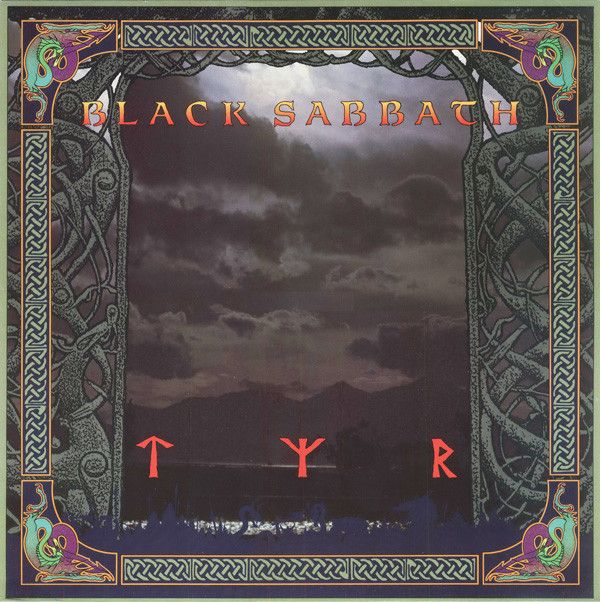
Label: IRS Records
Release date: 08/20/1990
Production: Black Sabbath
Album length: 39.58 min
Genre: Heavy Metal
Rating: 9 / 10
Tyr was the god of war and battle in Norse mythology. He was depicted with one hand, having lost the other in a fight with the demon wolf Fenrisulfr. The comparison between that Norse god and the Black Sabbath of the time was a pretty fitting one: apart from guitar guru and band boss Tony Iommi, every original limb had been amputated, yet the band was still fighting tooth and nail to survive.
By the time “Tyr” came out (which, by the way, is not a concept album despite popular belief, even though the lyrics and song titles draw on Norse mythology, since singer Tony Martin had always been a history buff), Black Sabbath were slowly getting back on their feet, even if they were still deep in the commercial doghouse. Once Tony Martin joined, there was no avoiding the fact that a run of three quality albums followed, each one better than the last.
Compared to its predecessor “Headless Cross” (1989, RockLine review), which wallowed in the occult and assorted devilish hocus-pocus, i.e. traditional Sabbath subject matter, this album is closer in its lyrical themes to what usually gets epic power metal bands fired up. In terms of song structure and overall mood, the record is closer to epic hard rock than doom metal, which means it carried on the stylistic tradition Black Sabbath had laid down in the early eighties. The late Ronnie James Dio would surely have been proud of lyrics inspired by Norse myths. Of all the Tony Martin-era Black Sabbath albums, “Tyr” is the one most closely related to the period with the legendary Dio. Geoff Nicholls’ keyboards are more dominant than on any other Black Sabbath album, which is one of the main reasons for the epic, ethereal atmosphere that rules most of the songs.
The opener “Anno Mundi” immediately sweeps us off into an ancient world of mysticism, mighty warriors and runes. The ethereal intro, with choral harmonies in Latin, gets cut through by Iommi’s guitar riff and opens the door for Tony Martin’s phenomenal vocals, whose similarity to Dio was one of the main reasons Black Sabbath slowly started winning back their lost relevance. The epic atmosphere is backed up by the breathtaking drumming of the legendary Cozy Powell, who is a touch less dominant than usual this time thanks to the changed production, but no less stunning for it. “The Law Maker” sounds a lot like something pulled out of the hidden treasure chest of Dio-era Rainbow, except that thanks to Iommi’s unique guitar approach it has a noticeably darker shade.
With “Jerusalem,” the band makes a brief historical leap toward the Crusades, and the result is epic grandeur with a mighty chorus and a heap of thrilling harmonies. The high value of this excellent song wasn’t forgotten, and in a slightly different form it later turned up on Martin’s solo debut “Back Where I Belong” (1992). “The Sabbath Stones” is another classic, a hybrid of epic metal and gloomy hard rock, of a heart-rending power ballad and a killer charge straight through the gates of hell. Martin’s vocals reach dizzying heights here, while Iommi proves once again that besides a sackful of crushing guitar phrases, he also carried a handful of subtlety in his pockets whenever he felt like it. And the spectacular power metal ending sends shivers down your spine.
That’s followed by a trilogy of songs inspired by Norse mythology, which many would easily assume are conceptually linked. “The Battle of Tyr” is a dramatic instrumental requiem directed by Nicholls, flowing straight into the acoustic ballad “Odin’s Court,” after which the mood hits its dramatic peak with the epic classic “Valhalla,” one of the heaviest things Sabbath ever put out. Powell’s drum fills fully blossom here, while Martin’s vocals reach almost mythological proportions. This is one of those songs that can still be a major source of inspiration for up-and-coming power and prog metal bands today.
The power ballad “Feels Good To Me” was made at the label’s request, as they wanted a radio hit at all costs, and it’s more than obvious, since it fits the album in neither style nor mood. Its “Californian” vibe is more reminiscent of “1987”-era Whitesnake than of Martin-era Black Sabbath, but that doesn’t mean it’s a half-baked effort. The magical subtlety and great chemistry within the band come into full play here once again, and the song’s outro is done in very good taste, even with a slight whiff of Dio-era Rainbow.
The closing “Heaven In Black” is a hard rocker in the truest sense of the word, with a classic Iommi guitar phrase and thrilling soloing. Compared to most of the other songs on the album it’s built on fairly simple principles, but its quality lies precisely in its simplicity and directness, while still keeping the sinister atmosphere going.
“Tyr” is a completely unique album within the magnificent Black Sabbath catalog. The forefathers of heavy metal never again recreated this mix of ethereal mysticism from the Nordic horizons and dark visions from the heart of hell, which reaches truly enviable proportions on one of their heaviest and most epic records to date. On this far-too-long-overlooked masterpiece, Black Sabbath finally morphed into a modern metal band that still stayed true to its sinister roots.
It’s a real shame that the pressure to reunite with Dio was too great, and Iommi was forced to end the collaboration with Martin, Neil Murray and Powell (the latter because of an injury). He later admitted he regretted it and that it was probably a mistake, since this incarnation of Black Sabbath had only just found the right chemistry. The greatest irony of it all is that the Martin-era Sabbath sounded much more like the famous 1980-81 incarnation than any version of the band on the two subsequent studio experiments with Dio.
The next outing by this lineup, in 1995, sadly didn’t end so successfully. “Tyr,” like the rest of the Tony Martin catalog (with the exception of the rather botched “Forbidden” (1995)), still awaits the recognition it deserves, thanks to an army of Ozzy-era Sabbath maniacs, but true music connoisseurs know how to recognize quality and reward long-overlooked gems too.
author: Peter Podbrežnik
Track list:
1. Anno Mundi (The Vision)
2. The Law Maker
3. Jerusalem
4. The Sabbath Stones
5. The Battle of Tyr (instrumental)
6. Odin’s Court
7. Valhalla
8. Feels Good to Me
9. Heaven in Black
Lineup:
Tony Martin – vocals
Tony Iommi – guitar
Neil Murray – bass
Cozy Powell – drums
Geoff Nicholls – keyboards