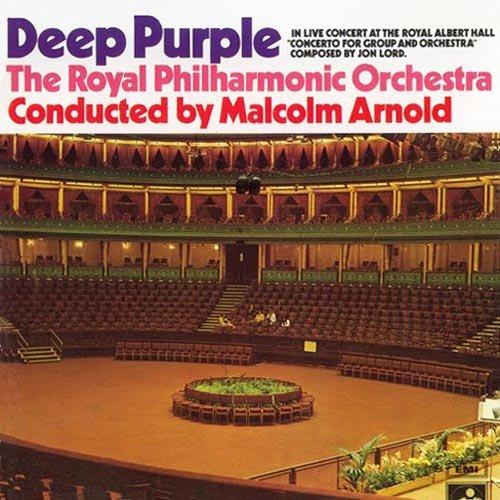
Label: Harvest Records
Release date: 20.. 12. 1969
Production: Deep Purple
Album length: 59.26 min
Genre: Heavy Rock / Hard Rock
Rating: 9.0/10
“Concerto for Group and Orchestra” was an ambitious orchestral project that built a bridge between rock and classical music, composed and arranged by the legendary Deep Purple keyboardist Jon Lord (1941-2012). It was also the first Deep Purple album recorded by the classic lineup, the Mark II, the one most beloved by fans of the legendary band.
Towards the end of 1969, the British heavy rock champions stood at a major turning point. Wanting a radical change of style, they showed singer Rod Evans and bassist Nick Simper the door, since the two didn’t share their vision of a much harder sound going forward. Lord, the unpredictable guitar virtuoso Ritchie Blackmore and drumming grandmaster Ian Paice brought in two former Episode Six members to replace them, singer Ian Gillan and bassist Roger Glover, who fit the new heavy rock sound perfectly. The first track recorded by the Mark II lineup was the single “Hallelujah” (originally written by Greenaway and Cook), whose release went practically unnoticed on British soil. Still, brighter days soon lay ahead for the ambitious band, with Gillan and Glover brimming with drive and hungry to prove themselves.
Well, even before they got down to recording the fourth Deep Purple studio album, Lord decided to record an orchestral project together with the Royal Philharmonic Orchestra under the baton of conductor Malcolm Arnold. The full program consisted of Arnold’s “Symphony No. 6, Op. 95” (which didn’t make it onto this recording), Lord’s three main orchestral movements titled “Concerto for Group and Orchestra”, a new version of “Wring That Neck”, the instrumental from “The Book of Taliesyn” (1968), the popular classic “Hush” with Gillan on vocals, and an extended version of “Child In Time”, the classic from “Deep Purple in Rock” (1970). Lord’s magnificent three-part suite, “Concerto for Group and Orchestra”, draws on elements of the classical forms of the concerto grosso, the sinfonia concertante and the orchestral concerto.
“Hush” with Gillan on lead vocals was pretty much the perfect showcase for the technically far superior new singer, and it’s an upgrade over the original version: you can already hear a slightly rawer tone from Blackmore’s guitar, while the vocal harmonies are convincingly better than on the original. Lord’s mouthwatering organ solo is also played with noticeably more authority this time. “Wring That Neck”, already an excellent instrumental in its basic form, comes off even better in the extended version thanks to plenty of fiery jams. Somewhere in the middle a proper soloing duel breaks out between Blackmore and Lord, and it ends with no winner. In one of his very first live tryouts, Glover proves he’s a much more gifted and distinctive bassist than his predecessor Simper, while Paice flattens everything in his path on drums, and between the wild marches he stops on a dime at just the right moments. Lord dominates with authority, laying down generous layers of shimmering Hammond organ.
There’s no doubt that “Concerto” was entirely his project, and the rest of the band, with the exception of Blackmore, saw him as the leader of the group back then, even though this eternal English gentleman, who was most often the band’s go-to guy for dealing with the media, kept fending off the flattering title. You could say this version of “Wring That Neck” gives a nice glimpse of the later long Purple live jams, when a track of about five minutes on average got stretched out to more than twenty minutes, or even half an hour.
The immortal classic “Child In Time”, even in a somewhat stretched-out version, gives a vivid look at the newly born, much heavier yet no less experimental Mark II style, which they cemented with the legendary album “Deep Purple In Rock”. Above all, though, it’s a stunning document of Gillan’s immense vocal talent, with which he completely overshadowed his predecessor. Technically, Gillan was an incredible singer with a fantastic vocal range, and his reach for radically high notes on “Child In Time” is so emotionally intense that it still stuns today, so it’s no surprise that in this respect he was also a major inspiration to a whole legion of heavy metal singers, led by Rob Halford (Judas Priest).
Gillan’s heart-wrenching wail, which slices through the air, is soon built upon with instrumental jams, where Blackmore impresses first with a supersonic guitar solo of the kind only one of the greatest guitarists of all time can conjure up. In fact, when you talk about the best rock musicians, the Deep Purple Mark II lineup can easily be called a rock supergroup in terms of the talent of its individual members, with the difference that none of the band’s members had tasted commercial success before. This interpretation of “Child In Time” is even better than the “Deep Purple In Rock” version in certain stretches. And Gillan’s hyperactive closing, emotionally unbelievably honest, cutting from a heart wounded by unhappy love as he hits dizzyingly high vocal frequencies, simply can’t be put into words.
The second half of the concert was entirely classical in color. Lord’s concert suite “Concerto for Group and Orchestra”, running just under an hour, is of course the centerpiece of the whole recording and a successful demonstration of his boundless talent as a composer and arranger, which this classically trained keyboardist had been honing practically since childhood. “First Movement: Moderato-Allegro” has gripping, ultra-dramatic orchestral arrangements that create an incredibly intense atmosphere within the first few minutes. Eventually some boisterously festive moments crash in, and around the seventh minute the band’s instrumental section dives in too, pulling off an unforgettable jam with soloing that borders on the impossible. Pompous orchestral themes keep flowing throughout, and more than once it feels like the band and the orchestra are fighting for dominance over the central theme.
On “Second Movement: Andante”, the band, riding on Gillan’s vocals, blends with the orchestra far more actively into perfect symphonic cohesion. Gillan’s lyrics are full of somewhat clichéd romanticism, while the fluidity between the orchestra and the instrumental talents of the individual Deep Purple members, especially in the solo flights, stays at an enviable level throughout and serves as a prime demonstration of the successful merging of an innovative concept: fusing rock and symphonic music. The closing part of the suite, “Third Movement: Vivace – Presto”, features powerful passages from the dominant woodwind section and a coherent shifting of the overall mood between drama, gloom and playful exuberance. The band eventually joins in, first via the rhythm section, which peaks with Paice’s monumental drum solo. Meanwhile, Lord and Blackmore, with melancholic solo turns on organ and guitar respectively, repeatedly take the lead instrumentally. Here the band and the orchestra finally merge into perfect sonic cohesion and conjure up majestic ambient magic ‘with one voice’.
“Concerto for Group and Orchestra” was an incredibly ambitious project for its time, the late sixties, and it deserves a special place in rock history, because it brought two completely different musical worlds together with real conviction. The brilliant Lord was without a doubt ahead of his time in his orchestral rock visions, and you could say that this project, which he revived exactly thirty years later with the help of friends on a new, monumental scale, became his life’s work. Gillan and Blackmore didn’t share his enthusiasm, since it bothered them that the public of the day had started treating Deep Purple as an orchestral band, while they themselves wanted to sail into heavy rock waters as soon as possible.
Rock albums featuring members of a symphony orchestra had been recorded before, but this was the first time a rock band performed live with a full orchestra. The Nice created a similar project to Deep Purple’s in 1970 with their “Five Bridges” suite, while popular acts like Roger Waters and Metallica later made this kind of collaboration between a rock band and a classical orchestra a widespread trend, and today the practice is long past being innovative.
Author: Peter Podbrežnik
Tracklist:
CD 1 (band only):
1. Intro (radio clips) (3:27)
2. Hush (4:40)
3. Wring That Neck (13:23)
4. Child In Time (12:02)
CD 2: Concerto:
1. First Movement: Moderato – Allegro (19:21)
2. Second Movement: Andante (19:11)
3. Third Movement: Vivace – Presto (13:08)
4. Encore: Third Movement: Vivace – Presto (part) (5:52
Lineup:
Ian Gillan – vocals
Jon Lord – keyboards
Ritchie Blackmore – guitar
Roger Glover – bass guitar
Ian Paice – drums
The Royal Philharmonic Orchestra conducted by Malcolm Arnold