Label: Harvest
Production: Deep Purple
Release date: June 5, 1970
Runtime: 43.30 min
Genre: Hard Rock / Heavy Metal
Rating: 10/10
“Deep Purple in Rock” (usually just called “In Rock”) was the fourth studio album by the legendary British heavy rock titans Deep Purple, and the first recorded by the so-called Mark II lineup, the most beloved in the band’s history. The arrival of two new members, singer Ian Gillan and bassist Roger Glover (both formerly of psychedelic rockers Episode Six), went hand in hand with a radical change of style. On “In Rock” the revamped band sailed boldly into heavy rock waters they’d flirted with before but never quite had the guts to dive into, facing the choppy waves of a genre that was still brand new. From this legendary album, which has been a must-have in every household for decades, their charge to the top and their claim to the title of loudest band in the world was just a formality.
Gillan’s technically superior vocal approach, compared to his predecessor Rod Evans, and his rare ability to hit extremely high notes through his trademark ‘wail’ blended perfectly into a much punchier, rawer sound. Even though some of the prog rock elements were dropped, there was no shortage of wild experimental adventures, especially in the long instrumental jams, which were the very picture of each player’s boundless virtuosity. Glover brought a melodic yet technically superbly polished approach to laying down complex bass lines. Teamed up with Ian Paice’s devastating and unpredictable drum escapades, that gave the band a much rawer and more massive rhythmic foundation than before.
The main say in the swerve into heavy rock waters belonged to the legendary keyboard wizard and unofficial commander of the band Jon Lord and the brilliant guitar innovator Ritchie Blackmore, who burned hotter than anyone in the band with the desire to see the new, much noisier and more macho version of Deep Purple finally conquer the world. With this album Ritchie’s wish started coming true. After two years of scraping by on home turf in Britain and a success on the other side of the Atlantic that melted away far too quickly, it finally delivered the breakthrough they were after and established them as a heavy rock superpower, one that stood shoulder to shoulder with commercially successful ‘heavyweights’ like Black Sabbath and Led Zeppelin as a pioneer of heavy metal.
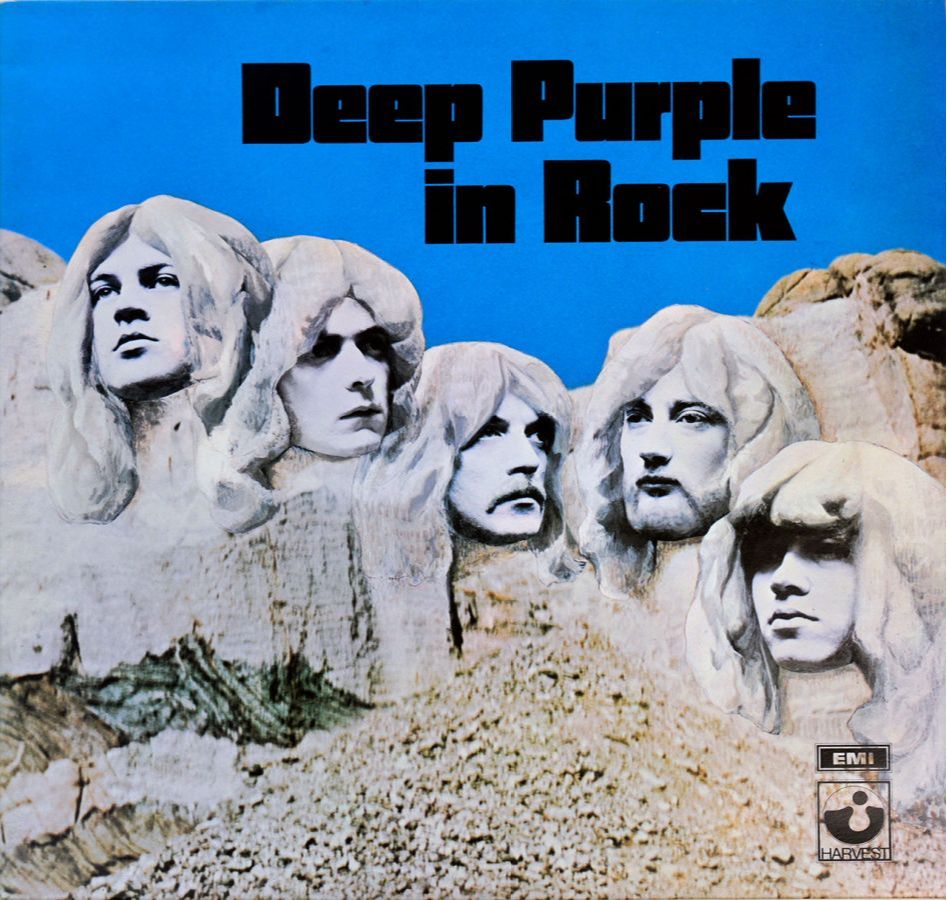
After the release of “In Rock”, the spoiled British audience finally embraced them with open arms. The brilliant single “Black Night” had already brought the Mark II lineup their first big hit before this studio masterpiece even came out, and only shortly after their first single, “Hallelujah”, had completely bombed commercially. Besides the superb music, the brilliant cover, one of the best in the history of heavy rock, did a lot for the promotion of “In Rock”. It showed the band members as stone faces on the famous American Mount Rushmore, where they replaced the stuffy depictions of the most revered American presidents.
Deep Purple started recording the “In Rock” material not long after the live gem “Concerto for Group and Orchestra” (1969), and already during the first jams and the writing of the new material they realized something big was brewing. They weren’t wrong, not even a little. “In Rock” holds a good number of the most beloved Deep Purple classics, starting with the opening wrecking ball “Speed King”, created as a musical and lyrical tribute to the legends of rock’n’roll, which staked out plenty of heavy rock standards. Contrary to the popular belief that it’s a song singing an ‘ode to joy’ to drugs, the lyrics touch on the often grueling life of singers in rock’n’roll bands and draw inspiration from the life stories of genre legends like Elvis Presley, Little Richard, Chuck Berry and so on. All of those singers/musicians were among Gillan’s key vocal inspirations.
While the Americans, in their ‘infinite wisdom’, chopped off the brilliant opening jam between Lord and Blackmore on the transatlantic version of “In Rock”, it stayed untouched on the British and most other versions. It serves as an unexpectedly experimental and vivid intro to this supersonic classic, which bursts at the seams with untamed power and unstoppable verve. The explosive instrumental intro to “Speed King” is a wrecking-ball fusion of Blackmore’s distorted electric guitar and Lord’s church-like organ. That’s followed by a switch to a faster tempo, backed by a full-fat guitar riff, where Gillan’s macho singing commands over relentless drum marches and untamed organ runs, and peaks in a mighty chorus. The intense atmosphere gives you the constant feeling that the charismatic singer, backed by the thunderous support of his bandmates’ supersonic virtuoso tricks, is about to take off into the sky at supersonic speed.
“Bloodsucker” is a spirited hard rocker with plenty of trading off of the lead between Blackmore’s roaring guitar phrases and Lord’s witty organ flourishes, while Gillan strikes a great balance with his relentless, screeching vocal outbursts. Like many standards by this legendary band, this classic tells of romantic ups and downs. In 1998 the Mark VII version of Deep Purple, with Steve Morse on guitar, played it again on the album “Abandon” under the changed title “Bludsucker”.
The immortal, more than 10-minute pacifist epic “Child In Time” is the most accomplished classic on the whole of “In Rock” and, thanks to its melodramatic mood, also the most intense in terms of atmosphere. Here Gillan peaks in his heart-wrenching telling of an unhappy love story, hitting dizzyingly high notes that still floor people today. After Gillan’s piercing wail, the melancholic opening section soon morphs into a bombastic rocker with fiery solo escapades between Blackmore and Lord. For the organ chords between the two melancholy-calm sections, Lord drew inspiration from the classic “Bombay Calling” by the American psychedelic band It’s a Beautiful Day. In the closing part the opening section returns, with Lord’s organ artistry and Gillan’s sky-splitting, glass-shattering vocal wails, which, along with the unusually heartfelt delivery of the pacifist lyrics, still hit you from head to toe today.
“Flight Of The Rat” is another energetic hard rocker, this time a bit longer, nailed down on three main guitar chords while the relatively simple structure is stretched out by Ritchie’s and Jon’s solo flights, which this time are clearly separated. The inventive guitar phrases of the man in black on this somewhat overlooked Purple classic are still a real treat today, while maestro Lord is once again unstoppable with his rustling organ epics. Gillan impresses again with the thunderous power of his incredibly elastic vocal cords, while the drum stampede and resolute bass lines add to an atmosphere that’s red-hot all the way through, one in which it’s not hard to picture one flying rat or another. The socially conscious wrecker “Into The Fire”, whose lyrics warn about hidden drug abuse in city clubs, became a classic on release and a fixture of Mark II live shows. Gillan’s furious singing is backed by a blazing guitar riff and resolute organ textures, which, with the help of grooving bass lines and wrecking-ball drum fills, create a scorching atmosphere.
“Living Wreck”, which features an iconoclastic guitar phrase and playful passages on the Hammond while Gillan once again shines with a heart-wrenching vocal performance, is a painful confession from a man who feels like a zombie after a big romantic disappointment. Lyrics like this, about broken hearts, became a staple for Deep Purple, who usually steered clear of social criticism aimed at politics and organized religion. The punchy atmosphere peaks in an unusually serene chorus. At the end, Lord sends the whole thing to hell with a supersonic organ solo.
The closing heavy rock classic “Hard Lovin’ Man” is yet another gripping demonstration of each player’s virtuoso skills. It opens with a punchy intro ruled by a galloping rhythm and a thunderous combo of guitar chords backed by hellish organ escapades. Glover’s snarling bass lines are further enriched by Paice’s unstoppable drum stampede. Gillan, with his deeply felt swings between low and high notes, once again shows off his phenomenal vocal range. And Ritchie’s and Jon’s solo gems in the instrumental section are once again on the edge of reality, and vividly show how brilliantly these two rock giants complemented each other in the ‘golden’ Deep Purple days.
The CD reissue released for the album’s 25th anniversary comes loaded with goodies, led by rare versions of “In Rock” standards, interesting studio jams never heard before, and the original single version of the unforgettable evergreen “Black Night”, which finally brought them worldwide fame. This legendary hit, which to this day remains the highest-charting Deep Purple single in the UK, boasts a distinctly melodic structure, a beefy guitar riff and a catchy chorus. It was exactly that combination and its seeming ‘holy simplicity’, complete with Blackmore’s furious guitar outbursts and Lord’s playful organ flights, that made up the winning recipe for the big hit.
“Deep Purple in Rock” is a timeless heavy rock masterpiece and, without a doubt, the most important studio achievement in the whole Deep Purple story. It’s also one of the most important rock albums of all time. With it, Mark II began their victorious march up the hard rock Olympus and earned a reputation as heavy metal pioneers, even though the band members spent years dodging that kind of label. Genre pigeonholing drove them up the wall, since they were forever probing the limits of their sound and working in all sorts of influences.
Author: Peter Podbrežnik
Tracklist:
1. Speed King (4:18)
2. Bloodsucker (4:12)
3. Child in Time (10:15)
4. Flight of the Rat (7:52)
5. Into the Fire (3:29)
6. Living Wreck (4:30)
7. Hard Lovin’ Man (7:10)
Lineup:
Ian Gillan – vocals
Ritchie Blackmore – guitar
Roger Glover – bass guitar
Jon Lord – keyboards, organ
Ian Paice – drums, percussion