Label: Harvest Records
Release date: June 21, 1969
Production: Derek Lawrence
Album length: 44.34 min
Genre: Hard Rock / Heavy Rock
Rating: 8.0/10
“Deep Purple” was the not-so-cleverly titled third studio outing from the British heavy rock giants Deep Purple, and the last album by their original lineup, which fans of this legendary band also call Mark I. In their first year, thanks to their first two studio albums and the hit singles “Hush” and “Kentucky Woman,” Deep Purple had carved out a dazzling name for themselves on American soil, while back home in Britain they were still almost totally unknown outcasts. Keyboard legend Jon Lord even claimed in one interview that they were the only schizophrenic British band, since they were far more popular in the US than in their homeland, where they played every gig for pocket change and took a big financial hit compared to their shows in front of American crowds. The demanding and also spoiled home crowd simply wasn’t impressed by the two hit singles (both were covers of other artists), and in the middle of the progressive rock explosion wanted something way more exciting, adventurous and fresh.
Determined that something had to change radically in their songwriting and arranging, Deep Purple decided to steer their third album toward a heavier sound. That was championed hardest by the wily guitarist Ritchie Blackmore, with firm backing from Lord and drummer Ian Paice. On the other side were velvet-voiced singer Rod Evans and bassist Nick Simper, who didn’t fancy the new direction and in fact weren’t even ready for it, which you can feel on most of the tracks on “Deep Purple,” so their days in the band were numbered.
Despite the heavier sound, the much darker overall mood and the fact that Blackmore went all out on the electric guitar, “Deep Purple” still sounds more progressive rock than hard rock on the whole, judging by the individual tracks, mostly thanks to Lord’s epic Hammond organ workouts and sprawling classical arrangements. Paice was stunning behind the kit as usual, while Simper made noticeable progress as a bass player within a single year. Covers have all but vanished, with the exception of the adaptation of Donovan’s psychedelic folk rock standard “Lalena,” while the individual arrangements got even more complex thanks to far deeper songwriting inspiration than on the previous two studio albums.
The sharper, darker sound is already well illustrated by the opener “Chasing Shadows,” which sets the standard for later experimental-tinged Deep Purple openers. On this experimental cut you can hear Paice’s shamanic-flavored drumming in the background, while Evans, with his velvety vocal approach, provides a hefty dose of melody. This time Simper’s grooving bass line is clearly audible too, and after some initial reserve Blackmore comes alive with a lusty guitar solo. At the end Lord juicily runs wild on the Hammonds as well.
“Blind” is another experimental-leaning piece that, thanks to its sacred-sounding organ passages and rough guitar phrases, sounds gloomier than anything they’d done on the previous two albums, while Evans’s vocals, in the middle of a convincing delivery of lyrics about unhappy love, are full of inconsolable melancholy. This time Ritchie also reaches for the wah-wah effect during his solo, backed by somber-sounding bass lines. The instrumental ending is a little reminiscent of the soundtrack to a black-and-white horror flick. “Lalena,” which is a psychedelic folk rock ballad in Donovan’s original, boasts a melancholic mood and a superb vocal performance from Evans, one of the best of his short but interesting singing career. The heart-wrenching vocal is accompanied by inconsolable organ arrangements and nostalgic acoustic guitar chords, which together create a truly magical ambience.
The suite “Fault Line/The Painter” was split into two parts on the reissued CD version, which luckily doesn’t hurt the intensity of its mighty, turbulent atmosphere. “Fault Line” is a progressive rock instrumental opening section, you could call it an intro, where Blackmore lets off some steam with a short guitar solo, while “The Painter” is a great, well-rounded song whose highlights are Ritchie’s devilish guitar riffing and yet another gourmet solo that guitar connoisseurs will still be licking their fingers over today. Throughout the whole album you can tell the man in black started taking a much bigger slice of the sonic collage than on the previous two studio albums, where he often left the main instrumental initiative to Lord’s Hammonds. But of course the legendary keyboardist also treats himself to a hefty solo organ escapade, which deepens the experimental nature of this splendid record even more.
“Why Didn’t Rosemary?” is the first of two “Deep Purple” standards that earned classic status, mostly because the whole thing already leans toward their classic hard rock style. The melodic central structure rests on Blackmore’s spirited, blues-spiced guitar riff, while Evans delivers a cocky vocal performance and Lord eagerly lays down rustling organ textures. The man in black wows once again with a bluesy guitar solo that makes ‘heaven and earth open up,’ while Paice impresses with wild drum fills. The black-humored lyrics, inspired by watching the film Rosemary’s Baby, tell of an unwanted pregnancy as the result of refusing the contraceptive pill.
The excellent psychedelic-hard rock hybrid “Bird Has Flown,” where you can already imagine Evans’s successor Ian Gillan on lead vocals, is another Purple evergreen, with a raw guitar riff, a grooving bass line and hearty organ seasoning. It’s all backed by sprawling, massive drum transitions. Evans’s vocal delivery is as grim and raw here as his soft, velvety voice would allow. It was precisely this kind of vocal limitation that led to his departure.
The closing, super-complex 12-minute progressive rock suite “April,” where maestro Lord reigns supreme with the help of lavish orchestral arrangements, is the longest and maybe even the most ambitious studio piece in the whole (to date) Deep Purple story. The first two sections are instrumental, while the third is a heavy rock song in the spirit of most of the earlier material on the album. Ritchie finds himself in a realm of pastoral-flavored acoustic guitar chords, while on electric guitar he weaves a monumental solo. Lord’s organ orgy is pure nirvana on Earth, and the sprawling orchestral arrangements give a vision of his upcoming classical-flavored project, “Concerto for Group and Orchestra” (1969). The closing vocal section fades a bit next to the preceding orchestral orgy, although Lord’s and Blackmore’s solo acrobatics over untamed drum transitions, helped along by mighty harmonies, deliver a triumphant and epic ending.
The reissue of “Deep Purple” includes the American single “Emmaretta,” which has almost nothing to do stylistically with the rest of the album, as it’s a distinctly commercial-minded piece with a Beatles-style pulse that failed to win American hearts. This last attempt of theirs to conquer the American scene, which was rapidly losing interest in a band it had until then associated with light, entertaining hits as Deep Purple’s sound shifted toward heavy rock, deserves an honorable mention mostly for its lovely chorus, funky grooving bass line and inventive guitar riff.
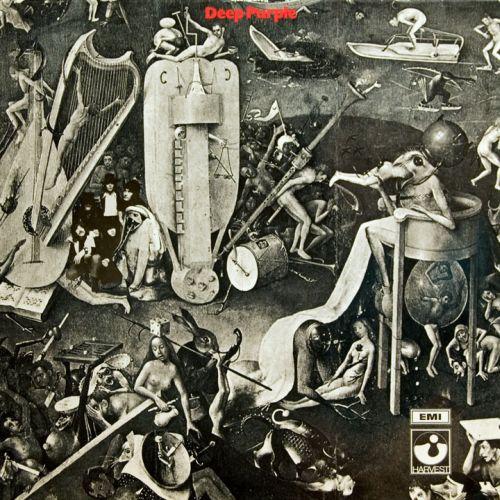
“Deep Purple” was, without a shadow of a doubt, the best record of the Mark I Deep Purple lineup. The legendary band hit its artistic peak here, with one foot already stepping toward the big stylistic shift that came right after Evans and Simper left. The two of them simply didn’t buy into the heavy rock vision of the future that Blackmore, Lord and Paice threw everything into in the following months, after new singer Ian Gillan and bassist Roger Glover (both formerly of the psychedelic band Episode Six) joined. “Deep Purple,” which is at least as far above its predecessor “The Book of Taliesyn” as that one was above “Shades of Deep Purple,” still flopped commercially on American soil too, thanks to catastrophically bad promotion from the label of the time. The proverbially dim and (supposedly) God-fearing Americans were even scared off by the rather feeble cover featuring Hieronymus Bosch’s painting The Garden of Earthly Delights, which they vehemently branded scandalous.
Author: Peter Podbrežnik
Track list:
1. Chasing Shadows (5:34)
2. Blind (5:26)
3. Lalena (5:05)
4. Fault Line (1:46)
5. The Painter (3:51)
6. Why Didn’t Rosemary? (5:04)
7. The Bird Has Flown (5:36)
8. April (12:10)
Line-up:
Rod Evans- vocals
Ritchie Blackmore – guitar
Jon Lord – organ, keyboards, backing vocals
Nick Simper – bass guitar, backing vocals
Ian Paice – drums