Label: EMI Records
Release date: November 16, 1974
Production: Deep Purple & Martin Birch
Album length: 36.31 min
Genre: Hard Rock / Heavy Rock
Rating: 10/10
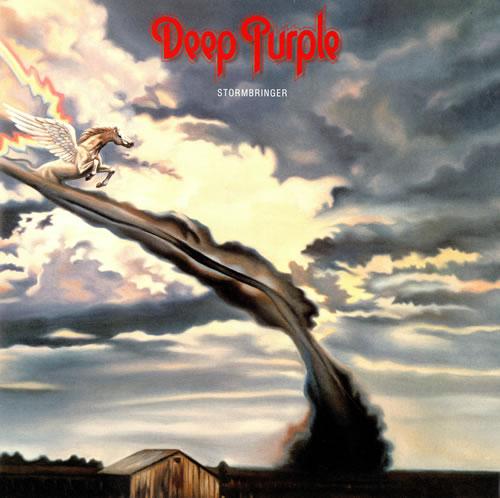
“Stormbringer” was the ninth studio effort from British heavy rock legends Deep Purple, and the second and last album by the Mark III lineup, which featured two superb vocalists in David Coverdale and Glenn Hughes. According to Coverdale, the title of the album and its classic opening title track was inspired by a mythological creature, which the great cover art represents with Pegasus, the winged horse of ancient Greek mythology. It was only after the record came out that David found out it’s also the name of the mystical black sword wielded by Elric, the hero of the fantasy novels by legendary British science fiction and fantasy author Michael Moorcock, who also helped write lyrics for legendary bands like Hawkwind and Blue Öyster Cult.
The album was originally supposed to be called “Silence” and come with a pretty goofy cover featuring a glamorous diva, but luckily the majority of the band’s members, with their fondness for romance and mysticism, won out in the end. The excellent sleeve and the best band logo in their history played an important role in marketing the funk-tinged “Stormbringer”, which, despite its first-rate music, sadly remains one of the most overlooked Deep Purple records in many ways, even though it holds some of the most beautiful evergreen gems of this cult heavy rock band’s entire career.
The legendary quintet headed to Munich to record, and when shaping the sound of the new studio project they decided to build on the capital of their brilliant predecessor “Burn” (1974), with one important difference: besides keeping their traditional heavy rock punch, on “Stormbringer” they gave much freer rein to funk elements. That suited every member of the band except the brilliant but moody guitar wizard Ritchie Blackmore, who was growing more and more unhappy with the new sonic direction and had quietly already hatched a plan for leaving the band that had made him world famous.
Blackmore, a huge blues fan who was by then getting increasingly excited about classical, especially baroque-flavored arrangements and traditional folk music (which he would start putting into practice on his future projects), was getting fed up that funk, mostly thanks to Hughes but also Coverdale, had started to dominate the sound and push aside his vision of Deep Purple, in which he didn’t leave much room for democratic decision-making. While the album was being made, he tried to force a cover of the prog rock band Quatermass classic “Black Sheep Of The Family” on the rest of the band, but in the end he had to save it for the debut of his future project Rainbow. Considering that the man in black already had his mind on Rainbow, which he founded together with legendary singer Ronnie James Dio (1942-2010), it’s a real miracle that “Stormbringer” came out so well and featured some wonderfully innovative ideas that let the individual strengths of every band member shine.
The opening title track, a hard-rocking wrecking ball, can be seen as a kind of stylistic sequel to the classic “Burn”, since the two share a fairly similar structure and main riff. The difference is that, thanks to the colorful synthesizer intro courtesy of legendary keyboard virtuoso Jon Lord (1941-2012), “Stormbringer” is a somewhat more refined affair with a completely different kind of main chorus. Coverdale’s mighty vocals, telling the tale of the mythological storm-bringer’s apocalyptically spicy arrival, ride on the wings of a crushing guitar phrase and Ian Paice’s massive drum fills. Hughes’ somewhat shy vocal bits add a touch of soul charm, while Blackmore’s melancholic guitar improvisations, backed by a fiery drum cataclysm, heat the temperamental atmosphere right up to boiling point.
The fun blues-funk rock hybrid “Love Don’t Mean a Thing” is a great chance for Coverdale’s vocal approach, marked by smoky eroticism, to take flight, since the legendary singer has always been enormously well suited to any song with the word “love” in it. His heart-wrenching vocal performance, in which the femme fatale is, as usual, not only supposed to be pretty this time but rich too, is enhanced by Hughes’ puffed-up soul mannerisms, which create an excellent contrast between the two vocal styles. Ritchie’s bluesy guitar phrases over sleepy rhythmic nuances give the song a fairly simple structure, but also an incredibly intense atmosphere that instantly brings to mind the desert plains of the American Midwest.
On “Holy Man”, another interesting funk experiment, inspired by an encounter with American religious preachers, the lead vocal scepter goes to a Hughes in great form, who pulls off an unforgettable emotional performance. The melancholic harmonies between the guitar passages and the sprawling keyboards are pure nirvana and build a distinctly nostalgic mood that peaks in a mighty chorus. The evergreen “Hold On”, dominated by mighty vocal harmonies and a harmonious exchange between the two lead singers, is one of the most vivid “Stormbringer” standards. This funk-blues hybrid, spiced with cheeky eroticism, stands out for its complex rhythmic nuances and a striking chorus in which romantic harmonies bloom. Coverdale and Hughes once again compete over who can pour more of their constantly warring emotions into the sexually charged cooing under their chosen femme fatale’s window, while Blackmore, with a mouthwatering guitar solo, briefly steals the starring role and, helped by Lord’s subtle piano passages, makes the whole mischievously salty vibe even bigger.
The next classic, “Lady Double Dealer”, is a potent hard rocker for a change, built on a crushing guitar phrase, combative drums and Coverdale’s ruffled vocals, which peak in a simple but mighty chorus. With the help of vivid vocal harmonies, Hughes can’t help but bring a bit of funky sophistication into the direct, punchy atmosphere of Coverdale’s angry confession about a treacherous woman. “You Can’t Do It Right” is a pure funk triumph with a slight bluesy aftertaste, where powerful bass lines and perfectly timed drum rolls set the tempo, while an innovative guitar riff and a subtle layer of keyboards tie it all together. While Coverdale’s vocals are once again the main source of classic bluesy melancholic inconsolability, Hughes’ singing brings his usual funky hedonism to the song. Lord’s synthesizer improvisations add some pepper to the fairly simple rhythmic backbone, over which superb vocal harmonies reign.
The up-tempo “High Ball Shooter”, where various stylistic currents mix again, is another genuine Purple classic and still one of the most fun Mark III achievements, with Blackmore serving up one of the most innovative and also playful guitar riffs of his entire career. This time the rhythmic nuances are a bit more complex thanks to livelier drumming and melodic bass parts, while the mighty chorus is the result of a colorful, all-out energetic vocal duel between the two vocal protagonists. Lord’s brilliant Hammond organ solo works like manna from heaven, and it’s something that was almost chronically missing through the first half of the album.
The nostalgic masterpiece “The Gypsy”, which in structure and atmosphere already sits very close to Ritchie’s early Rainbow work, is not only one of the best Mark III classics but one of the best of Deep Purple’s whole career. Blackmore’s romantic guitar riff, harmonic vocals from both lead singers and subtly timed drum fills create an unforgettable romantic mood. What really makes the whole thing lean toward Ritchie’s future band are the mystical lyrics about a mysterious gypsy woman and the weeping guitar solo, with which the man in black tells everyone who defied his dictatorial demands to go jump in a lake.
Right at the end comes the shattering blues rock ballad “Soldier of Fortune”, the simplest song on the album in structure but the best in atmosphere, and one that still never stops thrilling with its romantic-nostalgic intensity. The main “star” of this classic, soaked in indescribable melancholy and still the leading candidate for the most sincerely sung Deep Purple ballad, is Coverdale with his heart-wrenching singing. It boasts a rarely heard emotional honesty in which pain and indescribable nostalgia mix at once, as the singer realizes that, despite relentless aging, he will follow his own heart forever. Blackmore’s gentle opening chords gradually melt into a weeping guitar solo that reflects the pastoral Celtic visions he would fully realize as a member of Rainbow. Coverdale still performs this immortal ballad at concerts with his band Whitesnake and usually closes their shows with it. It was appreciated at first only by him and Ritchie, before it won over the other three members too.
“Stormbringer” blew in from a cloudy sky, came, saw and conquered, bringing Deep Purple’s Mark III lineup its last masterpiece, one with an extremely juicy stylistic seasoning. Funk dominates at its core, but all the traditional heavy rock elements that had made them world famous were still there. The mostly positive reaction from audiences to this overlooked but excellent album wasn’t enough to convince Blackmore, who, with a few compositional exceptions, was unhappy with its final sound, not to pack his bags and start his own heavy rock saga called Rainbow. After the in many ways shattering loss of one of the greatest guitarists of all time, an important songwriter and a founding member, the remaining four didn’t beat around the bush for long and started auditioning new guitarists as fast as they could. Blackmore’s spot finally went to the versatile American guitar gem Tommy Bolin (1951-1976), and another new, short-lived and very turbulent chapter began for Deep Purple, one that sadly didn’t have a happy ending.
Author: Peter Podbrežnik
Tracklist:
1. Stormbringer (4:03)
2. Love Don’t Mean A Thing (4:23)
3. Holy Man (4:28)
4. Hold On (5:05)
5. Lady Double Dealer (3:19)
6. You Can’t Do It Right (2:24)
7. High Ball Shooter (4:26)
8. The Gypsy (4:13)
9. Soldier Of Fortune (3:14)
Lineup:
David Coverdale – vocals
Glenn Hughes – vocals, bass guitar
Ritchie Blackmore – guitar
Jon Lord – organ, keyboards
Ian Paice – drums