Label: Manticore
Release date: 19.11.1973
Album length: 45.02 min
Producer: Greg Lake
Genre: Progressive Rock
Rating: 10 / 10
The brain salad surgery is the last but sweetest triumph of the most notorious trio in rock history. Opinions are still divided on whether “Brain Salad Surgery” is their alpha and omega artistic achievement (some prefer “Tarkus” or even “Trilogy”), but it’s without a doubt one of their best works and sits in the elite company of the greatest rock albums of all time, even though it still often goes misunderstood and without the respect it deserves. With it, the golden age of symphonic progressive rock hit its peak.
The album is packed with evergreen ELP classics (pretty much every track on it), and it can also be called a quasi-concept project, since its centerpiece is the nearly half-hour suite “Karn Evil 9”, the most ambitious creation in their history. Before we get into the details of this prog rock masterpiece, it’s worth saying a few words about the background that led to its birth and shaped its look.
ELP were at the height of their popularity back then and enjoyed the status of some of the most notorious rock stars around (the only ones in the entire history of progressive rock who milked that status big time and filled the gossip columns with all sorts of onstage and backstage excesses). After wrapping up the “Trilogy” tour, they first founded their own label Manticore (named after the mythological beast and one of the main characters on the album and suite “Tarkus”), then locked themselves in their studio, where musical ideas flew one after another. Never again in their history did ELP show as much creative drive as they did while making “Brain Salad Surgery”.
A big change in the lyric-writing department, which until then had been exclusively Lake’s turf and occasionally Emerson’s, came with the arrival of Peter Sinfield as an outside collaborator. Sinfield was Lake’s old buddy from the days of the original King Crimson, where he was the band’s fifth member and already had a reputation as one of the most original wielders of the poetic pen in rock. Sinfield played a small but important role on the album, contributing lyrics to the first part of the “Karn Evil 9” suite and the entire text for the burlesque “Benny The Bouncer”. Lake returned the favor by guesting on Sinfield’s solo album, which came out the same year on ELP’s own label Manticore.
As on all the previous ELP albums, which stood out among other things for their instrumental innovation, cutting-edge electronic technology (for those musical times) played a central role here too, usually exclusively Emerson’s domain. The keyboard wizard expanded his keyboard arsenal, which until then had been exclusively Hammond organ, piano and the monophonic Minimoog synthesizer, with the versatile, gargantuan Moog modular, back then a revolution in the polyphonic use of electronic keyboards, and he occasionally toyed with the accordion too. Thanks to the inventor Dr. Robert Moog, who brought new technology to market that year, Keith could now have his musical orgasms through polyphonic synthesizers as well, which made his recording and composing work easier in many ways. The other major innovation was Palmer’s electronic drums. The drumming grandmaster could now whack away at electronic drums while also playing percussion like timpani and tubular bells. Today most of these techniques have been replaced by modern MIDI recording technology, but some of the musical bits recorded with the innovations of the day sound anything but archaic on this album, even after a long test of time.
Of course, the musical content is what counts the most, and it’s what earned the album its reputation as the embodiment of perfection in symphonic progressive rock. The grand, bombastic opening is announced by “Jerusalem”, Emerson’s adaptation of the popular British church hymn, which in its original versions is usually performed as chamber music. ELP turned it into a bombastic, epic rock anthem, with Emerson holding down a majestic church-organ sound on the keys while Lake shines with an excellent vocal performance. His heartfelt delivery of the original text, penned by the legendary British polymath William Blake, lifts the album’s atmosphere to the highest level of grandeur. Interesting fact: the BBC refused to play it on the radio after it was released as a single, which proves the liberal 60s had minimal impact on organizations as conservatively ossified as the BBC.
But Emerson wouldn’t be Emerson if he didn’t take on at least one interpretation of a classical composition of his own. This time he picked a piece called “Toccata” for his crazy classicist shenanigans, originally written by the Argentine composer Alberto Ginastera. It belongs to the realm of modern classical music. In contrast to the trouble Emerson had in the early ELP years, mostly over copyright but also the disapproval of his colleagues from the classical world, Ginastera proved to be a reasonable and open-minded composer, who gladly listened to Keith’s interpretation at his home and gave it his blessing. Keith turned it into a proper proving ground for his experiments with polyphonic Moog synthesizers, while Palmer keeps him convincing company with his assaults on the electronic drums. From the very first second, a chilling atmosphere dominates, built from Emerson’s deranged keyboard improvisations, Palmer’s wild drum marches and assorted percussion. That makes it one of their more avant-garde creations.
A big stylistic contrast and change of mood comes with “Still You Turn Me On”, another of those lovely, romantic acoustic Lake folk ballads that are tailor-made for lovers of all kinds. Lake, largely thanks to his old King Crimson “friend” Robert Fripp, never became any great master of electric guitar or bass, but here he once again proves he was often highly convincing as an acoustic guitarist. His combination of pastoral acoustic guitar chords forms an exceptionally beautiful melody, which every now and then gets cut across by witty, razor-sharp wah-wah passages on Emerson’s accordion (the first time he tried anything like it). The singing is among the best of Lake’s career, which holds true for the whole album. But anyone who listens closely to the lyrics will find they’re anything but romantic, as they first seem, and are full of sarcastically tinted sexual innuendo.
That’s followed by another shorter piece, the slapstick “Benny The Bouncer”, one more silly, jokey little number in the tradition of their earlier rowdy creations like “Jeremy Bender”, “Are You Ready Eddy” and “The Sheriff”. This rowdy assault manages to conjure up the fun atmosphere of 50s saloon dance halls, where violence and cynicism rule. Emerson’s wild piano runs and Lake’s distorted singing create the feel of a full-on saloon brawl. It’s all best embodied by the grotesque lyrics, which end with somebody planting an axe in the bouncer’s head.
But all these tracks were merely a warm-up for the big finale and the core of “Brain Salad Surgery”, without which we couldn’t talk about an evergreen masterpiece. I’m talking about the already mentioned nearly 30-minute super epic “Karn Evil 9”, the most ambitious creation of their career, with which they proved they were still the epitome of innovation and the kings of grand epic suites (they only made two in their career (besides “Karn Evil 9”, the one ELP fans respect most is “Tarkus”), but both still count as their greatest achievements).
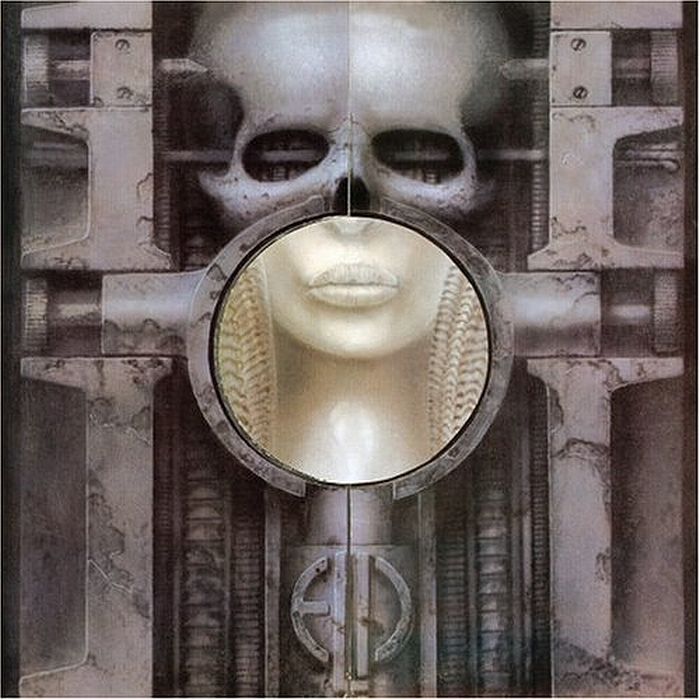
What further adds to the aura of simultaneous mystery and grandeur on “Karn Evil 9”, on top of its exceptional composition and performance, is its apocalyptic sci-fi concept, which is dramatically tied to Giger’s cover art. The story draws its inspiration mainly from classics like Huxley’s “Brave New World” and Orwell’s “1984”.
In the future, all crime has been wiped from the world forever, and with it all worldly decadence, creating a “clean” society. It’s kept in check by computers that monitor every move of human life. All forms of entertainment are banned, along with anything that could lead people to individual thinking and a rebellious spirit, and music is especially strictly forbidden. All of this is meant to turn people into the most impersonal, robotic beings possible, kindred in spirit to computers. Even so, deep underground there’s a hidden world where a few people still live freely, cooking up revolution and rebellion against the rule of the computers in the meantime. Sound familiar? Of course, you could see something very similar much later in the Matrix film trilogy or in movies like Equilibrium.
“Karn Evil 9”, whose unusual name comes from Emerson’s coinage meant to sketch out its carnival atmosphere, is split into several sections, as is the tradition with all the great epic suites. In this case, three sections: the first (along with its intro) is the initial warm-up with Lake’s vocals up front, the second is a majestic twist with longer Emerson instrumental improvisations (mostly on piano), and the third is mainly Emerson’s final orgasm on polyphonic Moog synthesizers, which create a fully cybernetic atmosphere. The best-known and most popular section is surely the opening one, which contains Lake’s famous words “Welcome back my friends to the show that never ends” (which later also became the title of their first live album). Besides Emerson’s shenanigans on his wealth of varied keyboards, whether Hammonds or Moog synthesizers, and Palmer’s assaults on the electronic drums, the spotlight falls on a majestic melody that reaches its climax with the dramatic central chorus. Over time a carnival motif and mood take shape and then dominate the whole suite.
The second section is ruled by Emerson’s breathtaking solo acrobatics, especially on piano, and Palmer’s idiosyncratic drum transitions. There’s no shortage of all sorts of witty improvisations from one of the greatest keyboardists of all time either. But the best part of the suite is its epic final stretch, a very convincing ending where a dramatic dialogue/epic battle between man and computer plays out. Lake nails this vocal dialogue and creates an incredible atmosphere as two opposing forces, the organic and the electronic-cybernetic, fight for dominance. The latter embodies evil and is deliberately distorted through Emerson’s vocoder effect, which carries an electronic sound. Both are deciding the future of humanity: whether we’ll return to nature and humanity or become slaves of machines and artificial intelligence. It’s worth remembering that when the album came out there were no personal computers yet, and back then all of this, unlike today, when computers almost completely run our everyday lives, seemed like pure science fiction.
At least as famous as the album’s music is one of the strangest covers in music history, created by the Swiss surrealist artist H.R. Giger. He later earned immortal fame mainly as the creator of the sci-fi creature the xenomorph, better known in the films of the same name as the “alien”. The cover shows a woman’s face (only the mouth is visible) trapped in a virtual-cybernetic prison shaped like a skull. Giger’s original idea caused no small amount of controversy, since he had initially painted a penis in front of the face. After stormy reactions and pressure, he later retouched the painting so that there’s a sort of light in that spot, but the outline of the penis, if you look closely, is still visible. On the other side of the sleeve, which ties in with the front cover, we can see a woman’s face freed from the artificial wall. You can see that her hair is strangely similar to the skin texture of the famous sci-fi monster. The cover concept was chosen because of the album’s original title, which was supposed to be “Whip Some Skull On Ya”, a phrase for oral sex. Well, “Brain Salad Surgery” is also one of those phrases, though a bit less obvious. The paintings are still missing today, since someone stole them during an exhibition of Giger’s work in Prague. Even Rolling Stone, which has traditionally sneered at everything that doesn’t smell like the taste of label corporations, MTV and similar muck, picked it as one of the best album covers of all time.
With “Brain Salad Surgery”, the three holy kings of progressive rock created a timeless classic of the genre and their last studio masterpiece, which, together with the double live album released the following year, sealed their artistically and commercially most successful period. “Brain Salad Srugery” remains, alongside “Tarkus”, the top contender whenever there’s a vote for their best album, and it’s also their finest monument to symphonic progressive rock, which was then peaking in popularity in Great Britain and Italy. Sadly, after the “Brain Salad Surgery” tour and the excellent live album that came out of it, ELP took a long break. As it later turned out, they never really recovered, and their golden days were inevitably over. “Brain Salad Surgery” is the crown jewel of the great trio at the peak of their artistic powers, and it belongs in the collection of every honest rock fan.
author: Peter Podbrežnik
Tracklist:
1. Jerusalem
2. Toccata
3. Still…You Turn Me On
4. Benny the Bouncer
5. Karn Evil 9
Karn Evil 9: 1st Impression, Pt. 1
Karn Evil 9: 1st Impression, Pt. 2
Karn Evil 9: 2nd Impression
Karn Evil 9: 3rd Impression
Lineup:
Keith Emerson – Hammond organ, piano, accordion, Moog synthesizer, Moog polyphonic modular, computer voice on Karn Evil 9: 3rd Impression
Greg Lake – vocals, acoustic guitar, electric guitar, bass guitar
Carl Palmer – drums, percussion, electronic drums