Label: Metal Blade Records
Release date: 6. 11. 2020
Produced by: Jim Matheos
Album length: 72.23 min
Genre: Progressive Metal
Rating: 10/10
Let me kick things off with a bit of “romance.” The new Fates Warning album is going to break the hearts of the diehards. In more ways than one. Don’t worry, though. They’re all positive, apart from the one hinting that this is apparently the last album of the band’s career.
Fates Warning are American heavy metal legends who, way back in the first half of the eighties, started playing a much faster, more aggressive and technically demanding take on what the old European continent had been doing with heavy metal, which was moving more and more into the global spotlight on the wings of the N.W.O.B.H.M. Without meaning to, Fates Warning pretty much forced the critics to slowly coin a new genre label, one that could also pigeonhole the singular artistry of this band. It was progressive metal, many years before Dream Theater.
Fates Warning have outlived every era of metal, seen all the big rises, survived the entire metal universe. In a career that has now entered its 37th year. The one constant across every incarnation of the band to this day is guitarist Jim Matheos. The quiet chieftain, the driving force behind everything that pushes the band forward. Fates Warning are known as a band that, in their whole career, has never served up a bad record to their fans.
“Long Day Good Night” is the thirteenth studio album from this extremely well-respected band, which can boast a fiercely loyal crew of rabid fans. So not a battalion, exactly, but the people who do listen are devoted worshippers of the band and everything it stands for.
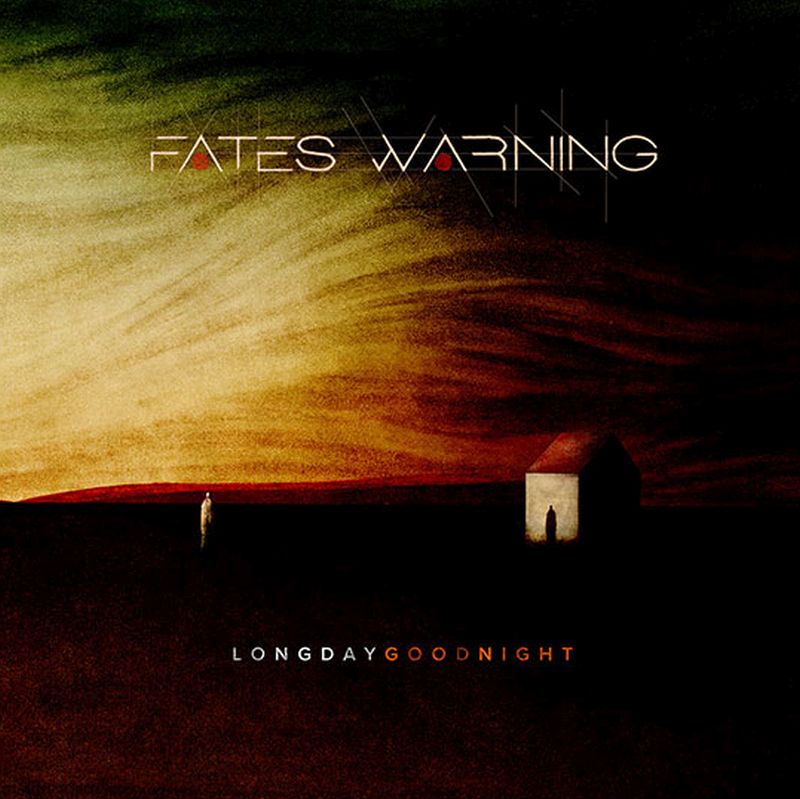
With the new album the band is back under the wing of Metal Blade Records. After eleven years, since the release of their tenth studio album, “FwX.” Even the covers of the new album and the one I just mentioned look a bit alike. Except one feels like a rebirth and the other like a quiet fade-out. “Long Day Good Night” is a triumphant continuation of the band’s expressionist musical journey, from a band that never stops and never rests on its laurels. Let’s be honest, Fates Warning belong to those defiant acts you could call the best-kept, best-guarded secret of the music world, a band the world never gave the honorable recognition for its artistry. Especially after they pompously took the progressive metal throne from Dream Theater in the early nineties, in the blink of an eye.
Compared to “Darkness in a Different Light” (2013), “Theories of Flight” (2016) was musically even more defined, serving up even more balance between technical complexity, progressive, exploratory color and musical value. “Long Day Good Night,” on the other hand, is an album with a whole string of moments of outstanding listenability, which make it easy to slap an art rock label on it. Because of its eclecticism, but above all because the interplay of all the virtuoso qualities the band is famous for is so perfectly fused with constantly catchy hooks, which adds up to a distinctive, unique atmosphere run by some serious drama theater. Those of you pickier music gourmets who maybe feared Fates Warning had gone marginal on the new album and taken the path of Alter Bridge or Foo Fighters couldn’t be more wrong. The moments of experimental exploration and virtuoso playfulness, which proverbially come from this band’s DNA, are spread across the album more sensibly, and the same goes for the most distinctive musical highlights, the ones that go straight to your ear. And this time there are loads of them. That’s exactly what makes it such a big surprise. In a good way. At the same time, “Long Day Good Night” is an album where Fates Warning allowed themselves a few excursions they’ve definitely never tried before. There are quite a few artistically bold and successful challenges. Take the integration of Gavin Harrison, drummer of King Crimson and The Pineapple Thief and a filigree, sensitive feel player, in the challenging yet fragile When Snow Falls, or the string arrangements in the touching ballad Under The Sun.
In the time before the covid-19 pandemic hit, the band members were incredibly active. Outside of Fates Warning. The year before last, Jim Matheos put out the second album of his joint project with former Fates Warning singer John Arch (RockLine review), which is even better than the debut, and he brought in absolutely every member of the current Fates Warning lineup (except Ray Alder) to collaborate. Ray Alder released his solo album, Joey Vera recorded and released a new studio album with Armored Saint (RockLine review) and, last but not least, the unofficial fifth member, the band’s live guitarist Mike Abdow, put out a fantastic instrumental solo studio album this spring (RockLine review). Add the stylistic detours that stand out across these releases and it’s clear that getting the guys together in one musical body always guarantees a fresh, unsung musical tale that can only thrill.
It was precisely these side activities that helped the guys enter the writing process for the new album in extremely good form. Even more mature, and above all, Matheos wanted to put together material that would be pure Fates Warning in every way, yet still surprise. Both the band itself and its fans. And in doing so, Fates Warning didn’t sacrifice a single bit of their eclecticism, recognizable from a mile away.
You hardly know where to start describing the material, it’s so varied and vivid. Adventurous, thrilling, and sounding very familiar. If we jump straight to the tail end of the album, there’s The Longest Shadow of the Day – you know how shadows are in winter at four in the afternoon, right? This is the progressive peak of the album. Not only because the song runs eleven and a half minutes, but because it speaks in an experimental language. Abdow opens the track with a jazzy clean-guitar solo. That’s the spot fans simply demand from the band. It unfolds spectacularly. Through a heap of motifs and changes of rhythmic keys, it brings together in one place everything Fates Warning are. Were, and let’s hope they stay. Just when everything makes it seem like an instrumental, Alder comes in with vocals, which carries the song into an atmospheric final crescendo.
“Long Day Good Night” really does what the title says. A day that takes a very long time to fade out, slipping into an equally long night. It’s a dark album. Seriously dark. It feels like a farewell. From start to finish. A farewell to everything. The cover shows the last fading ray of sunlight leaving a desolate world of post-apocalyptic vistas. Stripped of everything we ever believed in. This is very likely the last Fates Warning album.
Matheos and Alder started writing the album last year, and it’s actually the result of their joint and especially close collaboration. You can feel it above all in how the instruments, with the delicate strokes of fine mechanics, cunningly adapt to the lead vocal lines, which take the initiative and in which Alder simply fascinates with his phenomenal voice and all his emotional investment. Most of the lyrics were written by Ray Alder, with the exception of the lyrics for the aforementioned The Longest Shadow of the Day, which are Matheos’s, and for The Last Song, which the two wrote together. That’s the first time ever that Alder and Matheos have co-written lyrics. And symbolically, it’s apparently also the last Fates Warning song. The last one written. Alder said in an official statement that Matheos doesn’t want to write any more music for Fates Warning in the future. Touring is definitely still on the table, but it looks like “Long Day Good Night” could be the last Fates Warning album of their career.
The opening and the exit of the album complement each other. Like sunrise and sunset. The acoustic The Last Song, closing out the album, sets up a perfect base for diving straight back in for another listen. After a three-minute atmospheric build-up in the intro, The Destination Onward erupts with a distinctive riff that grabs you instantly. It’s clear right away that this will be a great album. The opening track lays bare Alder’s realization that Fates Warning will one day end their career. It’s the realization of something that will happen. One way or another. Because it’s destined to. For now the band is functioning, but it’s bound to its end, one way or another. A depressing lyric. But masterful gloom that breaks your heart. Right from the start. It’s the longest album of the band’s career, a good 72 minutes. Not a single second is superfluous. It’s that complete and polished. Shuttered World ups the ante on the opening assault, sounding even harder and even more wound up. It’s one of the fastest songs on the album. And it has no shortage of punch. Also in the catchy but melancholic chorus. Generally, the choruses this time around are, as a rule, all distinctively catchy. It’s hard to pick favorites.
Above all, it’s the quiet moments that hit especially hard this time, like Under the Sun, where Fates Warning surprise with the tenderness and bittersweetness they’re capable of producing so fragilely. A track that could easily get radio play. On the kind of stations with at least a smidgen of musical awareness and musical intellect (not in Slovenia). Then there’s the deeply yearning Now Comes the Rain, with a brilliant build between verse and chorus, where the mood keeps growing as the intensity develops.
The songs Now Comes the Rain and, a bit later, Begin Again are connected. Through their lyrics. After every fall, you have to know how to pick yourself up. The sprawling Scars is about how some things you go through stay with you for life and follow you like scars of reminders. Liar is the first lyric for which Alder found inspiration in the current political situation. With the USA at the center, of course, fascinated by the horrifying realization of how acceptable the depravity of racist anarchy seems to so many people. The Way Home draws inspiration from a story from a few years back, about a Malaysian airline plane that miraculously vanished mid-flight. Glass Houses leans on the world population’s ever-worsening dependence on social networks. When Snow Falls was originally meant as a bonus track for the version of the album to be released on the Japanese market. Gavin Harrison contributed all the drums for it, since Jarzombek was too busy with other things at the time it was recorded. It comes across as the calmest and most hypnotically exploratory point on the album, where the band allowed themselves an artistic excursion of a kind we’re not otherwise used to from them. Alone We Walk is about how everyone walks their own path. One day, Alder decided to walk home from the center of Madrid. During an eight-mile walk toward the city’s outskirts, he met fewer and fewer passing two-legged creatures. At some point along the way, Alder found himself completely alone in a park. Alone with himself and his feelings.
The album carries a perfect blend of piercing, penetrating phrases, ennobled by the exceptional power of the rhythm section, where the organic nature of the sonic production reigns. All that rhythmic punch is contrastingly crowned with the groove rhetoric of Joey Vera’s highly dynamic bass lines and the endlessly brilliant switch-ups, rolls and challenging transitional ideas of Bobby Jarzombek. The album is a top-notch accumulation of somewhat unexpected developments, which this time, as said, are woven into an extremely musical compactness of format. This time it’s more an art metal than a progressive metal album. As a product, it went through an exceptional process of detailing and really embodies a set of the most optimized compositional solutions. It’s a work of artistic brilliance and a special album in the band’s entire discography.
If it’s the last one, then on that count alone it will definitely break the hearts of all the band’s fans, but beyond that it breaks you with its depth and artistic polish, which bring boundless melancholy. Once you catch this intense pain that the album’s tracks lay bare, its hypnotic, “bittersweet” intoxication hits all the harder. And if it really is the last Fates Warning album, then as composers they’ve bid farewell with it in the style of the greatest musical heroes of the galaxy. Definitely one of the best albums of the band’s career, and if not the best, then definitely the most artistically mature. Including the early eighties. It goes without saying that this is one of the best progressive metal albums of this year. It feels strange to say that about the new album from a legendary band of progressive metal pioneers, who hit their first artistic zenith in the mid-eighties. Especially since it’s already their thirteenth studio effort. But that’s how it is. Even after countless spins it keeps rewarding you and keeps the listener busy with its expression. It has that much breadth and depth of expression. Delivered with a leap to a new level of artistic maturity. Well-known artistry, but this time it brims with sacred creative freshness and insight.
Author: Aleš Podbrežnik
Tracklist:
1. The Destination Onward
2. Shuttered World
3. Alone We Walk
4. Now Comes the Rain
5. The Way Home
6. Under the Sun
7. Scars
8. Begin Again
9. When Snow Falls
10. Liar
11. Glass Houses
12. The Longest Shadow of the Day
13. The Last Song
Lineup:
Ray Alder – vocals
Jim Matheos – guitar
Joey Vera – bass
Bobby Jarzombek – drums
Guest musicians:
Mike Abdow – guitar solos on tracks 2, 5 and 12
Gavin Harrison – drums, percussion on track 9
Mike Posen – violin on track 6
Raphael Weinroth-Browne – cello on track 6