Label: Insideout Music
Release date: 7/24/2020
Production: Adam “Nolly” Getgood
Length: 51.54 min
Genre: Progressive Metal/Progressive Rock
Rating: 9.5/10
Haken are one of those bands that somehow bridge the progressive metal of old and tie it, very vividly, to the modern trends of post-millennial metal subgenres. In fact, the valiant Brits have become one of the central protagonists of this trend, which has been thrilling people for quite a while with the realization that the evolution of rock ‘n’ roll is far from over. Alongside Haken there’s a whole bunch of bands scattered across the continents of the planet (Australia and North America especially) who flirt carefree with genre fusion while developing a progressive adventurousness that’s backed throughout by astonishing technical polish and complex structuring. Haken, being Brits, still come across as noticeably traditional at moments, yet you can slot them without much trouble among the heralds of the new generation of progressive metal-making, one that soaks up, among other things, the “breakdown” elements of metalcore as well as excursions into the fashionable sound of “djent” chugging.
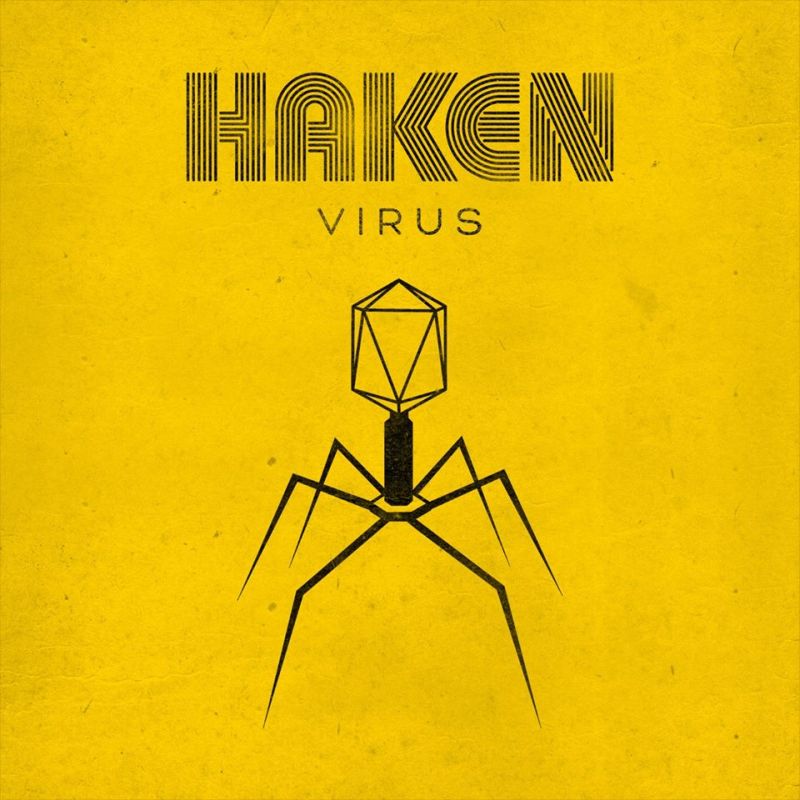
Anyway. “Virus” is actually an album whose creation began back when its predecessor “Vector” was being recorded, since Haken originally wanted to put out a double album. The two are linked, and “Virus” is really something of a visionary record. The title was picked before anyone was even talking about any Covid-19 pandemic. Virus and viral infection are tied, at the root, to the socially critical note the album carries. “Virus” is really an imprint of the moral decay of human society. Just like humans, a virus behaves in the same way. Without submitting to the laws of balance in ecosystems. And so it destroys everything in its path until it runs out of food and space. Then it destroys itself too. On the cover, Haken used the invasive stage of a bacteriophage-type virus, which looks the most “alien” of all the virus types. The family of viruses that Covid-19 belongs to looks far too much like a “cauliflower”, and that just doesn’t belong in metal.
Still, the new album is considerably different from its predecessor “Vector”. Above all, it’s even more concise, because it measures out its artistic steps and moves even more carefully, aiming for greater compactness. That means the “burn-it-down” side on one hand and the sophistication on the other are laid out on the album in a more structured way than Haken did in the past. In the first five tracks you can feel the band’s desire to present their music in a more concrete and compact manner. Not necessarily, they’re prog guys after all, but still. That feeling is there. So, in terms of arrangement, it’s more “transparent” than ever before in their career. But since Haken are a progressive band from head to toe, they channeled their experimental skills and virtues, in the sense of progressive purism, primarily into an excellent and extremely ambitious epic suite that runs 17 minutes and is built from five parts. In that respect, it’s some of the best stuff Haken have made to this day. Not because it’s long. It’s simply a “band-aid” for all of you who, even after this album, will keep preferring to stay with Haken in the era of the album “The Mountain” (2013). This long track called Messiah Complex was actually written on tour with Devin Townsend. The guys wrote this piece bit by bit while riding the bus from venue to venue. In the part of the bus that’s even been converted for recording, they got the ideas down into a demo sketch. Everything we know under the name Haken is packed into this track. They’re challenging the artistic reach of the hard-to-top “The Mountain”. With a heap of vividly atonal moments, which once again sensibly link them to the tricks of the good old school of pioneers like King Crimson and Gentle Giant, while this element, woven into the distinctly dark nature of the song, creates a feeling of chaos, where the combination of dazzling blasts of technical bravura, virtuously dosed with polyrhythms and syncopation from the rhythm section, thrills and entertains the listener the whole way through, keeps them busy and doesn’t let them breathe. In its opening first part (Ivory Tower), Messiah Complex evokes the influence of Dream Theater, while the melancholy it develops brings Haken close to the melancholy of Soen and Opeth.
The tightness is exceptional, the perception brilliant, and with the new album the band has once again proved that they’re maturing artistically on both the individual and the collective level. Haken’s strength is that they’re a collective of outstanding musicians, that they develop a clearly perceptible eclecticism, and that with the new album they’ve created music they hadn’t offered their audience before, while still keeping their unique musical essence and character in everything. They act 100% Haken-like and are comfortable in their own skin. The album is often very well balanced between musically more compactly defined passages and technically more complex parts, and there’s no shortage of some seriously pleasing, tickling bits of idea-level lucidity that entertain. This is an album that still surprises every demanding listener at every turn and thrills them, because it’s still dosed with a pleasing amount of unpredictable twists. That means “Virus” too needs several listens before it (at least roughly) settles into your ears.
What’s actually interesting is that Ross Jennings tried out a few vocal tricks you really couldn’t have expected. While in the fifth part of the Messiah Complex suite, called Ectobius Rex, his vocal lines musically love to recall those of Derek Shulman from almost fifty years ago, in songs like Invasion he took a considerably more attractive, contemporary approach in the style of the likes of Leprous and/or Caligula’s Horse. Haken have never made a track as compact and “radio-friendly” as Canary Yellow in their career. The album opens massively. Ominous, with the invasive punch of “post-thrash-metal” phrasing and the feeling of an approaching apocalypse. That’s the song Prosthetic. Right from the start, the “viral infection” “robotically dehumanizes” the last remnants of humanity’s healthy thinking, which sinks uniformly into a dystopian world without color, smell or taste. Prosthetic is a mad and bestial opening track, phenomenally crossed with the venomous thrashy bristle of guitar phrases and playfully fractured rhythms, which build a contrasting backdrop for the song and develop exactly what we look for in Haken. The extremely progressive nature of a unique format, the kind only this band serves up. Right there, Jennings already earns himself enough room to maneuver for a musical chorus melody. Considering how quickly the ten-minute Carousel turns on a dime, that’s just proof of how well structured the songs are in terms of combining the two basic approaches to composing. Complexity and musicality. When a track is long and still “turns” quickly, the progressive rock and/or metal act has done its artistic mission with great distinction and delivered its expressive core. Haken pull this off phenomenally across “Virus”.
It’s time to wrap up the review, because it ran too long ages ago. As said. “Virus” is thus the missing piece of the puzzle, which together with “Vector” has now told the whole story of who the “king of the cockroaches” is (a reference to the song of that title from the album “The Mountain”). With “Virus” the band has opened up new starting points for future artistic ventures. It’s very likely that Haken will go on to develop songs with even more compactness and a musically friendlier nature, in a style that’s more accessible to listen to, but at the same time the band keeps strengthening its unique artistry and, with maturity, keeps nurturing and upgrading it. That’s a guarantee that a band like this simply can’t disappoint. That’s why “Virus” is once again a different story compared to past albums and, above all, a brilliant one. “Vector” was a story of birth, growth and development, while “Virus” is its opposite. It’s the story of a not-so-honorable final lap of the human era.
Author: Aleš Podbrežnik
Track list:
1. Prosthetic
2. Invasion
3. Carousel
4. The Strain
5. Canary Yellow
6. Messiah Complex pt. I: Ivory Tower
7. Messiah Complex pt. II: A Glutton for Punishment
8. Messiah Complex pt. III: Marigold
9. Messiah Complex pt. IV: The Sect
10. Messiah Complex pt. V: Ectobius Rex
11. Only Stars
Line-up:
Ross Jennings – vocals
Charlie Griffiths – guitar
Richard Henshall – guitar, keyboards
Diego Tejeida – keyboards
Conner Green – bass
Ray Hearne – drums