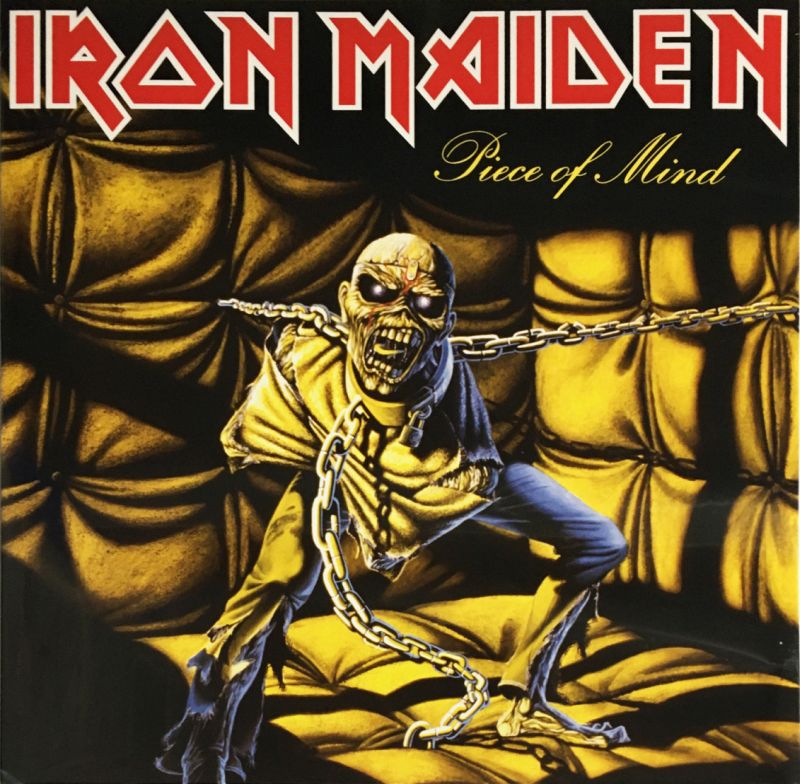
Label: EMI Records
Release date: May 16, 1983
Production: Martin Birch
Album length: 45.28 min
Genre: Heavy Metal
Rating: 9.0/10
Right around the corner after The Number of the Beast, Piece of Mind was waiting in 1983. If The Number of the Beast was still a kind of bridge between Iron Maiden’s NWOBHM era (Iron Maiden and Killers) and the Dickinson era, Piece of Mind delivered that real, epic Iron Maiden sound. It’s the first true step toward the classic Maiden sound we know from the eighties, and the lineup on this album is a classic too. Soon after The Number of the Beast came out, Clive Burr left the band over “musical differences,” but luckily Nicko McBrain quickly stepped in. Burr is a great drummer, best known for his raw energy, but in my opinion Nicko’s precision and drumming finesse surpass him. The fans prove it, too: they took to Nicko right away, and his lovable beak of a nose quickly became the band’s second mascot. The classic, legendary Maiden lineup stayed unchanged for almost eight years and recorded a cult heavy metal trio of albums. Piece of Mind was originally going to be called Food For Thought, but it soon got a more refined title. It’s also interesting that the plan was originally for our favorite monster to meet a grim end, but the boys found that too cruel. So Eddie “only” got a lobotomy. Nicko’s arrival let Iron Maiden perfect their style down to the last detail; Dickinson’s soaring vocals, artillery drums, classic guitar melodies and Harris’s galloping bass made Piece of Mind the best-selling Maiden record up to that point.
The new guy in the band naturally had to prove himself, and what better way than the album’s intro. Poor Nicko spent a whole day sweating over a drum intro and put together an extremely complex piece. Harris wanted something simple, Nicko played him a few patterns, and that’s how we got the great intro to the album opener, Where Eagles Dare. The lyrics are based on Alistair MacLean’s cult war novel from 1967, which was made into a famous film the following year, starring Richard Burton and “Clint” Eastwood. Instrumentally it’s a real little epic masterpiece: the riffs and chords are totally simple, yet they build an incredible wartime atmosphere, backed up by machine-gun sounds in the instrumental section. The solos are true epic treats, and Dickinson takes the song to a whole other level with flawless, epic vocal lines. One of the best opening tracks ever, and sadly one we hear live far too rarely. Dickinson’s half-ballad Revelations slows the album’s tempo down, with fantastic, deep lyrics that Bruce pieced together from bits of Christian mythology and the occult themes of his beloved Aleister Crowley. Lyrics that practically beg for deeper exploration and reflection couldn’t have found a better home than Revelations, a song full of mysticism, incredible melodies, an excellent bass line and acoustic guitars watched over by an air raid siren. Another timeless classic, and it’s followed without mercy by yet another. Flight of Icarus, of course, draws on the Greek legend of the mythical first aviator. Dickinson did admit they bent the story a little, turning it into an allegory about teenage rebellion against authority, but that makes it no less brilliant. Flight of Icarus kicks off with a fantastic combination of guitars and groovy bass, cut through by a heavenly vocal line, followed by an incredibly epic, infectious chorus. It’s more than obvious the song was written for a wider audience, but if anyone knows how to write a good catchy, mainstream tune, it’s Iron Maiden. The instrumental part, with its endless, dreamy solos, is more than great, though it could have been a bit longer. One of my favorite songs is the dynamic Die With Your Boots On, another proof that you can make works of art out of simple things. True, it’s not among their best tracks, but the simple structure is effective and sticks in your head fast. Die With Your Boots On is about anticipating an apocalyptic future, which was a very timely subject during the Cold War, when the song was written. With The Trooper, Maiden carried on with their string of war songs. Thanks to the killer opening riffs, one of the best-known moments in metal history, The Trooper became one of the band’s most famous songs, and it’s definitely the first association when someone mentions Piece of Mind. The song, about the senseless slaughter of the light cavalry in 1854 during the British-Russian Crimean War (1853-1856), flawlessly captures just one of many cases of generals playing games with human lives, with pure, raw energy and power and a harrowing set of lyrics. The event was summed up in the excellent poem The Charge of the Light Brigade by Lord Tennyson (Bruce borrows his verses when introducing The Trooper at gigs; “Cannon to the right of them/Cannon to the left of them/Cannon to the front of them/Volley’d and Thunder’d!”). The Trooper is a timeless metal classic and one of the best Iron Maiden songs ever! Next, Maiden treat themselves to a jab at the purists who accused them of Satanism, putting a spoken passage back at the start of Still Life. It’s none other than a slightly sozzled Nicko doing his impression of the dictator Idi Amin Dada: “What ho said the t’ing with the three “bonce”, do not meddle with things you don’t understand…” But the boys quickly get serious and, with Still Life, deliver one of the most beautiful moments on the album. The dreamy, melancholy atmosphere and divinely sung lines capture the theme of the lyrics perfectly, which tell of someone obsessed with spirits in the water who eventually joins them. Many suggest the lyrics refer to Clark Ashton Smith’s novella Genius Loci, or to Ramsey Campbell’s short story The Inhabitant of the Lake. Either way, it’s one of the best songs on the album, with a mighty atmosphere and incredible energy. Sadly, the run of six fantastic classics ends with Quest For Fire, based on the 1981 film of the same name by Jean-Jacques Annaud. Quest For Fire is mostly spoiled by its brainless lyrics, which we’re not exactly used to from Maiden; otherwise it’s a pretty solid track with catchy melodies and a fairly good, though also average, chorus. Sun and Steel is an even weaker song, despite Dickinson’s interesting lyrics about the legendary samurai Miyamoto Musashi, who is said to have been the greatest swordsman of all time. No wonder Dickinson picked him for the lyrics, but even that doesn’t change the fact that it’s a very average track that doesn’t deserve such good company. For that reason, neither of these two has ever been played live. But if that duo disappoints, Harris redeems himself all the way with the album’s out-of-this-world epic closer, To Tame a Land. The song was originally supposed to be called Dune, after Frank Herbert’s brilliant sci-fi series, but the gentleman in question refused to let them use the name. I hope Herbert regretted it, may he rest in peace, because this is a brilliant masterpiece from the first second to the last. To Tame a Land opens with a slow, calm, dreamy intro with an oriental touch, which explodes into a driving rhythm, which tips over into a heavenly instrumental section inspired by Asturias, the classic work by the Spanish composer Isaac Albéniz, and then finishes with another calm ending. Lyrically, too, To Tame a Land is a lovely tribute to an epic saga, one that will seem far-fetched to the uninitiated, while those in the know get whisked straight to Arrakis, among the Fremen and the sandworm riding. You couldn’t wish for a better ending to a great album!
Piece of Mind is Maiden’s most mature release up to that point, and it became a timeless heavy metal classic. It would very likely have gone down as the best release of the Maiden era, too, if they’d left out the two fillers or swapped them for better replacements. Still, it’s one of the boldest and brightest moments in the career of Iron Maiden, and really of metal as a whole, and it set the legends even more firmly on the metal throne, where they remain, despite a few missteps, to this day.
Author: Rok Klemše
Tracklist:
1. Where Eagles Dare (6:13)
2. Revelations (6:48)
3. Flight Of Icarus (3:51)
4. Die With Your Boots On (5:26)
5. The Trooper (4:12)
6. Still Life (4:57)
7. Quest For Fire (3:42)
8. Sun And Steel (3:27)
9. To Tame A Land (7:25)
Lineup:
Bruce Dickinson – vocals
Dave Murray – guitar
Adrian Smith – guitar
Steve Harris – bass guitar
Nicko McBrain – drums