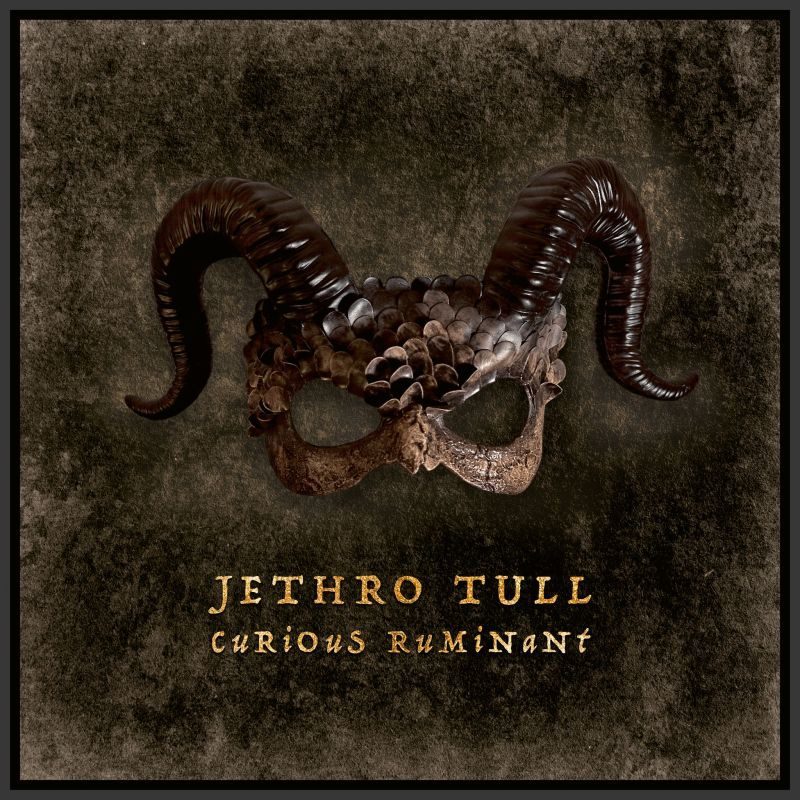
Label: InsideOut Music / Sony Music
Release date: March 7, 2025
Produced by: Jethro Tull
Album length: 50.31 min
Genre: Progressive Rock
Rating: 8.5/10
How is the average devotee of the legendary British prog rock institution Jethro Tull, led by the indestructible singer, flutist and composer Ian Anderson, supposed to make sense of the rather funny title of their latest, twenty-fourth studio album? “Curious Ruminant” is probably an allusion to Ian’s kinship with the image of the ancient Greek god Pan, half man, half goat, who is often depicted with various wind instruments, usually Pan’s pipes or a reed pipe, while the instrumental “Pan Dance” from 1975 is one of the more obscure creations in the vast Tull catalog.
Even though he’s closing in on eighty, Ian is still a sparkling, bouncy ‘ruminant’ on stage, one who has no trouble pulling off a one-legged stand while playing the flute. He has also kept his old habit of making listeners think with nothing but the title of a new album. It would be fun to fire up a time machine and meet the fresh-faced Ian of 1968, when he and the rest of the band dressed up as frail old men for the cover of the Jethro Tull debut “This Was”. He’d probably just burst out laughing at the idea that almost sixty years later, as an elderly gent, he’d be far more vital and spry than his artificially aged self. But he almost certainly wouldn’t have imagined for a second that his musical career and that of his band, the two inseparably intertwined, even when you count Ian’s solo efforts, would last this long.
Still, Ian is well aware that his time on this earth is (sadly) running out, so he decided to give his career a bit of a ‘boost’ and make up for the long stretch between 2004 and 2021, when we waited in vain for a new studio album under the Jethro Tull name. “Curious Ruminant” is already the third Jethro Tull album in the last four years, which is a seriously impressive feat for such an old band. Even more fascinating is that “Curious Ruminant” is no worse than its two predecessors, which rightly ranked among the best Tull work since the end of the ‘golden’ seventies, when they boasted probably the most impressive and longest-running string of great albums in the history of progressive rock. The only weak spot of modern-day Tull remains Ian’s vocal cords, which have really worn down over the past two decades, so his singing occasionally wavers between singing and declaiming. He often deftly ‘masks’ all that by adapting to a suitable register, with his exceptional vocal charisma and always brilliant flute playing.
Let’s also hope Ian has finally managed to find a guitarist who’ll stick around for at least a few years, since Jack Clark, who at around 30 could easily be the son or grandson of any of the other band members, is already the third Tull guitarist in the last four years. All three of the latest Tull albums were recorded with three different guitarists, which is a really odd stat considering that the legendary guitarist Martin Barre lasted more than forty years in the band. Ian’s other helpers on “Curious Rumiant” are well-known veterans: bassist David Goodier, keyboardist John O’Hara and drummer Scott Hammond, while nostalgics will be glad to hear that former keyboardist Andrew Giddings and occasional live drummer (and Ian’s son) James Duncan guested on a few tracks.
“Puppet and the Puppet Master” is a convincing album opener that will satisfy longtime fans, since it has all the recognizable Tull ingredients: Ian’s flute in harmony with sharp guitar passages, a symphonic seasoning led by a exuberant accordion and plenty of backup from eclectic rhythmic nuances conjure up a splendid atmosphere in no time. The title track features hard-rocking guitar phrases that Matin Barre himself would have blessed, while the rhythm duo of Goodier and Hammond keeps serving up fluid and at times slightly jazzy tempo shifts. The central instrumental section is especially tasty, reminding you of some of the best moments in this unforgettable band’s rich history.
“Dunsiane Hill” is the next piece, a mostly folk-rock-tinged number named after a Scottish hill. That same hill also gets a mention in Shakespeare’s tragedy Macbeth. In 1054, the real, historical King Macbeth suffered a heavy defeat on this spot in battle against Earl Siward. The energetic “The Tipu House”, which also has world music elements and recalls the era of the albums “Roots to Branches” (1995) and “J-Tull Dot Com” (1999), refers in its title to an archaeological site of the Maya civilization on the border between Belize and Guatemala.
The almost solemn “Savannah of Paddington Green” has cheerful arrangements on flute and accordion, while the calm rhythmic nature of this track suits Ian’s current vocal range, i.e. what his vocal cords can handle, very well. The title refers to Paddington Green, a rare patch of greenery in the old part of London. “Stygian Hand”, with its folk-rock nature and tasteful interplay between Ian’s acoustic guitar and Jack’s electric guitar passages, is somewhat reminiscent of the folk-rock Jethro Tull trilogy from the second half of the seventies and is without a doubt among the album’s highlights. “Over Jerusalem”, whose lyrics refer, at least indirectly, to the decades-long bloody conflict between two related Middle Eastern peoples without taking either of the warring sides, features a splendid instrumental section with superb guitar and flute solos.
The epic treat “Drink From the Same Well” runs almost 17 minutes, matching the unforgettable masterpiece “Baker St. Muse” from the album “Minstrel in the Gallery” (1975) in length, if not quite in quality, and, alongside “Thick As a Brick” (1972) and “A Passion Play”, is among the longest epics in the band’s history. It was an extremely bold move by Ian and his musical comrades, and it paid off, because it comes across as hands down the best and most complex piece, not just on “Curious Ruminant” but also next to the compositions from the previous two studio albums. The brilliantly executed instrumental part features world music elements with an emphasis on Ian’s flute antics, and that’s only the start of an adventure that’s wildly varied in both arrangement and rhythm. Further on, solemn piano harmonies come in with a subtle touch, and about halfway through, when Ian’s vocals kick in, the nature of the composition changes completely and becomes much more melancholic and dramatic. “Interim Sleep” is a short closing ‘lullaby’ with Ian’s narration, a mix of philosophical wisdom and his trademark humor.
“Curious Ruminant” is already the third extremely solid album in a row that Ian has managed to put together with the modern version of Jethro Tull in a relatively short time. It would be thankless to compare it with the classic Jethro Tull albums of the seventies, when the central, still-living patriarch of progressive rock was at full vocal strength while they plowed the musical fields of prog rock adventurism. Compared with the ‘grueling’ eighties and nineties, though, when only a handful of truly interesting Tull creations were made, “Curious Ruminant”, just like both of its predecessors, shines in top fashion. It probably wouldn’t be the least bit brazen to claim that Jethro Tull are currently in the best form of any of the key, still-active prog rock giants who emerged in the second half of the sixties.
Author: Peter “Dr. ProgRock” Podbrežnik
Track list:
1. Puppet and the Puppet Master (4:04)
2. Curious Ruminant (6:00)
3. Dunsinane Hill (4:17)
4. The Tipu House (3:31)
5. Savannah of Paddington Green (3:13)
6. Stygian Hand (4:16)
7. Over Jerusalem (5:55)
8. Drink from the Same Well (16:42)
9. Interim Sleep (2:33)
Lineup:
Ian Anderson – flute, vocals, acoustic & tenor guitar, mandolin
David Goodier – bass guitar
John O’Hara – piano, keyboards, accordion
Scott Hammond – drums
Jack Clark – electric guitar
Guest musicians:
James Duncan – drums, cajón, percussion
Andrew Giddings – piano, keyboards, accordion