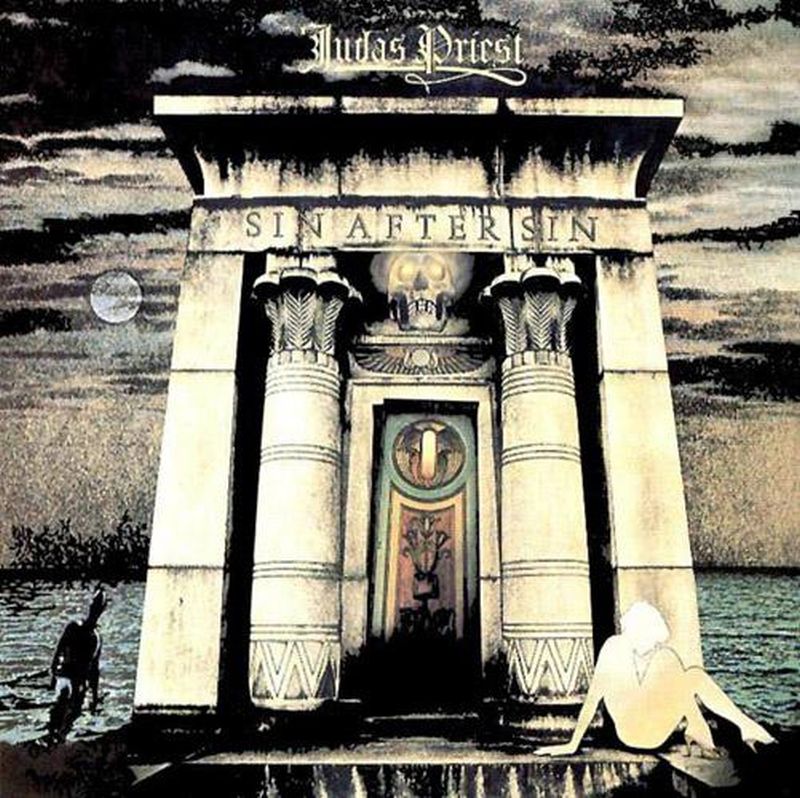
Label: Columbia Records
Release date: April 8, 1977
Production: Roger Glover & Judas Priest
Album length: 40:07 min
Genre: Heavy Metal
Rating: 8.5/10
The future looked shaky for Judas Priest. After “Sad Wings Of Destiny” (1976) failed to put the new band on the rock scene’s radar, the guys found themselves in a dead end. Stick it out or call it quits? Faith won out, and right then a big, wealthy record label, one of the biggest names in the music business, took the little band under its wing. That surely gave the guys a fresh push and brought back some badly needed confidence. With “Sin After Sin,” Judas Priest opened a new chapter in their history. Helping them produce the album was none other than Roger Glover, the Deep Purple bassist.
Of course, “Sin After Sin” isn’t yet the leap onto the tracks that made Judas Priest immortal legends in the eighties. Songs like the opener Sinner (in its middle section), Last Rose Of Summer, Here Comes The Tears, or even most of Raw Deal don’t yet give away what would make Priest the bible of heavy metal in the eighties.
Judas Priest hadn’t yet developed that relentless rawness and destructive aggression in their sound, even though they were getting bolder and more arrogant sonically. Their look at the time also had more of a whiff of “belated” hippies about it, because there was still no sign of studded leather or Halford’s obsession with Harley Davidsons on stage, the things that also did a lot to build the band’s later fame. “Sin After Sin” doesn’t deliver proper heavy metal yet. It’s an interesting record of seventies hard rock colliding with new, original ideas that Judas Priest were working in their own way. In other words, something that was only just about to morph into heavy metal. An album that still swings wildly between genres, and that shows in its dynamics too.
The album kicks off with a wound-up riff of sharpened spearheads. In Sinner, Halford sings in a frothing, raspy voice straight from the throat, a style he’d never used on the previous two records. But in the chorus he lets rip with full intensity, crystal clear, which adds a fantastic atmospheric contrast to the song. Right in the middle, Sinner carries psychedelic touches over winding guitars, very much an early-seventies trend. They keep the listener guessing the whole time whether the song might tip into something like the opening Victim Of Changes from the previous record. But the expressive main riff holds its dominant position throughout, and the song ends as furiously and notoriously as it began. Diamonds And Rust is a Joan Baez cover. Production-wise, the guitars are pushed back as if they were serving as an orchestra filling out the soundscape, while the rhythm line takes center stage, with a pulsing bass on one side and Rob’s heartfelt, clean, atmospheric vocals on the other. It adds a fantastic contrast to the record, especially because its basic beat sounds like it was lifted from some seventies disco club. Starbreaker is definitely one of the white-hot peaks of the record, one that will instantly set fire to the heart of any true heavy metal fan. An open, simple, punchy, scorching riff. No detours, no complications, it serves up a real dose of untamed wildness and genuine rebel attitude, which Judas Priest’s lyrics of defiance are full of too.
Last Rose Of Summer dials down the intensity and takes a good chunk of the album’s dynamics with it, so you get the feeling that “Sin After Sin” has a pulsing, wound-up start and finish while the middle of the record stays lukewarm and less expressive. Of course, that’s not quite the whole story, since Priest hit the gas again in Let Us Prey/Call For The Priest, while the mid-tempo, six-minute Raw Deal, with its R&B licks, takes the wind out of the record’s sails once more. The exception is the last two minutes of the song, when Priest finally let the riff run free, closing out atmospherically through the verses of the “I’m Going! No Loss!” chorus. Here Comes The Tears is another ballad, opening gently in the style of Last Rose Of Summer, with Rob shining in his feel for softness and tenderness. The song is a clever trick, with the intensity building round after round, especially once a multi-layered accompaniment of piano and acoustic guitars joins in, along with steely, self-destructive assaults of distortion that tear the world down to its atoms at the end. The listener now craves a final blow, and gets it, because the crumbling mood of the previous song flows straight into the white-hot Dissident Aggressor, which, along with Starbreaker, contains the most of what Judas Priest carried over into all their later studio work. A perfect metal assault, with Halford’s vocal acrobatics and incredible screams, in places split across the left and right channels, lifting the dynamics and atmosphere. So the record surges up right at the end, through all the aggression Priest had in them at the time.
The first bonus track is an excellent cover of a hit by the band Gun, called Race With The Devil (“Gun,” 1969), and a great choice for the 2001 remaster. I can’t say the same for the “live” version of Jawbreaker. Jawbreaker is a track from 1984. So in the seven years since “Sin After Sin” came out, the band made a huge leap in quality, and in this case it would have been better if Judas Priest, having found no material from the “Sin After Sin” recording sessions, had simply left this bonus track off. The whole retrospective that the newly released remasters offer would also have made more sense and come together as a nicer (more tasteful) whole.
“Sin After Sin” continues the story of Judas Priest’s drummer troubles. Alan Moore left the band, and the excellent Simon Phillips came to Judas Priest’s rescue, at the time a renowned session drummer highly regarded in music circles, who today plays with Toto. That’s another reason the jump in quality compared to “Sad Wings Of Destiny” is more than obvious. The record is played much more confidently, and the Downing/Tipton guitar duo sounds tighter. It’s a shame Simon didn’t join the band, because his work blended brilliantly with Judas Priest’s musical posture of that period. For the upcoming tour, in their search for an available drummer, Judas Priest recruited Les Binks.
Author: Aleš Podbrežnik
Track list:
1. Sinner
2. Diamonds And Rust
3. Starbreaker
4. Last Rose Of Summer
5. Let Us Prey/Call For The Priest
6. Raw Deal
7. Here Come The Tears
8. Dissident Aggressor
bonus tracks on the remastered reissue, 2001:
9. Race With The Devil
10. Jawbreaker (live)
Line-up:
Rob Halford – vocals
K.K. Downing – guitar
Glenn Tipton – guitar
Ian Hill – bass guitar
Guest musician:
Simon Phillips – drums