Label: Magna Carta
Release date: July 11, 2000
Production: Kerry Livgren
Album length: 68.09 min
Genre: Progressive Rock
Rating: 8.5/10
The dream of many rock veterans is to reunite, at least once before the end of their careers, in their original or most beloved lineup — provided, of course, that all the members of that original or classic lineup are still alive and well. In 2000, American prog-rock champions Kansas pulled off a reunion of the classic lineup that recorded the biggest classics in the history of this legendary band between 1970 and 1980 (up to the album “Audio-Visions” (1980)). The fruit of this rather unexpected reunion was their fourteenth studio album “Somewhere to Elsewhere,” which, as expected, wasn’t up to the level of their seventies masterpieces, but still pleasantly surprised plenty of people who had figured that vocalist/occasional keyboardist Steve Walsh, guitarist/keyboardist Kerry Livgren, one-eyed guitarist Rich Williams, violinist Robby Steinhardt, drummer Phil Ehart and both bassists, Dave Hope and Billy Greer (the latter earned the right to join the original members in the lineup), would never be able to catch even a sliver of the magic of their golden years.
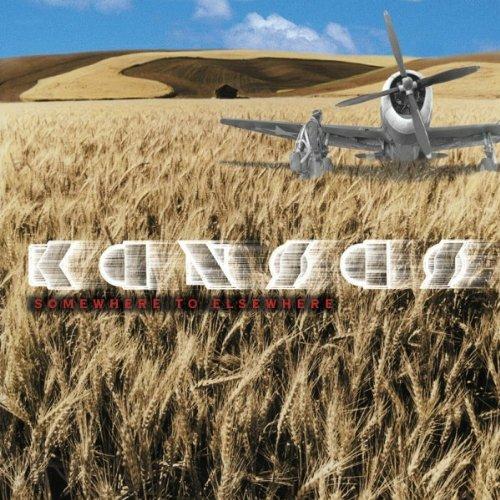
Those ‘devotees’ had probably forgotten by then about Livgren’s songwriting chops. Kerry wrote and produced all of the “Somewhere to Elsewhere” material himself, played all the keyboards, and even tried his hand at lead vocals on the hidden satirical track “Geodesic Dome,” less than two minutes long, tucked away at the very end of the album. That freed Walsh to focus purely on singing, with help from Steinhardt, who contributed lead vocals on three songs, while Greer took the lead mic on one composition. The album cover wasn’t up to the high standards of the seventies, but at least it stirred up a certain amount of nostalgia.
The biggest strength of “Somewhere to Elsewhere” is that the compositions lodge themselves in your ear incredibly well, and the album as a whole flies by in a blink. There are no potentially boring moments on it, although no composition other than “Myriad” and the opening “Icarus II”, the sequel to the classic “Icarus – Borne on Wings of Steel”, really stands out from the ‘golden middle’. “Icarus II” contains practically the same central motif as its predecessor from the album “Masque” (1975). Already during this track it’s clear that all the key Kansas trademarks are back in full force: fantastic symphonic arrangements with an emphasis on sophisticated string passages, exceptional vocal harmonies of the kind only the classic incarnation of the band could conjure up, and punchy guitar passages on the level of the best hard rock. “When the World Was Young” is a nostalgia-stirring creation with a rousing chorus, which as a whole this time leans closer to hard rock than prog, something true of a few more pieces on this album.
On “Grand Fun Alley” Steinhardt takes the lead vocal baton, while on the symphonic treat “The Coming Dawn (Thanatopsis),” which at times strongly recalls some of the achievements of the golden years, Walsh shines again — by this stage in his career his voice was already slightly frayed, yet he still sang with remarkable fire and incredible energy. The previously mentioned “Myriad,” which at times, with its pompous chorus, mighty symphonic arrangements and complex guitar passages, sounds like it was made in the mid-seventies, is one of the album’s peaks, where the classic Kansas magic burns brightest. A short and atypical, ‘Yes-style’ insert with slick vocal harmonies comes off a bit funny, but still settles nicely into the slightly jazz-spiced structure of this splendid piece. On “Look at the Time” Greer takes the lead, one of the people most responsible for Kansas still being active today.
Two songs follow where Steinhardt again takes the lead — “Disappearing Skin Tight Blues” and “Distant Vision.” The first has an interesting, ‘Beatles-style’ chorus that fits surprisingly well over a bluesy riff, while “Distant Vision” has brilliant instrumental sections and at times gets very close to the unforgettable “Leftoverture” (1976) evergreen “Cheyenne Anthem.” “Byzantium” sounds like a church aria in its opening and closing parts, but most of the time pompous symphonic prog rock with hard rock elements rules. “Not Man Big” is a bit of an unambitious closer for a legendary prog band like Kansas, being an average hard rocker with funk touches that would suit someone like Deep Purple better, and as such it’s the least interesting piece on the album.
“Somewhere to Elsewhere,” a very decent effort overall and close to the seventies standards, was long considered the last Kansas studio album, until it emerged that the latest version of Kansas, with only Williams and Ehart left of the original members, was recording an album titled “The Prelude Implicit,” due out in September 2016. Fans meanwhile are piously hoping it’ll be better than the Kansas side project Native Window and its self-titled 2009 album, and at least roughly on par with “Somewhere to Elsewhere.” The devout Christians Livgren and Hope left their bandmates (again) soon after the release of “Somewhere to Elsewhere,” although Kerry still worked with Kansas for a while as a touring guest. He then devoted himself to his Kansas ‘proto-band’ Proto-Kaw until an insidious illness got the better of him, leaving him unable to play guitar and keyboards, so his musical activity shrank sharply. Steinhardt lasted with Kansas until 2006, when he was replaced again by David Ragsdale.
Author: Peter Podbrežnik
Track list:
1. Icarus II (7:17)
2. When the World Was Young (5:50)
3. Grand Fun Alley (4:38)
4. The Coming Dawn (Thanatopsis) (5:44)
5. Myriad (8:55)
6. Look at the Time (5:37)
7. Disappearing Skin Tight Blues” – 7:02
8. Distant Vision” – 8:48
9. Byzantium (4:15)
10. Not Man Big (8:49)
11. Geodesic Dome” (Hidden track) (1:24)
Lineup:
Steve Walsh – lead vocals, backing vocals
Kerry Livgren – guitar, keyboards, lead vocals (11)
Robby Steinhardt – violin, viola, backing vocals, lead vocals (3, 7 and 8)
Rich Williams – guitar
Dave Hope – bass (2, 6)
Billy Greer – bass, backing vocals, lead vocals (6)
Phil Ehart – drums