Label: Pivec
Release date: June 18, 2021
Production: Jernej Kržič
Album length: 51.42 min
Genre: Art Rock
Rating: 9.5/10
Buy the album!
If we’re counting right, “Kužne pesmi” is the ninth album from Katalena, by now rather legendary eclectic Slovenian alt and folk rockers. Twenty years on the road, which they hit this year. Even in circumstances that common sense can barely picture in its wildest, most delirious dreams, their creativity doesn’t run dry. So here’s the new record, pointedly named after the plague of modern times. And of old ones too, except that now the uncontrollable laws of nature suddenly torment and rattle us without limit. Which some people cleverly exploit. But let’s leave that story for another context.
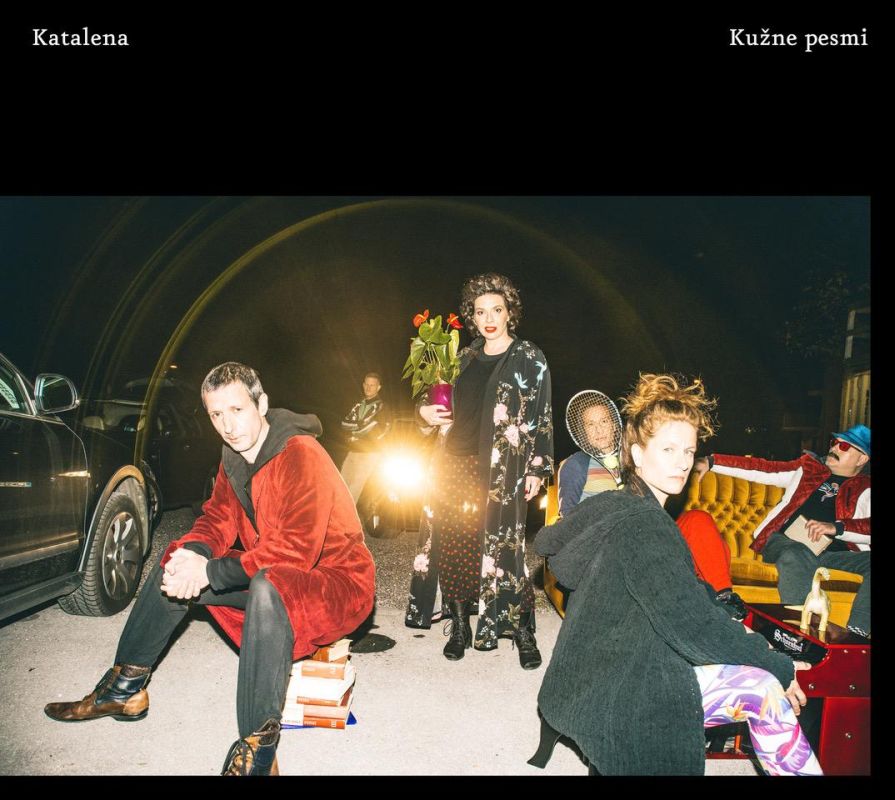
A couch. Frank Zappa? If only there were still a hole or two in it. Yes, from one of his cigarette butts, which were impossible to count. This goes beyond the worst extremes. Remember those virtuous instructions from the prime minister on how to save the world in plague times, when in the autumn-winter of 2020 he waved us over with a glow of boundless love to the sofa, to munching chips and watching TV? Genius. The costumes of the band members on the album cover are genius too. The Fužine end of Ljubljana comes alive instantly. And Šiška’s Brilejeva and Kunaverjeva streets. Especially when your eyes land on the mustachioed Gombač, the hooded Rebolj, who in isolation “retired” the ball and racket, and above all the fizzy, colorful Syed. Goofy intellect and sharp insight have always been the band’s faithful companions. In fact, they were granted citizenship in the sextet ages ago. Okay, eleven songs tied to the theme of life in isolation and under special conditions, which creates a new illusion of individual prosperity for the benefit of the community. That’s reality. And inspiration, too.
And Katalena, being just what they are, whether you love them or hate them, remain a case of musical-theatrical artistry with masterly lucidity, which in this confession packages all the bitterness, sorrow and other dark sides of the Slovenian psyche with incredible skill and finesse. And there’s no shortage of those. The album is once again a brilliant wake-up call. A sobering-up like no rehab program can offer. And “Katalena-esque” like it couldn’t be more so. From the first second to the last. Rich in ideas and lavishly arranged. Cheeky once more, yet with an incredible melancholy woven into it, and a longing too. Shattering. Even though the band has, over its good two decades, more or less drawn on an arsenal of feats that generate its artistic evolution, it keeps fascinating again and again with that eclectic nature of theirs, which has no equal. And that’s enough. That’s what the album “Kužne pesmi” is like too.
The album opens with “Od kuge na drugi strani”. It’s a musical setting of a poem by Ivan Rupnik Mož, a folk poet and fiddler from Lower Carniola who lived in the nineteenth century, and it provides the opening catalyst that fills the sails of “Kužne pesmi”. All the essential trademarks are here right away. Musical infectiousness crossed with their peculiar way of arranging, the buildup and development of the song itself, and Vesna’s recognizable, signature vocal. All the essential elements, then. With a playful sentiment that comes from the band’s well-oiled chemistry. And more. A seventh member has been added too. The violin and viola of Jelena Ždrale, whom we can treat on this album as the band’s new member. So the cheeky delivery of the bitingly bitter plague message is rounded off by a new aura.
The album is once again remarkably varied. Confessional. Hard to put into words. Especially “briefly” (as you’ve noticed yourself, if you’ve made it this far into the essay). The interim “Kekec maneuver” was necessary (2018, RockLine review) for the band to artistically “unstick” from the deeply melancholic yet boundlessly brilliant album “Človek ni zver” (2018, RockLine review) Since we’re already mentioning “Človek ni zver”, it’s worth pointing out that “Kužne pesmi” shares a melancholic link with it, especially in the new album’s longest composition. I dare say this very song is the artistic peak of the new record. Not because of its length, but because of its nature and the way its daring, well-tuned artistic maneuvers unfold. It’s called “Kuge nas reši, gospod”. It’s an epic symphony with hints of progressive rock, where there’s no shortage of chant-like impulses, nor of things not far from gospel (melodies harmonizing Vesna’s lead vocal), nor of blues sentiment, before the song enters its theatrical finale. That’s the last two minutes, seasoned by the whole instrumental side of the crew, who bring this well-tuned, gradually building highlight to its final crescendo. A composition that’s easy to imagine on “Človek ni zver” too.
On “Kužne pesmi”, Gombač’s winds come back into the arrangements more generously, and there’s a bit less of his otherwise indispensable, juicily experimental sound input this time. The song “Ah, kaj ti povem”, also released as a single, is really a track that belongs straight on the radio. A dance “beat” whose guts are flintily shaken up by the fascinating musicality of bassist Tibor Mihelič Syed (the lines have plenty of expressive room), while Vesna and Gombač step into the center of the song, willing and pleasing, in a cheeky duet that’s a kind of allegory for today’s trend of mutual isolation. The crafty buildup of drama and theater once again fans the extended instrumental finale of one of the most listenable and memorable songs on “Kužne pesmi”. In terms of monolithic rhythm, the track can be linked to the album’s ninth song, “Kamenkost”, where Syed’s acrobatics are again hugely important for “smashing up” and loosening the set rhythm. And just as you’re slowly getting your fill of the repetitiveness (of the vocal dictates), Katalena “break” the structure of the song in truly masterly fashion. With a modulation. A new musical motif, which shifts the mood, dynamics, atmosphere. That lifts the song to a new level of expression, a welcome trick that instantly makes the listener perk up again. Crafty. In a compositional manner that shows the band’s maturity, experience and toughness.
Then there’s the particularly intimate (folk, though unsurprisingly adapted) “Pleš, pleši čärni kus”, dressed in the caressingly playful footwear of vocal metrics, flirting through wordplay from Vesna. The vocalist handles most of the song by herself, even though the instrumentalists color the backdrop in subtle ways. They add sounds thoughtfully, devotedly and inventively. The closing instrumental piece of this “comedy” belongs to a fine new interplay between Gombač, Ždrale and Janežič. Musical, mystical and yearning, in that “Katalena” way.
“Antifona” is an example of the higher yield of experimental maneuvers on the new album, actually bringing something new, something different, something artistically fresh into the band’s catalog. Just as its name suggests. A search for “unusual” tonalities that don’t want to seek musical “openness” right off the bat, with a fascinating final twist toward a jazzy loosening of structures and a combination of choral chants. But they don’t take the fragmentation all the way. Instead, like deft tightrope walkers, they “stop at the edge” and skillfully steer the tune back into a compact musical ending. For this song, Katalena set to music the text of a Franciscan prayer from the 1715 plague epidemic.
The accusatory and plague-and-society-bitter “Poslednji ljudje” is a very short song. Boštjan Narat is and remains the band’s quiet conductor in the background, even if he’s a little more “modest” on guitar this time, since alongside Polona Janežič he’s the main author of the material on the album. This song could just as well sit on either of his two solo albums. Its message is a reflection on the present. Especially the last year and a half. It’s thoroughly dark and dystopian. A chasm between two generations that have severed all ties and act as if they no longer know each other. A chasm in which the younger generation wants to settle scores with the older one, unaware that through a “scenic matrix backdrop” it’s being led and steered by just a handful of gerontocratic forces. Those who control global capital, and who “think” in their place. No less brilliantly insightful in its lyrics is Narat’s “Zagovor” (it could also have been called “Expulsion”), where Vesna keeps a similar vocal stance as on “Poslednji ljudje”. Her thunderous, angry delivery of the verses almost gives you the creeps in theatrical terms. Then there’s one more deeply lucid Narat song, or rather lyric. The track Pretaknjeno srce. It’s really a description of a menu so original that even the ancient Romans would have had their hair stand on end. Genius, and definitely a special kind of dessert on this album. The most folk and traditional echo on the new record comes from the song “Jabuka se potočila”, which speaks in the band’s well-known manner.
How to end this “strapping” and “hairy” essay? Simply put, it’s hard. Once again there’s a ton of information on this gorgeous, lovely new album from the band. Eleven richly varied tracks. Polished down to the detail. They contain everything that made Katalena so beloved over time on the Slovenian music and rock scene. They became a folk institution. Expectations for every new album from the band are therefore always high, and Katalena haven’t disappointed this time either. Their adventurous directness, free-spirited self-grown wildness, let’s call it ever-sharp escapism, where at the melting point alternative rock, folk melos, cabaret, pop, neo-classicism, blues, even electronics, and certainly jazz too keep a unique mutual reconciliation, preserves all its artistic boundlessness on the ninth studio effort as well.
Author: Aleš Podbrežnik
Tracklist:
1. Od kuge na drugi strani
2. Ah, le kaj ti povem
3. Pleši, pleši čärni kos
4. Antifona
5. Poslednji ljudje
6. Kuge nas reši, gospod
7. Jabuka se potočila
8. Zagovor
9. Kamenkost
10. Pretaknjeno srce
11. Vse tičice lepo pojo
Lineup:
Vesna Zornik – vocals
Polona Janežič – piano, organ, synthesizer, backing vocals
Boštjan Gombač – clarinet, bass clarinet, soprano saxophone, flugelhorn, melodica, vocals, backing vocals
Tibor Mihelič Syed – bass guitar, electric guitar, ukulele, Roland HPD-20, backing vocals
Boštjan Narat – guitar, banjo, backing vocals
Robert Rebolj – drums, percussion
Jelena Ždrale K. G. – violin, viola, backing vocals