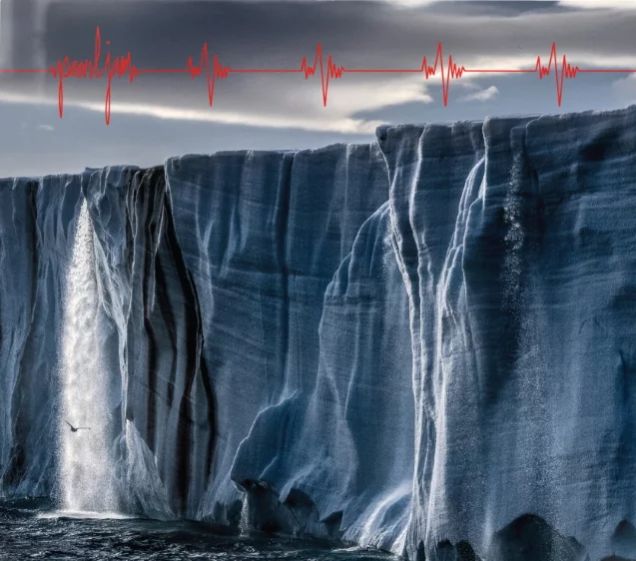
Label: Monkeywrench / Republic Records
Release date: 27.03.2020
Production: Josh Evans & Pearl Jam
Album length: 57.05 min
Genre: Alternative Rock
Rating: 9.0 / 10
Pearl Jam! A mega rock outfit celebrating 30 years together this year. With close to 90 million albums sold worldwide, they’re back after seven years with their new, 11th studio album overall, »Gigaton«! Studio activity has calmed down since the new millennium, and you have to wait a good long while for the band’s new studio efforts, but Pearl Jam have grown into a band that is first and foremost a huge live attraction, building its cult mainly on outstanding concert performances. That may well be why their album sales are still growing. Even though the band keeps its eternally youthful character and drive, »Gigaton« is an album of noticeable maturing for a “gigantic” band that founded grunge in its “childhood” years, and whose confessional sermon today rests on an equally self-grown musical ID card of (alt/art) rock’n’roll.
For the new album, the band made a surprising decision: after ten albums produced for Pearl Jam by Brendan O’Brien, they swapped him for a new (co-)producer. That’s Josh Evans, the band’s guitar and keyboard tech since 2008, who also worked as guitar tech for Soundgarden between 2010 and 2017. And there’s more. He produced the Soundgarden album »King Animal« (2012), as well as the solo album »Heaven/Hell« by Pearl Jam bassist Jeff Ament. Evans’ first direct studio link to Pearl Jam dates to 2018, when he worked on sound engineering for Pearl Jam’s cover of Again Today, originally by Brandi Carlile, which appeared on the various-artists compilation »Cover Stories« (2017). Later Evans also engineered (not produced) the sound for the band’s original single Can’t Deny Me, released digitally in 2018.
So the band sensed that working with Evans opened up new avenues for development, in terms of upgrading the sound and style of the band’s already recognizable and well-established artistic aura. And »Gigaton« is a somewhat different album, even more different than anyone dared to expect. In Evans, Pearl Jam found the potential to lead them toward new artistic adventures and nudge them a bit away from the predictable solutions of their past studio outings.
Lyrically, »Gigaton« is once again an exceptionally strong album. Especially in songs like Seven O’ Clock, Vedder’s poetry stamps it with a hugely powerful singer-songwriter imprint. The band is socially critical and politically engaged on the album, openly voicing its dissatisfaction with Mr. Trump’s character and work, while also being consciously branded with a “green tongue” that screams we’re racing toward the destruction of the planet (Quick Escape). Vedder has once again very cunningly lined his verses with a hairdo of black humor, which speaks from the background. But it’s there and noticeable throughout.
The album opens with a punch. It hands out two rock slaps right at the start, catching the wind in its sails with the potent Who Ever Said and right after it Superblood Wolfmoon. A mix of garage-y, wild rock’n’roll inspired by the theatrical debauchery of legendary seventies bands like The Who and/or Cheap Trick, but with a restrained, controlled guitar sound that doesn’t overdo the “rocking out”. The drums carry a more “metallic” ring compared to »Ligthning Bolt«, which gives the album a somewhat different rhythmic engraving and gratefully widens the spectrum of the sonic picture, which the building blocks of sound occupy at will. The sonic density is implemented extremely well, with the “rocking out” of the phrases backed up by the organic sound of keyboards. This kind of garage-y rock’n’roll rhetoric is joined further on by Never Destination. Even in the songs where it lets loose more testosterone and adrenaline rush, the band keeps up an extreme pedantry and details its passages, building intros and outros with a lot of arranging finesse and mature splendor. You can feel that the tracks were built from jams, yet they keep an extreme flow and highly vibrant dynamics, with a payoff of live, organic vitality and, above all, seething passion and emotion. Take the Long Way keeps the energy currents in the character of true-blue rocker grit, but a few fleeting sympathies with their countrymen Sondgarden creep in. Quick Escape is the hardest song on the record (production-wise). What surprises here is the especially emphasized drum “racket”, which stands out on the album for its hardness. The ending of this song is an extended jam that can blast a nostalgic right back to the album “Ten” and the similarly led outro of Alive, especially thanks to the solutions in the guitar-solo embellishment and the rise in drum activity, which spare no expense on a plethora of highly inventive improvisational tricks. An outstanding atmospheric final crescendo and a track with incredible “groove”!
Across all the songs on the album, even the furious and fast ones, an extraordinary chorus melodicism is held back or developed. In this respect, the transition from verse to chorus in Take the Long Way is interesting. It gives the feeling that the song is built from two different tracks that communicate perfectly with each other in terms of ideas, because in the verse Pearl Jam don’t stray much from the preceding Never Destination, and then suddenly leap into an exceptionally distinctive and memorable chorus that could become a crowd favorite live. In fact, the whole album is very cunningly wrapped in a blanket of musical catchiness, and at the same time it has a noticeable moment of anthemic solemnity, which fans will surely receive with enthusiasm.
After Take the Long Way the album calms down until the end, which is a surprising decision, since that still means four more songs of playing time before the album closes. Well, the songs Retrograde and especially the (acoustic) Comes Then Goes don’t bring anything particularly interesting. The latter in particular would fit better on some Vedder solo release (a track that’s actually redundant on the new album and, on top of that, too long), while Retrograde gets pulled upward by an excellent modulation in the outro, which culminates in a peculiarly twisting atmospheric crescendo of a finale, decorated psychedelically.
That leaves the goodies. The first is definitely Dance Of Clairvoyants. This is the song that the more demanding fan of the band looks for on the album, the one who wants as many welcome novelties as possible in the form of successful experimental feats from the band. It’s a dark song led by the ether of a thickened, almost “shoegaze” line inherited from the eighties new wave era, and even Robert Smith (The Cure) would freeze up listening to it. Vedder’s vocal approach in this song also speaks with a twist, and the guitars are woven into the arrangement especially slyly. A brilliant track from head to toe, where you don’t know what to favor. The verse or the chorus. The closing song River Cross is an outstanding ballad where Vedder’s unique vocal charisma shines in special measure. The dominant vocal is given a special engraving this time by the ring of old-timey organs in the background and, on the opposite side as a “counterweight”, the fragile interplay of bass lines and percussion. Alright is also a highlight of the album. It’s a point of extremely refined arranging, fusing fragile and delicately measured steps, where arrangements stick to the basic pattern of the kalimba and programmed drum loops. The guitars paint soft pastels across the sonic landscape. And over everything, Vedder’s sensuality and tenderness take over again and again. That the intimate songs are the real winners on this album is also confirmed by the excellent Buckle Up. The very long Seven O’Clock must also be counted in this category, where Vedder internalized something “Springsteenesque” in the way he delivers the lines within the verse, while the song’s build surprises once more, dynamically jumping to a new mood level in the contrasting chorus, into which a nostalgic, retro-sounding keyboard tone is fitted, quite unexpectedly but very cunningly. Seven O’Clock can be declared the energetic equivalent of the excellent Sirens from the predecessor »Lightning Bolt«.
»Gigaton« is an album that Pearl Jam have never made before in their career. Working with Evans paid off in the search for new artistic challenges. With a refreshed sound, the band tried out a bunch of new ideas, especially working in sonic structures they’ve never used before (programmed sampling, implanted sound loops, mbira (kalimba), an emphasis on variety in keyboard arrangements,…) and “grew up”. In this respect, the new album is considerably more varied than its predecessor »Lightning Bolt«. It has considerably more little touches and details in the building of sound and arrangements, which reveal themselves only after repeated listens. This is also an album that creeps into your ears a bit more slowly, although it is certainly very musical. Artistically it’s also more challenging and considerably more interesting to enjoy. In this respect the albums »Backspacer« (2009) and »Lightning Bolt« are artistically more closely related, while »Gigaton« brings a more pronounced departure of expression. In fact, the band has managed to step onto new creative ground with it. We’ll see where their artistic daring and exploratory courage take them in the future, since the groundwork for that on »Gigaton« is more than successful. It confirms the maturity Pearl Jam are reaching artistically in their slowly ripening years of activity. And here’s what matters. “Gigaton” keeps the aura of that well-known band that once, long ago, recorded “Ten” as well as all the remaining albums since, right up to »Gigaton«.
author: Aleš Podbrežnik
Track list:
1. Who Ever Said (05:10)
2. Superblood Wolfmoon (03:49)
3. Dance of the Clairvoyants (4:25)
4. Quick Escape (04:46)
5. Alright (03:43)
6. Seven O’Clock (06:14)
7. Never Destination (04:18)
8. Take the Long Way (03:41)
9. Buckle Up (03:36)
10. Come Then Goes (06:02)
11. Retrograde (05:22)
12. River Cross (05:52)
Lineup:
Eddie Vedder – vocals, guitar, keyboards on track 6, organ on track 12
Stone Gossard – guitar, bass on track 3, percussion and backing vocals on track 9, keyboards on track 11
Mike McCready – guitar, percussion on track 3, keyboards on track 11
Jeff Ament – bass guitar, keyboards and guitar on tracks 3 and 4. programmed loops on track 4, keyboards on tracks 5 and 6, mbira (kalimba) on tracks 6 and 12, programming on track 6, piano on track 9
Matt Cameron – drums, programming on track 3, guitar on tracks 5 and 8, backing vocals and programming on track 8
Guest musicians:
Josh Evans – keyboards on tracks 2., 7., 9. and 12., drum programming on track 5
Meagan Grandall – backing vocals on track 8