

Label: Parlophone Records / BMG
Release date: September 3, 2021
Production: Kevin Shirley
Album length: 81.58 min (2CD)
Genre: Heavy Metal / N.W.O.B.H.M.
Rating: 7.0/10
Fans of Britain’s biggest metal institution, Iron Maiden, had to wait almost six years for their new, seventeenth studio album, “Senjutsu”, which means ‘tactics and strategy’ in Japanese. The successor to “The Book of Souls” (2015, RockLine review) was already recorded in the studio in early 2019, but the fallout from the coronavirus crisis meant another two long years of waiting for its release. Once again it’s a double album, packing at least twenty minutes too much music for anyone to claim it was worth the six-year wait, since most of the tracks on “Senjutsu” are stretched way too thin, while predictability and a chronic shortage of fresh ideas rule the day.
On their previous three albums, Iron Maiden already tried their hardest to come off as big-time ‘prog heads’ with long songs that usually went nowhere and were often marked by predictable, repetitive motifs, but they never quite pulled it off, while their (pseudo)intellectualism in the lyrics, especially lately, is often downright pitiful. On the last album they still managed to hide these flaws somewhat with a few refreshing moments, but this time most of the songs sound so ‘played out’ that there’s no covering it up anymore.
As a whole, “Senjutsu” is a somewhat more melancholic and ‘softer’ effort than some of this legendary band’s other albums of the past twenty years, while Iron Maiden simply can’t get out of their own skin, predictably recycling the ‘Celtic’ motifs, dual guitar harmonies and drawn-out acoustic intros and outros we’ve already heard a hundred times. You could search “Senjutsu” with a magnifying glass and still find nothing truly fresh or exciting.
Iron Maiden chieftain Steve Harris, who played keyboards again on top of his bass, took more of the songwriting initiative once more, though this time it brought very mixed results, which also goes for the compositions he wrote entirely on his own. The album ends with Harris’s epic trilogy, which, like most of the material on “Senjutsu”, leaves you with mixed feelings, but still manages to slightly improve the generally pale impression. Three of the more notable tracks came from the longtime songwriting partnership of Bruce Dickinson and Adrian Smith, while Dave Murray didn’t contribute a single song for the first time since “Powerslave” (1984).
For a singer over 60, Bruce is still in very decent shape, especially compared to most of his peers, while Nicko, with his drumming, is one of the main reasons the old Iron Maiden locomotive still keeps chugging along in the studio, with varying results, even though it’s running ever lower on fuel. All three guitarists deserve praise too, although the rhythm guitars often sound ‘washed out’ in the production. The production, which does most of the songs on “Senjutsu” a bear’s favor (read: a disservice) — even though most Iron Maiden fans got used to the fact long ago that it will never again match the level of the eighties, when Martin Birch handled it — was once again the work of ‘old pal’ Kevin Shirley.
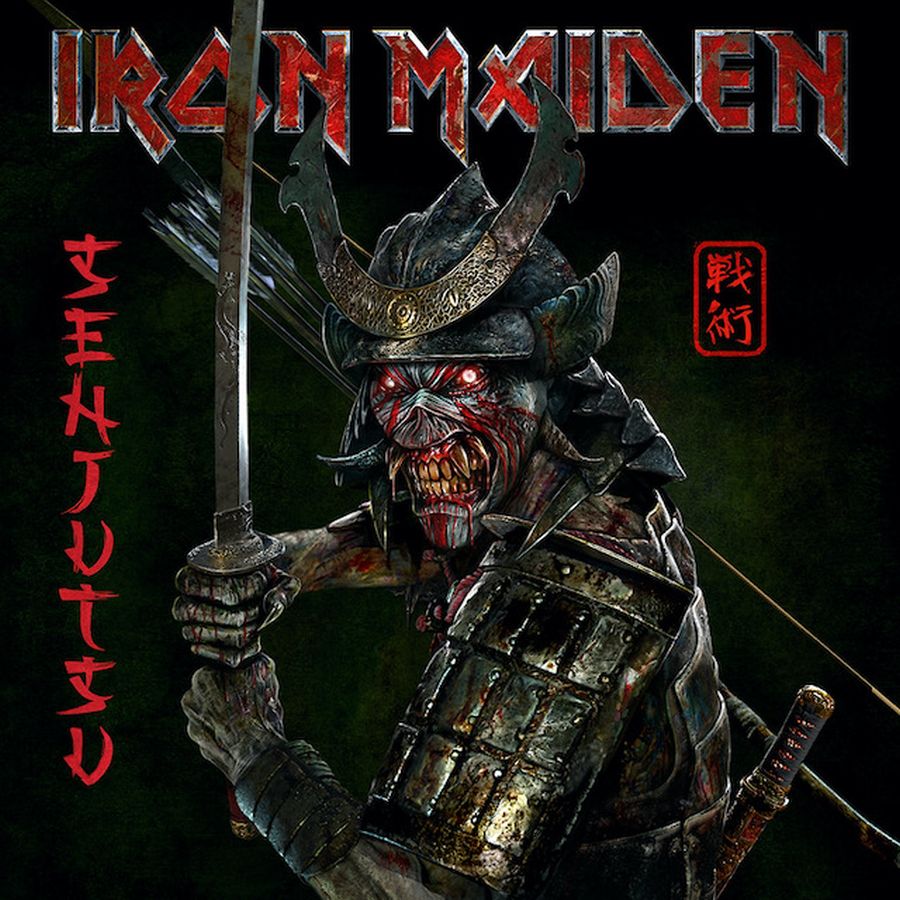
Eddie, the band’s unofficial seventh member, who on Mark Wilkinson’s cover looks like Yoshimitsu from the Japanese video game franchises Tekken and Soul Calibur, has already been just about everything in his career. On “Senjutsu” he’s gone to feudal Japan and become a samurai, though he already held a katana in his hands on the live EP “Maiden Japan” (1981). In their prime, above all on the ancient Egypt-flavored “Powerslave”, the futuristically spiced “Somewhere Out in Time” (1986) and the mysticism-laced “Seventh Son of a Seventh Son” (1988), Iron Maiden managed to marry a given idea or concept with the right musical atmosphere, but for years now, despite plenty of effort, they just haven’t been able to pull that off anymore. “Senjutsu” is no different: don’t expect any traditional Far Eastern musical motifs that would properly liven up the mood and ‘sync’ it with the cover. That’s already ‘rocket science’ for Iron Maiden, even though they absolutely love it when somebody mistakenly labels them metal ‘progressives’.
All the songwriting, arranging and conceptual emptiness mentioned above is already audible on the opening title track. The only traditional Japanese element is a few seconds of percussion at the start. As a whole, this Harris/Smith creation, with its dragged-out length, rhythmic repetitiveness and completely forgettable chorus, is one of the most boring opening tracks in Iron Maiden’s entire history and a poor send-off for the rest of the album.
“Stratego”, which came out as the second “Senjutsu” single, improves the impression a bit. Stratego isn’t the name of a new member of the Masters of the Universe, but a popular board game that became big, especially in the West, after World War II. Though it’s a pretty predictable piece, one where most fans will immediately start wondering where they’ve heard that motif and main guitar line before, it has a good chorus and fitting epic guitar harmonies.
“Writing On the Wall” turns out even better. It’s the album’s lead single and one of the few moments on “Senjutsu” that doesn’t vanish into oblivion after the first listen, with a genuinely ‘tangible’ chorus. Even the slightly bluesy main riff sounds fairly fresh by modern Iron Maiden standards. It has to be said that this is one of the better Iron Maiden singles of the past twenty years, and the same goes for its accompanying video.
“Lost In a Lost World” is one of the duller compositions on “Senjutsu”, which its unoriginal title already hints at, since The Moody Blues used it for a song of the same name almost fifty years ago. The acoustic-leaning intro drags and drags and goes nowhere, while after the transition the Celtic-flavored guitar harmonies soon start repeating ‘ad infinitum’. If this song were half as long, it would surely be a lot more interesting. The solid “Days of Future Past”, one of the few tracks of the right length, leans mostly on bombast, Smith’s trademark guitar soloing and Dickinson’s still-respectable vocal chops.
“The Time Machine”, the product of a songwriting partnership between Harris and Janick Gers, despite packing in plenty of tempo changes, lands squarely in the ‘forgettable’ category, while the band stretches this thoroughly average song beyond all reason. The impression gets a slight lift again from Dickinson and Smith’s melancholic, gloomy creation “Darkest Hour”, which has good instrumental sections and a solid build-up of atmosphere. With a more memorable chorus it would surely have been even better.
Next up is Harris’s ambitious trilogy of three songs, each more than ten minutes long, which could have been a single suite of three interconnected sections. This trilogy, a sort of Harris answer to Dickinson’s “Empire of the Clouds” from the previous album, varies quite a bit in quality from song to song. The first part, “Death of Celts”, is undoubtedly the weakest of the three epics, and not just because of its silly title and the ‘strumming on heartstrings’ aimed at all the Scottish, Irish and Welsh Iron Maiden worshippers. This song is a case study in total recycling of old motifs, and it doesn’t even hide that it’s a weaker follow-up to the “Virtual XI” (1998) classic “The Clansman”, since the two share a similar lyrical theme about rebellious Celtic clans and the matching Celtic motifs. Sadly, it soon turns drawn-out and repetitive.
“The Parchment” is without a doubt the best of Harris’s closing trilogy and one of the few compositions on “Senjutsu” that Iron Maiden fully nailed. The fact that it’s the heaviest piece on this relatively melancholic and ‘soft’ album surely helped. The build-up of ambient drama is handled intelligently this time, and the instrumental sections, with an emphasis on epic guitar harmonies, are top-notch too, with nicely timed tempo changes.
The closing “Hell On Earth” turns out good as well, despite a fairly predictable acoustic intro, and with a somewhat shorter running time it might even have become the highlight of the whole album. If nothing else, it wraps up the album in the traditional Iron Maiden epic style. You could say the last two compositions slightly lift the not-too-thrilling feelings “Senjutsu” leaves behind, but that’s not enough to congratulate the band on another job well done in the studio.
In the context of Iron Maiden’s whole discography, “Senjutsu” sadly comes off as a pretty average and at times boring effort that, on release, failed to live up to the high expectations of most Iron Maiden fans. Of all the albums since Dickinson and Smith’s return in 1999, “Senjutsu” is convincingly the least interesting, and despite its overall melodiousness and accessibility, it’s pretty hard to sit through without dozing off. While there’s not a single track on “Senjutsu” you could call outright bad, there’s also none you could declare a genuine Iron Maiden classic or one of the better compositions of the past twenty years. On the other hand, these are still unmistakably Iron Maiden, and even their weaker efforts still sound better than what most of their imitators put out, let alone modern ‘mainstream’ bands, who can only bow down before the English metal legends even when they release an average album like “Senjutsu”.
Author: Peter “Dr. ProgRock” Podbrežnik
Track list:
CD1.:
1. Senjutsu (8:20) – Smith/Harris
2. Stratego (4:59) – Gers/Harris
3. The Writing On The Wall (6:13) – Smith/Dickinson
4. Lost In A Lost World (9:31) – Harris
5. Days Of Future Past (4:03) – Smith/Dickinson
7. The Time Machine (7:09) – Gers/Harris
CD2.:
1. Darkest Hour (7:20) – Smith/Dickinson
2. Death Of The Celts (10:20) – Harris
3. The Parchment (12:39) – Harris
4. Hell On Earth (11:19) – Harris
Line-up:
Bruce Dickinson – vocals
Dave Murray – guitar
Adrian Smith – guitar
Janick Gers – guitar
Steve Harris – bass, keyboards
Nicko McBrain – drums

Hm, tole pa ni slišati nič kaj vzpodbudno. Me pa be preseneča, sploh ker sem pri Maidenih že dolgo valentines razočaranj. Morda tudi zaradi previsokih pričakovanj. Zadnji album, ki me je v celoti navdušil, je Somewhere In Time, na trenutke pa sem začutil klokotanje po żilah še ob Fear of the dark.
Mi pa ob Maidnih vedno pridejo v glavo skrivnostna pota uspehov v glasbeni industriji. Namreč, kako so trije največji hard in heavy bandi postali zares veliki šele precej let po izdaji svojih najboljših albumov in še kar naprej polnijo stadione, kljub temu da že več destletij niso posneli ničesar zares vthunskega. V mislim imam seveda Maidne, AC/DC in Metallico.
JA absolutno. Pri men se konča vse s prvimi osmimi albumi (plus Live After Death seveda). Potem pa prebliski. Fear of the Dark, bi moral biti enojen, gor je nekej super zadev, ki so spregledane. The Fugitive, Aparition, Childhood’s End, ampak tud nekaj off shootov kot sta Weekned Warriors, pa Judas Be My Guide, From Here To Eternity pa mi gre vsa tolk na živce kot Holy Smoke.
Men je kot celota potem res edini album oziroma edina dva Brave New World plus hja, bogoskurnstvo gor ali dol, The X Factor.
Ja tale novi album, je pa men osebno spet vsaj 40 minut predolg. Ma nekaj zelo dobrih momentov, ampak v celoti zvodenijo, album potegne ven Harisova trilogija na koncu, plus par vmesnih zadev, sploh tam kjer sta avtorja Smith in Dickinson.
Očitno so se fantje skozi leta precej spremenil. Hecno mi je to, da na novi plati ni enga mal bolj hitrega komada, otvoritveni naslovni na tem mestu nikakor ne bi smel stat, ampak okej, to je njihova odločitev. Škoda. Muska ostaja dobra – overall odbra, samo dolgočasna je postala. Predvidljiva in izživeta. In to za popizdit dolgočasno izživeta.
Vseen si bom pa vinil nabavu, če ga kdaj v kaki štacun zagledam (prek interneta ne maram naročat), ostanem raj na mp3-jih 😀
Omenjaš, da je album predolg, sem razmišljal o ten, da je pravzaprav zelo malo odličnih albumov nad 60 minut. Takole na hitro se spomnim samo Psychotic Supper in Hysterie, ki sta res klasa, po drugi strani pa mi takoj pride na pamet kopica takih, ki bi jih bilo bolje skrajšati. Na prvem mestu seveda obeh Use Your Illusion, iz katerih bi lahko sestavil odličen en album.
V bistvu je izum CDja v tem smislu precej škode naredil, tudi za stare albume mi je ljubše, če so brez bonus trackov. Sploh ce gre za neizdane pesmi – če pred 35 leti niso bile dovolj dobre za na album, zakaj bi bile zdaj?
Ja odlične albume nad 60 minut je mogoč najt še največ v sferah progresivnega rocka, ampak dejansko tam minutaža do 50 minut tud pri proggerskih platah povsem zadošča. Bolš pustit kakšne ideje za naslednji album.
Somwehere In Time je mislim da okol 55 minut dolg in je pravzaprav delo perfekcije. Nič mu ne moreš odvzet, nič dodat, se prav skor eno uro hehe. Men osebno daleč najljubši I.M. album.
To je komplet res. CD na katerga spravš 80 minut, je precej razvrednotil enega izhodnih umetniških postulatov pri ustvarjanju glasbe: “kratko in jedrnato” 🙂
Ko sem prebral recenzijo, sem vedel, da bo album mojstrovina. In prav sem imel.
Evo, danes sem prvič poslušal in se strinjam z vsem, kar si napisal. Reciklirano, sploh tisti keltski kitarski motivi, zaradi katerih mer album spomija na shredderske instrumentalne albume iz osemdesetih, ne zaradi same glasbe, ampak ker sploh ne ločim več komadov med seboj. Ves čas se počutim, kot bi poslušal neke previously unreleased bonus tracke iz obdobja Seventh Son.
Predvsem mi manjka nek hiter, udaren komad, kot je bil denimo Be Quick Or Be Dead, da ne segam v itak nedosegljiva osemdeseta.
Ena pesem mi je pa zelo všeč, in sicer Darkest Hour, ki pa mi zveni bolj kot pesem iz Dickinsonovih solo časov, morda bi pasala na Balls To Picasso.
Mene osebno je album pozitivno presenetil. Je kot celota izjemno poslušljiv, komadi Days Of Future Past in vsi štirje s CDja 2 dve gredo pa pri meni v favourites. Neizvirno? Mogoče, ampak ali res kdo želi izvirne Maidene?? Definitivno ni tako slabo, kot govori ta recenzija, ljubitelji Iron Maidenov ne bodo razočarani IMHO.