

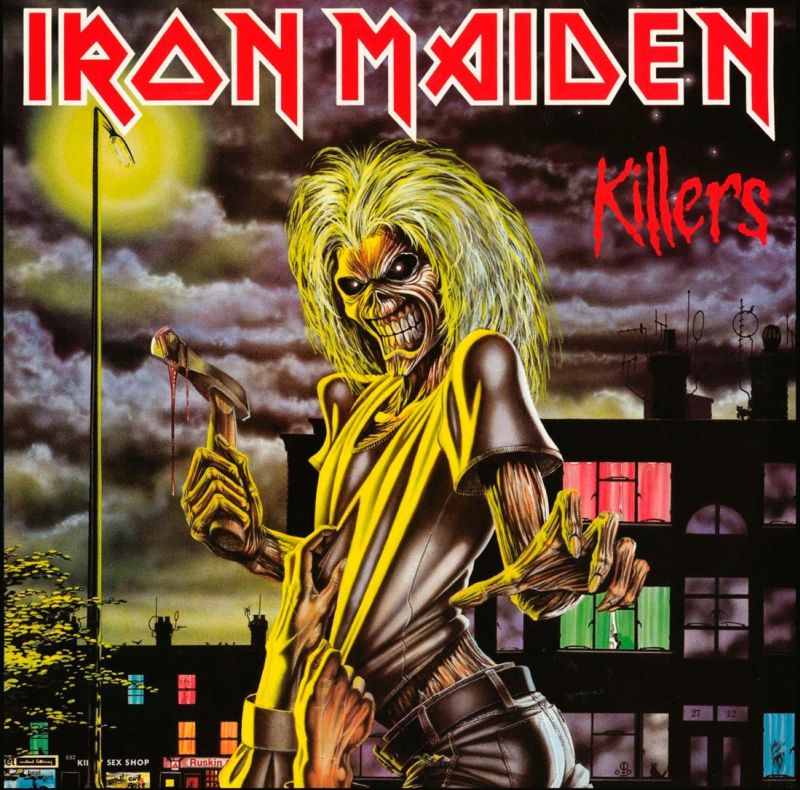
In 1981, Iron Maiden were slowly closing in on the point of a massive change that would hit them at the end of March 1982. But even in the stretch right before that career turning point, things didn’t go without some serious shake-ups, and they followed the band into the recording of “Killers” (RockLine review). After its release, on February 2, 1981 in the UK and June 6, 1981 in the US, “Killers” went largely unnoticed, since it didn’t repeat or improve on the chart position of the debut. Even though it was a real step up from the aura of its eager predecessor in terms of songwriting, performance, ideas, creativity and arrangements, not to mention the production itself, its mild obscurity was, of course, down to the success of the third album, “The Number of the Beast“. In a way, “Killers” can be treated as a stepping stone in the band’s discography and evolution, much like “Fireball” (1971) is for Deep Purple or “Benefit” (1970) is for Jethro Tull. What do these three albums have in common? They’re all superb, but unfairly overlooked, because each was followed by an album that brought these bands eternal glory.
From 1976 on, Steve Harris, the heroic boss of Iron Maiden, fought to put Iron Maiden in front of the music-loving masses. He dragged the band from one dive club to the next, and the words “despair” and “retreat” simply weren’t in his vocabulary. He kept the helm of his Iron Maiden tub pointed firmly ahead, and the band weathered the hurricanes of splashing punk, fashion and the emerging new wave synth pop sounds. He kept a small crew of devoted, loyal musicians by his side and alive through sheer faith in the musical vision, though plenty of players had to leave and make room for those next to whom Harris’s will gained granite resilience and solid realization.
And so came that April of long-ago 1980, when the band’s debut “Iron Maiden” landed at number 4 on the UK albums chart. That slowly carried them to the front of the N.W.O.B.H.M. movement and put them among the big hopes of a new genre, heralding new musical times. The golden age of heavy metal. Until August 24, 1980, Iron Maiden were the headliners, and then they joined Kiss as a support act on the “Unmasked” tour. Iron Maiden played the last show of that tour in Norway, on October 13, 1980 in the town of Drammen. It was also the last show with guitarist Dennis Stratton. Stratton, who was by then close to a round 30, stood out from the rest of the Maiden gang not just by age but by musical taste. He was a fan of the softer side of rock’n’roll, which included listening to bands like Queen, 10 CC, Eagles, Reo Speedwagon … This had been turning Harris’s and Iron Maiden manager Rod Smallwood’s hair gray for quite a while. So they decided to show Stratton the door.
The band had a month off until November 20, 1980, when the second leg of the Iron Maiden tour kicked off, and in the meantime a third single came out, meant to boost promotion for the tour. They decided to cover “Woman In Uniform”, originally by Australian punk rockers Skyhooks. The single came out on October 27, 1980 and hit number 35 in Britain. The push for the single came from the label Zomba, which booked the Battery studio in London and brought in Tony Platt, known for his work with AC/DC, as producer. Harris was very skeptical at first, since the song was stylistically a long way from what Iron Maiden played. But he figured Platt might be just the producer to help Iron Maiden find an even heavier sound. It’s worth adding that Iron Maiden had produced their debut entirely on their own. And then exactly what Harris didn’t want happened. After the band had already recorded their version of the song with Platt, he got a message from Zomba to rework and polish it sonically to the point where the track would grab listeners as a proper radio hit. The single “Woman In Uniform” is the very last piece of work by Dennis Stratton with Iron Maiden. Stratton kept Platt company while he softened and tweaked the version the band had already recorded. When Harris found out about this “sonic prettying-up”, he blew a fuse, fired Platt and did a new mix himself. After that, Harris raged in interviews that no “outsider” would ever, ever mess around with the band’s music again. For the single’s B-side, Iron Maiden put a refreshed version of “Invasion”, and the 12-inch vinyl edition added a live version of “Phantom of the Opera” (on the German version it was replaced by “Drifter”). “Woman In Uniform” was the band’s only “cover single”. Harris wasn’t the least bit proud of it. That’s why it only got remastered in 2015. Until that reissue the single was hard to come by, having had just two official reissues before it. It came out in the box set “The First Ten Years” (1990) and then on the limited 2CD reissue of the album “Killers” from 1995. The cover of the single shows a woman in uniform with a Sterling submachine gun in her hands, who more than obviously resembles the then prime minister, Margaret Thatcher.
Enter Adrian. Not the Running Wild mascot, but a bloke by the name of Adrian Smith. Iron Maiden had already invited him to join back in 1979, but he turned them down at the time because of his band Urchin. Dave Murray had known Smith since childhood and their school days together. Before Stratton left Iron Maiden, Smith, Murray and Harris ran into each other completely out of the blue in one of London’s pubs and used the meeting to pick up the talk about working together. Things at Urchin were a mess by then and Smith’s faith in the band was fading. So he didn’t turn down the new offer. With Smith’s arrival, Iron Maiden got their first real classic lineup. Smith played his first show on the third leg of the “Iron Maiden” tour, which started on November 21, 1980 in Uxbridge, England (Brunnel University) and wrapped up a month later at the no less English Rainbow Theatre in the middle of London.
Smith had been in the band for less than a week when, after the fourth show of the last leg of the tour, the band announced they were heading into the studio to start recording a new album. When he arrived at the Battery studio in Willesden (north London), Smith was overcome by unease. He had barely joined a band that was already very well known. So he understandably wondered whether his guitar services would work out at Iron Maiden at all. Together with his new colleagues Harris, Murray, Clive Burr and Paul Di’Anno, Smith entered the process of creating an album that, compared to the debut, brought the band a noticeable transition in both musical character and sound.
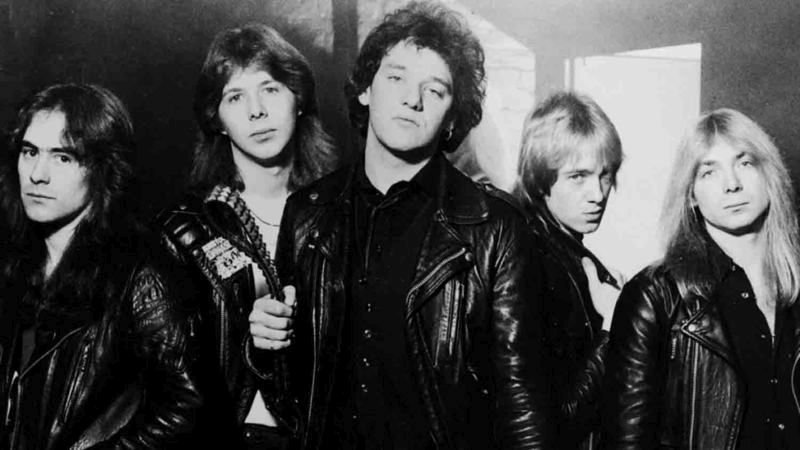
Smith wasn’t the only new face to step into the Iron Maiden story at that time. For the new album the band managed to get producer Martin Birch on board. They’d wanted him for the first one too, but he was busy with Black Sabbath and their album “Heaven And Hell” (1980). The charismatic producer was one of the most in-demand guys of the day thanks to his modern take on the sound trend of the time, which called for a higher dose of demolishing decibels. And what a track record. Birch had already put in more than a decade of sonic innovation, breathing a sonic soul into the giant acts of the rock era, led by Deep Purple, Blue Öyster Cult and Rainbow, to name just a few seventies heavyweights. Steve Harris had always held Birch in such awe that he didn’t even dare approach the esteemed producer to ask about working together. He was convinced Birch wouldn’t give a modest quintet of young hopefuls like Iron Maiden the time of day. For Smith, who was still getting over the shock of joining the band, working with the famous producer added another load of stress, and Adrian once said: “He was a phenomenal producer, but intimidating at the same time. Because of his high reputation. That week we were recording, I barely ate anything out of nerves and excitement.” But Smith’s doubts, and all his fears, were completely unnecessary. His pedantry and strong musicality, which he developed in inventive, characterful solos, fit more than brilliantly into Harris’s vision, together with the convincing moves of Birch’s production. At the same time, quite a few of the songs that came up for recording were already well established in the band’s live sets. Iron Maiden had started working them into their live repertoire as far back as 1976 and 1977. Two of the songs they began playing very early on but “skipped” on the studio debut were “Innocent Exile” and “Wrathchild”. Both are even among the oldest material Harris ever composed. They were written back in 1973.
“Wratchild” was already familiar to the “metal mutants” by then, as it had come out in 1980 on the compilation “Metal For Muthas”, released by EMI Records. Iron Maiden had deliberately left it off the debut. They recorded a new version that grabbed even harder and was even more uncompromising than the original, proof of what Iron Maiden were capable of with a refreshed lineup.
Let’s tear through the rest of the material at top speed. “Drifter,” which closes out “Killers,” is definitely the album’s most old-school moment, even with a veil of blues boogie leaning over it. But the required mockery, at that speed, comes mostly from Di’Anno’s trademark piercing delivery, with the vocalist once again not holding back his testosterone-fueled hunger for lonely young women. “Innocent Exile” also nails the ideal mix of new times and an internalized feel for rock’n’roll rascality. Considering the more than solid vocal showing on the debut, the singer took an even more decisive step up in quality here. “Prodigal Son” is especially interesting, because it definitely stands apart from everything else on “Killers”. And then some. From the band’s entire career, really. It’s a semi-acoustic track with a splash of prog-folk pastoral, but with occult lyrics – and it works great even if you just play it on an acoustic guitar – especially if you can pull off singing the words. Let’s go back to Iron Maiden for a second. This is the only song from the Paul Di’Anno era of the band that Iron Maiden never played live. But the biggest impression is left by the songs played at hellish speed, serving up the most bristling noise alongside highly meticulous execution. Among the most magnetic in that respect are “Another Life” and “Purgatory” – two frighteningly fast wrecking balls and, at the same time, true prototypes of the bestially snarling N.W.O.B.H.M. character.
The title track is the artistic triumph of “Killers”. It’s built in a distinctly adventurous way and can be linked to the debut’s mini epic suite “Phantom of the Opera”, but its hellish nature would be completely unthinkable without Adrian Smith joining Murray in a guitar tandem. Alongside the chilling “Murders In The Rue Morgue”, inspired by one of Edgar Allan Poe’s thrillers, it makes a pair of songs that practically beg to be tied to Derek Riggs’ fantastic cover art, except that a shot of some subway underpass would almost be a better fit. Edgar Allan Poe would be proud. For most of the band’s fans, both songs rank as the album’s biggest favorites. While the title track came together during the recording of the album, “Prodigal Son” and “Murders In The Rue Morgue” were written back when the studio debut “Iron Maiden” was being recorded.
“Twilight Zone”, the first single from “Killers”, which you won’t find on the European version – it came out on the American version and on the 1998 CD reissue of the album – is another brilliant moment, and at the same time a mildly overlooked door-smasher. Thanks to the extreme heights the frenetic Di’Anno could hit with ease back then, the song became the perfect test, one Iron Maiden were already using in secret auditions in September 1981 to break in Bruce Dickinson. Even though Adrian Smith is not credited anywhere as author or co-author of any of the Iron Maiden songs on “Killers”, he wrote the most recognizable phrase in “Twilight Zone”. Adrian also explained later that this song came together very quickly. Iron Maiden conceived it as an extremely fast number, building it (according to Smith) on a rhythm so quick that playing it pushed the limits of what was manageable.
“Genghis Khan” is the instrumental successor to “Transylvania” from the debut, with a melodic wink at Arabesque flavors. But it’s played considerably faster, stirs up even more fury and even more rhythmic upheavals, and as such is yet another solid proof of the band’s artistic progress. “Genghis Khan” was chosen as the B-side of the “Purgatory” single.
“Killers” showed its ambition right from the intro. The band put this intro instrumental, a little over a minute long and titled “The Ides Of March”, in that spot to build theatrical tension. The intro “The Ides of March” is almost identical to “Thunderburst” by Samson. Steve Harris wrote the piece back in 1977, when Barry Purkis – everybody’s favorite fan of cages and masks, known under the notorious nickname “Thunderstick” – briefly drummed for Iron Maiden. He soon joined Samson. They named their version “Thunderburst” and put it on the album “Head On”. Samson’s singer at the time was a guy still going by Bruce Bruce, but that’s a whole other story.
As it turned out, everything went just the way Harris wanted. Birch successfully completed his mission and brilliantly poured the crackling, sparkling enthusiasm of the new lineup onto tape. He gave the band a big, lively yet crisp and pouty sneer, exactly what Harris had always dreamed of. This album is where the guitar pairing of Dave Murray and Adrian Smith found its foundation. Di’Anno’s vocals, compared to the debut, squeezed out even more screechy vampirism, mirroring the singer’s cocky and increasingly swaggering personality. At the same time, the album delivered considerably more technically demanding arrangements, which was possible mainly because the Murray–Smith duo had reached a higher level of technical polish. That showed in even faster playing, which the new guitar partnership, thanks to its great precision, matched without breaking a sweat. In places the songs became even more structured, with more rhythmic turns. Everything was charging ahead toward defining its own vocabulary and leaving behind the elements of the seventies rock that had inspired Harris and the gang. The pouty edge of the guitar phrases, the marked jump in speed, and a much bigger helping of solo guitar acrobatics left less and less room for the outline of punk, which was also slowly leaving the character of Iron Maiden’s first era. All of this was also driven by an upgrade in both Burr’s drumming and Harris’ bass flourishes.
“Killers” came out on February 2, 1981. Compared to the debut, which climbed to #4 on the UK albums chart, “Killers” settled at #12, which left the band disappointed. Many years later, a good 17 years on to be exact, only “Virtual XI” “improved” on that placing, which wasn’t exactly hard for it. Much later, Di’Anno said in an interview that he doesn’t like the album and that it doesn’t reach the level of the debut: “Don’t ask me why. We all tried like crazy, but it didn’t recreate the magic of the debut.” His statements should definitely be taken with a grain of salt, since “Killers” was his last Iron Maiden album, and it’s also well known that Di’Anno’s farewell from the band didn’t exactly happen in a friendly atmosphere.
The album got a lot of unfair treatment – from who else but the (hapless) music critics, again and again. Harris later tied this to the fact that some reviewers received a copy containing one of the intermediate mixes rather than the final one. The label “problematic second Iron Maiden album,” which over time became a mantra the music media pelted the band with far too often, was anything but “problematic”. Frustration is only understandable given that the band exploded with “The Number of the Beast” right after. “Killers” is in fact the stepping stone between establishing the sound on the debut and the launch into the fields of glory and eternity that followed at the end of March 1982. After that transformation, Iron Maiden shook off the punk fans for good too. The punk was still noticeable on “Killers”, despite Birch’s production upgrade, precisely because of Di’Anno’s vocal attitude, but with the third album Iron Maiden sorted that out as well. Harris had always aimed for the band not to sound even slightly punk.
Two weeks after the release of “Killers”, the band set off on a world tour called the “Killer World tour”. It kicked off on February 17, 1981, in Ipswich, England. On April 2, 1981, the band stopped right next to the “Iron Curtain” when Iron Maiden played in old Gorizia. Then in early September of the same year they actually crossed it, entering Yugoslavia straight from Gorizia. The band had a booked festival slot in Belgrade for September 6, 1981. At that festival Iron Maiden played ahead of the headliner, none other than Bijelo Dugme. Iron Maiden also lingered on Slovenian soil in between, and for longer than you might think, but let’s save that for a special story, which we hope will be written up in a separate piece as soon as possible.
It was no news anymore that Paul Di’Anno – an exceptionally charismatic and distinctive vocalist – was also a guy known for his stubbornness, recklessness, willfulness and vagabond streak. At the same time he was finding it harder and harder to rein himself in as he reached for drugs and booze. His vocal form was crumbling on tour, and the band was leaning on him less and less comfortably. The singer had turned into a real hellraiser you couldn’t work with normally anymore. So Harris and Smallwood had been hatching a plan behind the scenes for quite a while to replace him. Di’Anno sang his last show with Iron Maiden on September 10, 1981, in Copenhagen, Denmark. The backstage plan for his replacement was pulled off so smoothly that the singer had no clue a permanent farewell from the band was waiting for him after the gig. In the last ten days of October 1981, Iron Maiden played five more shows in Italy, already trying out Bruce Dickinson in the lineup. That was followed by two more concerts in London before the new year of 1982: the first on November 15, 1981, at the Rainbow Theatre, and the second on December 23, 1981, at Ruskin Arms.
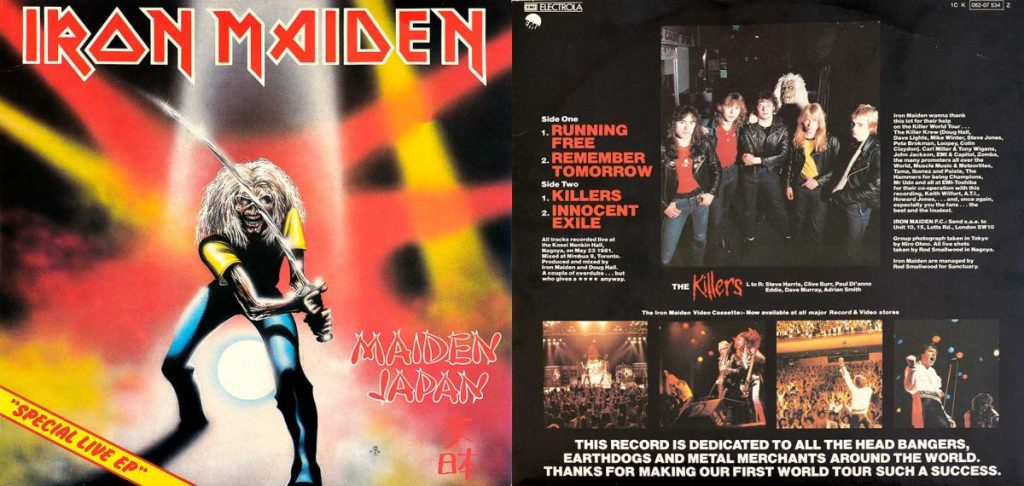
This tour also saw the band cross the Atlantic for the first time, opening the shows throughout June on the American leg of Judas Priest’s “World Wide Blitz Tour.” Judas Priest were promoting their album »Point of Entry« (1981). Before heading to the US, the band played four shows in Japan, and that’s where the live EP »Maiden Japan« comes from. All four tracks on the EP were recorded at the band’s gig in Nagoya, Japan, at the Aichi Kosei Nenkin venue, on May 23, 1981.
“Maiden Japan” would never have happened if Toshiba-EMI hadn’t pushed so hard for a live album. Thank goodness they did. It’s the only official live document of the band with Paul Di’Anno on vocals. The original version of the EP, first released only in Japan, had just four tracks. The initial idea was to use a cover with Eddie holding Di’Anno’s severed head. But since the release came almost at the same time as Di’Anno getting the boot, Smallwood scrapped that choice at the last minute. So the cover ended up with Eddie wielding a samurai sword instead. The EP came out just four days after Di’Anno was kicked out of the band. In 1987, “Maiden Japan” got a reissue for the Venezuelan market, and that version used the original artwork. Some versions of the EP pressed elsewhere in the world may also contain five tracks. Alongside the original “Running Free,” “Remember Tomorrow,” “Killers” and “Innocent Exile,” “Wrathchild” was added too.
Two singles accompanied the “Killers” album. The first came out for “Twilight Zone” on March 3, 1981, with “Wrathchild” on the flip side. Both, however, carry the status of A-sides. Iron Maiden thought “Twilight Zone” was an exceptionally strong track, while the “Wrathchild” version is a live one, taken from the band’s pre-Christmas show at the Rainbow Theatre. The band filmed that gig and put together a separate video for “Wrathchild.” According to Harris, the band figured they’d be away from the UK for a long stretch because of the tour. If they got an invitation to play Top of the Pops, they’d at least have that video to fall back on. So they decided to release that version together with the “Twilight Zone” single. Landing at number 31 on the UK singles chart wasn’t exactly what the band had hoped for.
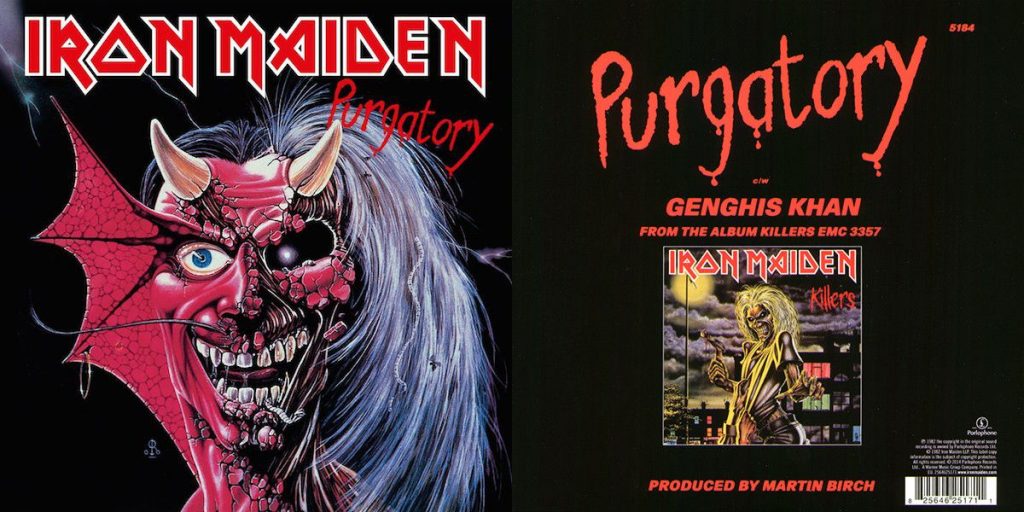
For the album’s second single, Iron Maiden picked “Purgatory.” The B-side got the studio version of the instrumental “Genghis Khan.” “Purgatory” was originally called “Floating,” and the band completely rearranged it while recording “Killers.” The single hit number 52 on the UK chart. The story behind the cover choice is a fun one. The original artwork by Derek Riggs later ended up on the cover of “The Number of the Beast.” When Smallwood got Riggs’s painting in his hands, he was so blown away that he said: “This picture is simply too good.” So the crafty manager saved it for another occasion, which turned out to be a brilliant move. He had Riggs create a new piece instead, and so the single got the image of a decaying devil’s face with Eddie appearing beneath it.
So “Killers” is a manifesto of the incredible potential shown by the revamped Iron Maiden, now with Adrian Smith in the lineup. It’s also the swan song of Paul Di’Anno, whose unique vocal charisma co-created the special touches that adorn these two albums in the band’s discography. “Killers” tops the debut in every way that matters. On the new record, working with Martin Birch, Iron Maiden were starting to take on the real contours of their sonic identity, the one that would soon spark global euphoria and the expansion of metal. The far wilder, no-compromise “Killers” speaks with even more focus and fire from a band set on building their dream. That moment was now just a little over a year away.
Author: Aleš Podbrežnik
