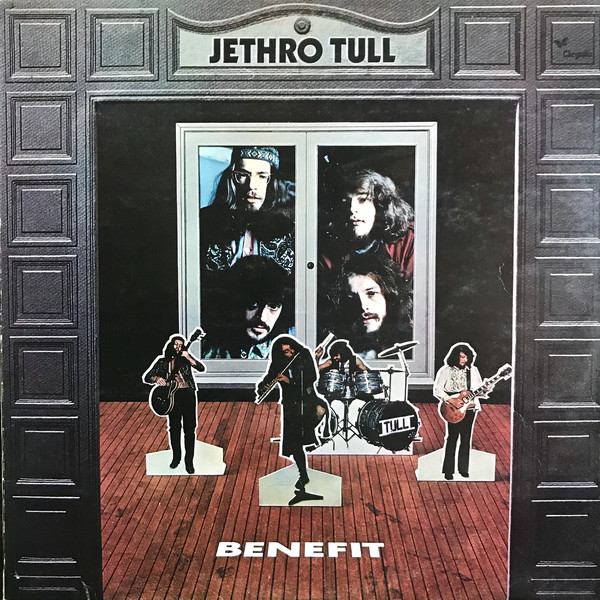
Label: Chrysalis Records / Island Records
Release date: April 20, 1970
Production: Ian Anderson
Album length: 42.49 min
Genre: Progressive Rock
Rating: 8.0/10
By the time their third album dropped, Jethro Tull, with the singles “Sweet Dream” and “Witch’s Promise”, were already one of the most successful and promising bands of early progressive rock. “Benefit” is the hugely important record where they staked out their trademark sound around folk rock and dropped almost every last blues element for good. That was mostly thanks to their unique rhythmic backbone, built on flute and acoustic guitar, which over the years became the band’s calling card and the foundation of the whole progressive folk rock genre. Ian Anderson made huge strides at this point, not just as a musician but as a lyricist too. His words were getting smarter and, at the same time, incredibly cynical and barbed. His image as a wandering sage, a sort of Frank Zappa of progressive folk rock, grew right along with it. On “Benefit,” Ian started taking aim for the first time at the same old daily grind and the false values that British society still rests on today. The album title also reflected the band’s wish at the time for a permanent home, somewhere to retreat to now and then, away from the prying eyes of annoying media (the pressure of fame was growing by the day, and the band wasn’t ready for it). Musically, unlike most of their albums, “Benefit” gives noticeably less room to Ian’s flute, especially his energetic solos. This time the electric guitar of Martin Barre gets the spotlight, and it also makes for a much heavier sound than on “Stand Up” (1969). Barre had clearly made big progress in his playing technique too, and his solos here sound completely different from those on “Stand Up”. On top of that, his guitar work, with all its inventive and original solos and riffs, radiates much more confidence. Ian obviously wanted to prove that the band could make a great album without leaning on his trademark flute every single time. An important addition at the time was the arrival of charismatic keyboardist John Evans (credited here only as a guest musician), the former leader of the John Evan Band, the group Jethro Tull grew out of. With his command of piano and organ, he took a load off Ian, who’d previously had to cover those duties himself. In short, on “Benefit” Jethro Tull already had their own recognizable identity, one that only kept growing and getting more refined over the years. The overall atmosphere on “Benefit,” compared to its predecessor, is a lot darker and more melancholic.
The album opens with “With You There to Help Me”. After a flute intro, Ian’s acoustic guitar deftly carries the main melody together with Barre’s electric guitar, while Ian’s trademark flute passages keep weaving in and out. In my opinion it’s a hugely overlooked track that should rank among the band’s classics. “Nothing To Say” is steeped in melancholy and a sense of cynicism, mostly radiating from Ian’s wonderfully vivid vocals. Barre’s hard rock-leaning electric guitar parts add extra drama. Just when you expect the punch his guitar brings to ramp up even more, the song unexpectedly slides into a gorgeous outro marked by lovely Celtic melancholy, with beautiful exchanges between Barre’s solos and Anderson’s acoustic guitar. Another forgotten classic. “Alive and Well and Living In” has the same fiercely cynical spirit, reflected in great harmonies between guitar, flute and piano. On the piano you can hear newcomer Evans show off his chops for the first time, and Ian’s flute arrangements are once again wonderful. “Son” opens with a cocky guitar tempo and Ian’s extremely cynical, downright mocking vocals. You can really hear how far his singing had come by then and how well the guy plays with his versatile voice. One of the album’s best moments is undoubtedly “For Michael Collins, Jeffrey and Me”, another in a series of songs (after “A Song for Jeffrey” (This Was, 1968) and “Jeffrey Goes To Leicester Squarre” (Stand Up, 1969)) dedicated to future Tull bassist Jeffrey Hammond-Hammond. It’s evidently also a nod to Michael Collins, the legendary Irish independence fighter. Ian’s vocals and the constant swapping between fast and calm tempos on acoustic and electric guitar are the main charm of this wonderful track, which has all the makings of a Tull classic and is one of my favorites on the album. “To Cry You a Song” is at its core hard rock with classical touches, an almost metal Barre riff and his frenetic solo in the middle of the song. In the outro, the interplay between the two guitars is impressive again, and in places there’s even a bluesy sound the band had shaken off on most of the other tracks by then. This is another of the album’s best compositions, and it also has the most progressive virtues. “A Time For Everything?” calms the mood a bit, though it’s still a pretty energetic piece. Again the classic Tull elements impress, meaning the flute and especially Barre’s guitar, which gets even more room here than usual. “Inside” has a somewhat lighter vibe and nicely settles things down after the punchy tempo of the previous tracks. Of all the songs, mostly because of its blues-leaning guitar, it’s the one that most recalls their early work. “Play in Time” has a slightly psychedelic feel. It has the most of Ian’s energetic flute solos of any track on the album. The varied arrangements and unusual sounds the band coaxes out of their instruments here are outstanding, and it’s surely the most playful and upbeat track on the whole album, which makes it stand out quite a bit from the rest. Ian’s vocal cynicism then peaks with another great composition, “Sossity; You’ re a Woman”, where the combined rhythm of acoustic guitar and flute successfully stands in for Bunker’s drums, which are completely absent this time. The band also once again shows off its knack for weaving in elements of classical music.
The reissue also includes four excellent bonus tracks. Most of them have a completely different vibe from the original album. They were recorded before its release, which means they’re much less dark in mood. That makes for a striking contrast when you listen, and they fit in perfectly with the original tracks. “Singing All Day” is a playfully light, acoustic-driven piece with plenty of Ian’s lovely flute. “Witch’s Promise” has a slightly different tempo, a song with an extremely intense atmosphere that also came out as a single. It blends traditional elements of classical music, folk and hard rock in a wonderful way. It’s still considered one of their best-known and best-loved songs, even though the band hasn’t included it in their live set for a long time. “Just Tying To Be” is a short, pleasant little number built mainly on Ian’s acoustic guitar. Right at the end is the British version of the single “Teacher”, which brought the band its first notable success outside their homeland. It’s a hard rock classic that impresses mostly with Ian’s vocals, his fast flute playing, Cornick’s ever-prominent bass and Evans’s psychedelic keyboards. It’s clearly a fairly atypical, commercially minded piece by the band, aimed at the American market, where it was destined to become their first hit.
Besides the better production, “Benefit” is above all a much more mature album than its predecessor. It’s where the band finally shaped its signature identity. The same goes for Ian Anderson, who by then had become the band’s trademark not only through his playing and stage presence but also as one of the best lyricists in rock. With its heavier sound, “Benefit” stands shoulder to shoulder with the best British hard rock bands’ releases of the time. At the same time, with its noticeably more complex songs, it marks the next step in the band’s progressive development. In short, this is an album that all fans of the band can enjoy together, both those who prefer their heavier side and those who see them mainly as one of the leading names of progressive rock. That’s exactly why I can’t wrap my head around why Jethro Tull so rarely play anything from this album live, which means the band itself also leaves it as one of their most overlooked works. After the album came out, a major lineup change followed. Excellent bassist Glenn Cornick left the band soon after the tour ended and founded Wild Turkey. He was reportedly too much of a night owl and party animal compared to the other members, who preferred to read books in bed. He was succeeded by the aforementioned Jeffrey Hammond-Hammond, another excellent and charismatic musician (heh, that’s the tradition in this band), whom fans already knew well from the songs dedicated to him. Meanwhile, everything was already set for the next album, one of the greatest masterpieces in the history of rock music.
Author: Peter Podbrežnik
Track list:
1. With You There To Help Me (6:17)
2. Nothing To Say (5:12)
3. Inside (3:49)
4. Son (2:50)
5. For Michael Collins, Jeffrey and Me (3:49)
6. To Cry You A Song (6:12)
7. A Time For Everything (2:43)
8. Teacher (3:59)
9. Play In Time (3:48)
10. Sossity, You’re A Woman (4:30)
Reissue bonus tracks:
11. Singing All Day (3:07)
12. Witch’s Promise (3:53)
13. Just trying To Be (1:37)
14. Teacher (original UK mix) (3:49)
Lineup:
Ian Anderson – vocals, flute, acoustic guitar
Martin Barre – electric guitar
Glenn Cornick – bass guitar
Clive Bunker – drums, percussion
Guest musician:
John Evans piano, organ