

After »Seventh Son Of A Seventh Son«, the hugely successful tour that followed its release – with the band pushing their stagecraft even further, expanding and enriching all the sets and scenery to serve up even more spectacular shows – and their most ambitious album, one that demanded even more complex arrangements, even leaned progressive and once again featured guitar sounds played through a synthesizer, Iron Maiden reached their zenith. Artistically and commercially. The lineup had a certain magic: unchanged since 1982, it had racked up the best albums not just of the band’s golden era, but of their entire career. No wonder »Seventh Son Of A Seventh Son« (RockLine review) landed at number one on the best-selling charts in the US. Any band that had pulled off something like that would normally take at least a year off without a second thought, recharge the batteries and revitalize. Pat each other on the back and reconvene a year later to carry on with the mission. So 1989 should have been a well-deserved year of rest for Iron Maiden. And yet?
Steve Harris was busy producing and directing the concert film »Maden England«, taken from the UK leg of the »Seventh Tour Of A Seventh Tour« and the show in Birmingham. Adrian Smith, who had cashed in on a songwriting talent mainly on »Somewhere In Time« (RockLine review) and »Seventh Son Of A Seventh Son«, launched a new musical project, A.S.a.P. (Adrian Smith and Project), which was “softer” rock-wise and much more musically oriented, even downright AOR in places. The spark behind it can be traced to two secret gigs by Iron Maiden members, FM and Urchin. One of them even came out as a bootleg (The Entire Population of Hackney, 19.12.1985, live from the Marquee club). In A.S.a.P. Adrian also took over the vocals (a rougher voice that every now and then brings Bryan Adams to mind), and many feared metal might be off the table for good. Maiden fans didn’t exactly warm to the debut and only album of the project, »Silver And Gold«, the media barely noticed it, and it turned into a commercial flop that sank into oblivion fast.
Meanwhile, Bruce Diskinson spent 1989 recording his first solo studio album, »Tattooed Millionaire«. Around then Dickinson wrote Bring Your Daughter to the Slaughter, meant as the musical backdrop for the film »A Nightmare On Elm Street 5: The Dream Child«. In Dickinson’s studio crew was ex-White Spirit guitarist Janick Gers, who had also gathered experience with Ian Gillan and his band and even contributed one of the guitar solos on the debut by ex-Marillion singer Fish, »Vigil in a Wilderness of Dreams« (RockLine review). Gers actually played all the guitars on Dickinson’s first album. Bruce Dickinson explained the move by saying that this was a way to test himself against musical challenges that he could never have, or been allowed to, take on inside Iron Maiden.
Then came the end of 1989 and November, when the band threw a party to celebrate the release of the new concert film, available on VHS tape. That’s where they revealed that in the near future they’d start work on a new album, one that, compared to the sprawling »Seventh Son Of A Seventh Son«, would be more “stripped down” and simplified, bringing the band back to its roots – to the basics. While everything still looked like a perfect spring bloom for Iron Maiden, if not the very peak of artistic and commercial flowering, that near future hinted that the band was approaching a whirlpool that would drag them into the uncertain and turbulent nineties.
What Dickinson was cooking up on the solo album impressed Harris. »Tattooed Millionaire« came out in May 1990, a good four months ahead of the new Iron Maiden album. Harris was already excited about »Bring Your Daughter… To the Slaughter« and figured Iron Maiden could look for an opening in a similar musical direction too. Harris liked Dickinson’s song, written as the backdrop for a horror flick, so much that Harris asked whether Iron Maiden could record their own version for the new album, and the singer agreed. And then some. Dickinson was even honored. The solo studio debut was uneven in quality. It didn’t include Bring Your Daughter… To The Slaughter, and in general its common denominator lay more in hard rock than metal. It offered a very varied selection – an epic opener with Son Of A Gun, then a hymn-like title track, then the racing rock’n’roll teaser Dive! Dive! Dive!, the personal confessional Born in ’58, and even a more than decent cover of the Mopp The Hopple hit All The Young Dudes, written by David Bowie. Anyway, with the first solo studio album the singer reached the goal. For a moment Dickinson stepped out of the conformist comfort that came with the artistry of life in Iron Maiden
Smith, burned by the A.S.a.P. debut »Silver And Gold«, was at heart a classic hard rock composer. Smith had a refined, well-developed feel for distinctive musicality when putting songs together. The guitarist’s dejection over the A.S.a.P. debut flop only deepened the rift between Smith’s musical vision and the new course charted for Iron Maiden. Steve Harris sensed the drift and called a meeting. There Harris asked whether Smith wanted to stay in the band. Smith replied that he wasn’t sure anymore, and Harris effectively made the decision on Smith’s behalf – and as someone whose number one priority in life is Iron Maiden, Harris had to swallow hard when it sank in that Adrian Smith was gone. All Harris knew was that the band had to stay strong and hold on.
Anyone who followed one of the paragraphs above closely won’t be surprised that Iron Maiden not only found a replacement for Adrian Smith very quickly, but that the new member turned out to be none other than Janick Gers, from Hartlepool in England. Just three songs at the audition were enough for Iron Maiden to take him in. Outwardly, it all looked as if nobody was grieving too much for Adrian Smith. In the glow of strict professionalism, there was no room for excessive emotion and mourning.
For the first time since 1982, when they released »The Number Of The Beast« (RockLine review), Iron Maiden recorded their next album back in the UK. For the job they picked none other than their sixth member, Martin Birch. This time they chose a barn converted into a studio on Steve Harris’s property in Essex, England. Recording took three weeks.
While »No Prayer for The Dying« was being prepared, Steve Harris mused: “It’s mostly a more aggressive album than the previous ones. I think some of our fans were pretty disappointed with the musical direction we took recently. So they’ll be happy to see us going back to a more aggressive, punchy style. There’s definitely still fire in the band!”
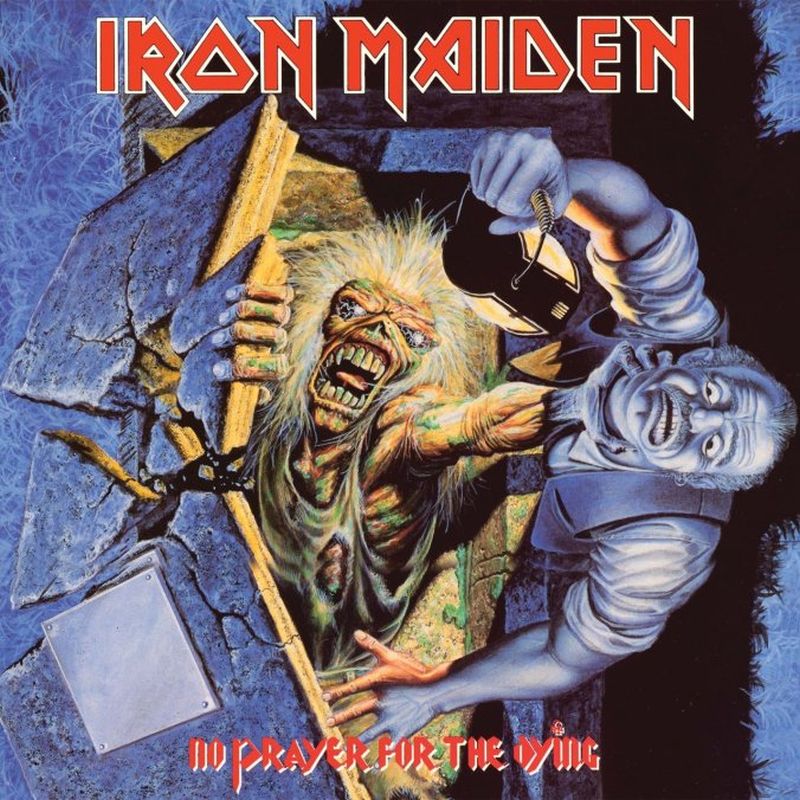
Maybe the fire is exactly the key, because it never really blazed the way you’d expect. No doubt the band poured plenty of good ideas and solutions into »No Prayer For The Dying«, but as a whole the album stalls in lukewarm territory and leaves you with the feeling that something is simply missing. Sure, with Smith gone the magic isn’t there anymore and Gers isn’t the same kind of guitarist, but that wasn’t the problem. The chemistry of the eighties was gone for good, but that’s no excuse for Maiden not finding a more distinctive chemistry going forward. Dickinson drastically changed the approach to singing, which turned distinctly guttural, raspy and aggressive. That’s the approach on most of the album, and it works best on both singles, Holy Smoke and Bring your Daughter … to the Slaughter, which was the band’s first and only single ever to hit number one on the chart.
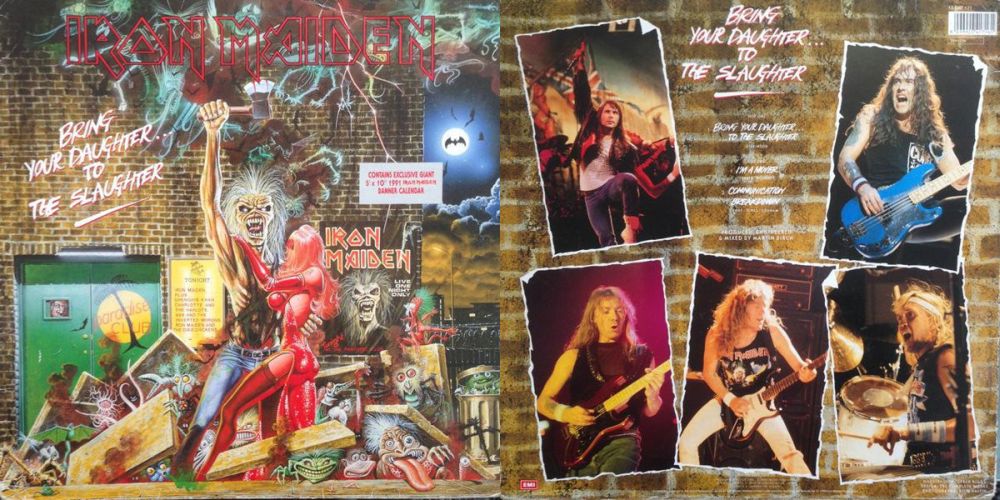
The fact that the album did worse than its predecessor on both the American (number 12) and British (number 2) charts, even with a number one single, brings little relief. Tailgunner was also originally planned as a single, but the band only shot a video for it. The single never came out, though Derek Riggs did create a cover with Eddie on that theme!
The band released its first single, for Holy Smoke, on September 10, 1990, a few weeks before the album’s official release. It reached number three on the UK singles chart.
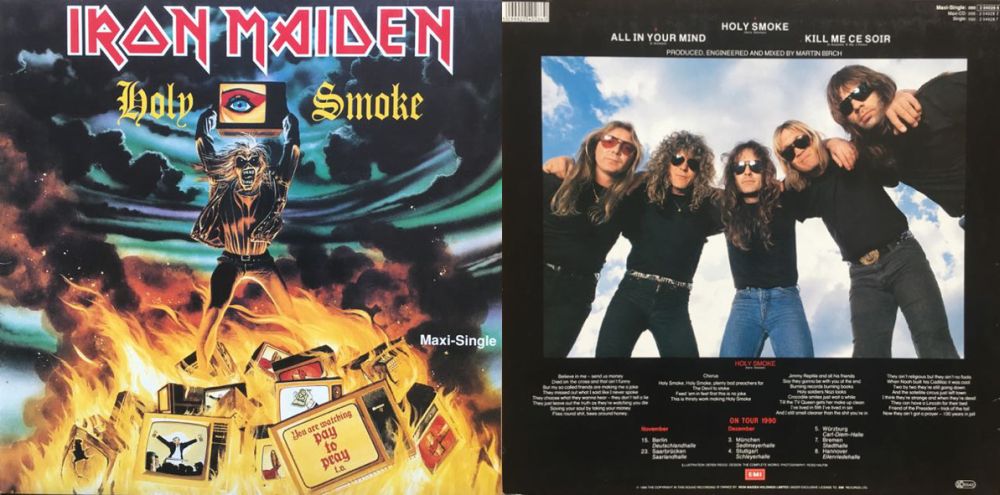
Half the songs, maybe a few more, leave you feeling they could have been a lot better and carry, in a way, unfulfilled potential. Take The Assassin, where the dark atmosphere builds up brilliantly through a nicely done verse and pre-chorus, until a completely pointless, melodyless chorus buries it. Public Enema Number One still manages to wriggle out of that trap, while Fates Warning stays just as unfulfilled in the chorus. The closing Mother Russia brings a spark of hope that an epic in the vein of the title track from the previous album or To Tame A Land is finally here, and yet … The tune gets “cut off” after five and a half minutes, right at the point where it should be developing further through a heap of varied motifs and time signature changes, which once again leaves the listener cold. The song has excellent ideas that Iron Maiden deliberately didn’t develop to the end, because the vision demanded “the basics”. Needless to say, the rawer sound and simplified arrangements were matched by the content of the lyrics, which swapped mystery, the occult and fantasy for the troubles of everyday life, social criticism, rushing toward ecological catastrophe, mocking tele-evangelists …
The sound is stripped down and tries to chase a live feel. The simplicity and directness suit songs like Holy Smoke, Bring Your Daughter… to the Slaughter (with a sneaky rock’n’roll flavor) and the opener Tailgunner. But they add a “party time” vibe to the album, which heavy metal orthodoxy handles very poorly. The rare gems that bring some joy are the excellent title ballad and Run Silent Run Deep, which chase some of that “escaped” magic of earlier albums, and even that mostly because Dickinson goes for clean vocals on both. All of this fed the sense that the album lacks detail and the conclusion that it never unleashed all the fire it had the potential for. That demanded fire the guys had trained and spoiled their fans with over the previous seven releases. Then there’s the notably softened Hooks In You, which actually sounds the most hard rock, no surprise since it’s an unfinished work by Adrian Smith. Funnily enough, as a composition it strikes a better deal in connecting verse and chorus than some of the other, more aggressive songs on the album.
All the “side” facts about the other novelties – like Dickinson “upgrading” the back-to-basics idea by growing a beard, the fact that the fresh, committed Janick Gers is nowhere near an equal to Adrian Smith as a guitarist, that Eddie returned to the cover without a lobotomy – in tune with the imagery of the first three albums, only now frighteningly “uglier”, if not the ugliest Eddie of Iron Maiden’s career, and so on – aren’t essential observations, even though they fit the musical change perfectly well. Simply put: something was missing from the album as a whole. It’s as if the band deliberately held itself back and reined in the glow of inspiration, channeling ideas too tightly in order to squeeze out the most aggressive, original-sounding album possible. Clearly, it was precisely in that blind desire that they burned out.
Harris later defended it: “We wanted the album to sound as live as possible. For my taste, the album isn’t quite what I expected, though in discussions like this it also depends on who you’re talking to. Some people think it’s our best album, others say it’s our worst. If you ask me, I’d say it’s not our best album, but certainly not our worst.”
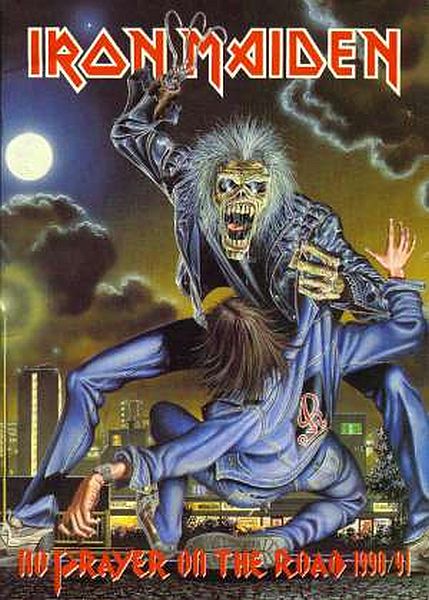
The »No Prayer On The Road« tour kicked off on September 19, 1990, a good ten days before the album’s official release, and wrapped up a little over a year later on September 21, 1991. The band played 110 shows on the tour. For this run Iron Maiden steered clear of giant stage productions and followed a model of sacred simplicity, mostly just solid stage lighting, conjuring a club feel again – only this time with the massive crowds to go with it. The bands opening the shows ahead of Iron Maiden were Anthrax, Kings’ X, The Almighty and fellow Brits Wolfsbane, whose singer Blaze Bayley had no idea whatsoever that four years later he’d be stepping in as Bruce Dickinson’s replacement.
Despite all the “flaws” – which may be too harsh a word, but still – if you weigh the album’s quality without comparing it to earlier releases, it’s a very good album all around. And despite the weak moments that »No Prayer For The Dying« embodies, the album succeeded at one thing. It got the band ready for a new decade and for an “exciting” life through the nineties. That “garage”, stripped-down, raw sound, meant as a return to the basics and about which Bruce Dickinson – if you ask for an opinion – won’t say anything nice, almost prophetically foreshadowed the rise of grunge. By negating the sonic excess of the band’s own hyper-produced albums from the second half of the eighties. Ironic enough. Albums from the time when Kurt Cobain was still doodling the Iron Maiden logo on school desks.
As said, »No Prayer For The Dying« is a quality album. In a way even a masterpiece. From the first listen it’s clear this is a very different album, that Adrian Smith isn’t on it, but on the other hand, if you want, you can enjoy the talents of Janick Gers and the novelties the guitarist brought to the sound of this album and the band, which became a constant from here on. It’s an album of transition. In terms of the quintet’s chemistry, and, as said several times in this essay, in terms of direction. Look at the album in terms of its unity and wholeness, without any comparisons, and you quickly realize that »No Prayer For The Dying« is an often unfairly overlooked album in the Iron Maiden discography. It demands engagement from the listener, but it also rewards that engagement in a very special way. All its own.
Author: Aleš Podbrežnik
