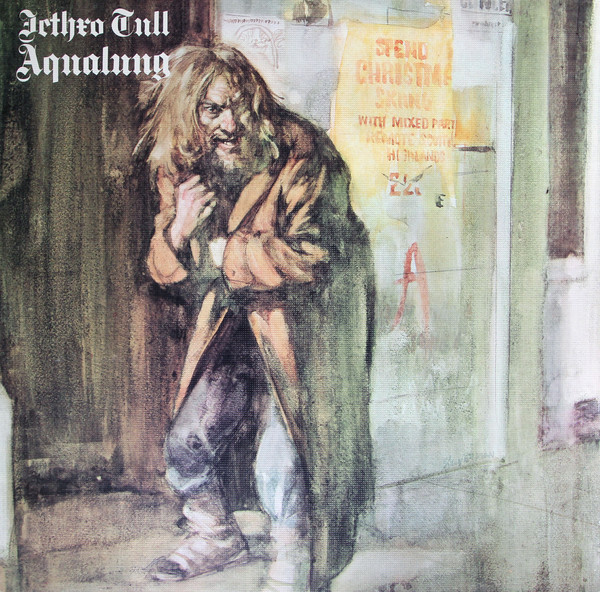
Label: Chrysalis Records / Island Records
Release date: March 19, 1971
Production: Ian Anderson & Terry Ellis
Album length: 42.55 min
Genre: Progressive Rock
Rating: 10/10
What do a pedophile tramp called Aqualung, an underage prostitute named Cross-Eyed Mary, and a frigid, notorious village schoolteacher whose pupils nicknamed her Mother Goose have in common? They’re not characters out of Kersnik’s Kmetske slike or Cankar’s Hlapci, but the main characters of one of the best albums in Jethro Tull’s history. “Aqualung” is a half-concept album. Officially it has no concept, and yet you can feel one the whole time you’re listening, in both the first and second halves of the record. The charismatic flutist/singer and driving force of the band, Ian Anderson, had already started establishing himself on the previous album, “Benefit” (1970), not just as a top-notch musician but also as an exceptional storyteller with a sharp social conscience. His razor-sharp black humor, which describes the everyday life of ossified British class society without any sugarcoating, lifted the band to a higher intellectual level in an instant. On “Aqualung” he finally treated himself to a vivid, open and outstanding cross-section of British society, from the lowest rung of the social ladder all the way up to the fat-cat clergy. In the first half of the album, the band uses the lyrics to mostly describe the misery and apathy of those at the bottom of society, while the second half is an outright attack on the delusions of organized religion, in this case mainly the Anglican Church. The album’s cover art stirred up plenty of controversy when it came out, too: is Ian Anderson Jethro Tull, is Aqualung Ian Anderson, or the other way around? With this album, the band almost took on mythological proportions.
Musically, most of the tracks on the album are still considered among the best in the band’s history and are a regular part of their live sets. An important novelty in the band’s sound was definitely brought by bassist Jeffrey Hammond-Hammond, who replaced original bassist Glenn Cornick, who had left after the end of the previous tour. This is also the first album where keyboardist John Evans, who had already been an unofficial member of the band on the previous record, really comes to the fore. “Aqualung” is stylistically heavier than all the band’s albums before it, packed with classic Barre riffs and plenty of punchy transitions, with lots of variation in both the style and tempo of individual songs. By this album, practically all the blues influences that had noticeably dominated their music until then had disappeared almost completely. Hard rockers really had no trouble embracing this album when it came out, since it contains loads of punchy guitar riffs, the main hallmark of most hard rock. Of course, the listener once again gets big doses of Ian’s flute, which by then had long since become the trademark and main carrier of Jethro Tull’s music. The mood on the album is incredibly varied, which matches the stylistic variety of the individual songs.
“Aqualung”, one of the band’s greatest classics, opens with Barre’s instantly recognizable hard rock riff. Right away, the image of the ragged tramp from the front and back cover of the album pops up before the listener’s eyes, seeking shelter from the first snow while watching little girls at play with one eye, on the sly. Part of the lyrics for this masterpiece came from Ian’s wife at the time, Jenny. At its core, “Aqualung” is a relatively accessible piece with recognizable hard rock guitar riffs, complemented by drums, a unique vocal line and acoustic guitar in the role of the rhythm section. I’m especially struck by the originality of the idea of Ian’s “distant” vocal (pushed slightly into the background in the production) at the moment of the chorus, when the rhythm of the acoustic guitar joins in. The song is extremely dynamic overall and has all the hallmarks of progressive rock, with plenty of tempo and style changes running through it. Its classic status was therefore a given. At the same time, it’s kind of ironic that one of the band’s best-known songs is played without a flute (making it one of their rare tracks that don’t feature the instrument). In “Cross-eyed Mary” Ian’s vocal is almost completely unrecognizable, since it sounds like a hoarse, congested screech. The song is about an underage prostitute secretly watched by the tramp Aqualung, who thus shows up again in the lyrics, which brings the album much closer to a concept. It’s another great piece and a classic, with an intense flute and piano intro, followed by an incredibly energetic part where Ian’s hoarse, screeching vocal and Barre’s punchy guitar riffs shine. The autobiographical “Cheap Day Return” is a shorter creation, a gorgeous folk ballad describing the apathy of everyday life, where every day is the same as the one before. It’s another captivating number that fits perfectly after the first two fairly punchy tracks. With its nostalgic folk atmosphere, carried by acoustic guitar, flute and Ian’s clean vocal, it wins me over again and again. The excellent acoustic guitar fills and the central melody are especially delicious. Next comes “Mother Goose”, another great piece, where the listener can easily picture the old, nasty teacher bullying her pupils. The song stands out for its superb flute arrangements as well as the transitions on acoustic guitar and flute. Besides the outstanding melody, some folk elements impress too. The piece also has a brilliant acoustic guitar passage that blends perfectly with the main vocal line. It’s yet another one of the album’s many masterpieces. “Wond’ring Aloud” is another lovely, short ballad built on acoustic guitar and vocals. The vocal line, the nice acoustic guitar passages and some orchestral arrangements stand out here. “Up To Me” is also one of the best tracks on the album, even though it never became a classic. It’s an extremely interesting piece that opens and closes with the laughter of drunks in a smoky dive bar. At its core it’s almost pure folk rock with Celtic motifs, brilliant riffs, flute and excellent choruses. Another great number that reflects the music of Jethro Tull in the best possible way. Then comes the second half of the album, which forms a sort of half-concept called “My God”, a critique of organized religion that tries by every means to push the individual away from God instead of bringing them closer. “My God” is, as mentioned earlier, dedicated to the delusions of the Anglican Church, which worships a “plastic god”. The piece has a mighty melody and brilliant acoustic guitar passages in the intro. After an intro with Ian’s extremely mocking vocal, it tips over into an energetic rhythm with plenty of drum hits and guitar riffs. The combined work of Ian’s flute and Martin’s electric guitar is truly thrilling, especially Ian’s flute solo in the middle of the song. “Hymn 43” is another excellent hard rocker with mighty riffs and a good combination of Evans’ piano and Ian’s flute. “Slipstream” is another short, pleasant acoustic ballad. “Locomotive Breath” is a legendary classic and the best-known piece on the album (perhaps even of their entire career), where after a quiet piano intro the rhythm backing and electric guitar create the feeling of a locomotive in motion. Barre’s hard rock riffs really create incredible dynamics. The closing track “Wind Up” is another energetic number with strong hard rock touches, where the band shows off its exceptional blend of folk and hard rock, making for a superb finish to this masterful album.
The 1998 reissue of the album comes with plenty of bonus treats that will satisfy all true fans of their music. First up is the brilliant and extremely witty “Lick Your Fingers Clean”, which hits at full steam with hard rock riffs, tasty flute solos and special sound effects. It’s a great piece that doesn’t fall short of most of the other tracks on the album. Next comes an alternate version of “Wind Up”, which doesn’t fall short of the original either. Then there’s an interesting interview with Ian Anderson, in which he comments on the background of the album’s making and shares quite a few interesting bits of information. Finally, there are three tracks from their early period, recorded live for the BBC radio station. These are “Song For Jeffrey” (This Was, 1968), “Fat Man” and “Bouree” (both Stand Up, 1969).
“Aqualung” is the pivotal album in the band’s history and one of the greatest works in the story of rock music, the record that cemented Jethro Tull among the immortal giants of rock. At the same time, it pushed the band up to a higher level of creativity, which later fed into some of their works that stand at the very peak of progressive rock. After this album, Jethro Tull set off into the thrilling and unpredictable world of progressive rock. The album can easily win over and unite fans of progressive rock as well as classic rock and hard rock. “Aqualung” is also one of the first albums in progressive rock to go “gold” on the charts, and it earned numerous awards from both their fans and music critics. This is a timeless masterpiece that every lover of quality rock music should own. There’s really no excuse whatsoever.
Author: Peter Podbrežnik
Tracklist:
1. Aqualung (6:31)
2. Cross-Eyed Mary (4:09)
3. Cheap Day Return (1:23)
4. Mother Goose (3:52)
5. Wond’ring Aloud (1:56)
6. Up To Me (3:18)
7. My God (7:10)
8. Hymn 43 (3:18)
9. Slipstream (1:13)
10. Locomotive Breath (4:25)
11. Wind-Up (5:42)
bonus tracks from the 1998 remastered version:
12. Lick Your Fingers Clean (2:46)
13. Wind Up (Quad Version) (5:24)
14. Excerpts From The Ian Anderson Interview” [Mojo Magazine] (13:59)
15. Song For Jeffrey (BBC) (2:51)
16. Fat Man (BBC) (2:57)
17. Bourée (BBC) (3:58)
Lineup:
Ian Anderson – vocals, flute, acoustic guitar, electric guitar
Martin Barre – electric guitar, descant recorder
Jeffrey Hammond-Hammond – bass guitar, alto recorder, backing vocals
Clive Bunker – drums, percussion
John Evans – piano, organ, mellotron